
The Internet is a critical component of contemporary life which has emerged as a worldwide, high-speed digital construction out of research networks that are experimental. By going through the transformations that occurred in the history of the Internet, it will help us realize how the world of the Internet has been influenced by technological innovation, collaboration, and policy decisions.
Since its inception as an instrument of academic and military communication, or more precisely, the technological advancement of the World Wide Web that runs billions of devices and services has not stopped in its development, the Internet history represents not only a display of human resourcefulness but also of clever design. The knowledge of this chronology will help one to appreciate how the Internet has been instrumental in communication, commerce, and innovation today.
Principles Early Foundations: ARPANET and Research Networks
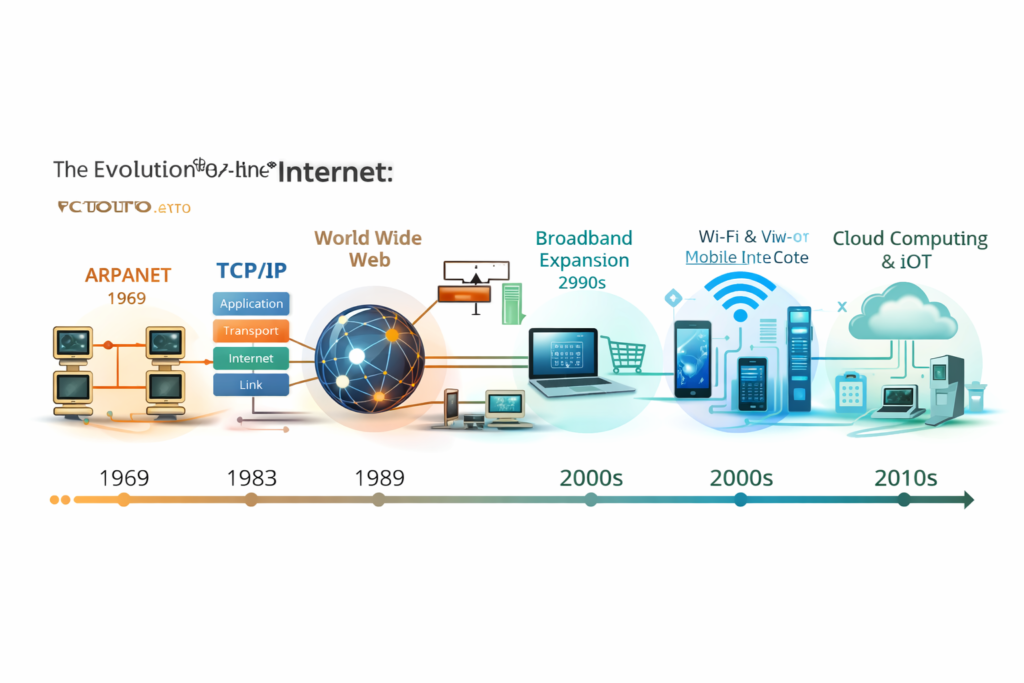
The origin of the Internet is in the late 60s when ARPANET (Advanced Research Projects Agency Network) was invented. ARPANET, which was sponsored by the U.S. Department of Defense, was built to link computers in research institutions, which allowed resources to be shared and collaborative work to be done in different locations. The first network consisted of:
- UCLA
- Stanford Research Institute
- UC Santa Barbara
- University of Utah
Packet switching was a very important invention that rendered ARPANET possible. In comparison to the old-fashion telephone networks based on circuit switching, packet switching separated the information into tiny bits transmitted separately on the network. The approach made it more efficient and offered a backup: in case of the failure on one of the routes, packets could be redirected. By 1971, ARPANET had expanded to more than 15 nodes demonstrating the idea of distributed computing and establishing the basis of a network on a worldwide scale.
TCP/IP: Internet Language
Another significant breakthrough that was made in the 1970s was the invention of Transmission Control Protocol (TCP) and Internet Protocol (IP) by Vinton Cerf and Robert Kahn. TCP/IP enabled compatibility of various kinds of computers and networks to enable a regularized way of information exchange.
In 1983, TCP/IP was introduced in ARPANET, and this became a turning point in the evolution of the Internet. This standard allowed networks to be connected and scaled all over the world. Modern inventions like cloud computing, online banking and social media platforms cannot exist without TCP/IP. Its introduction is one of the greatest milestones in the capabilities of Internet to support billions of devices and applications today.
NSW Expanding Research Networks
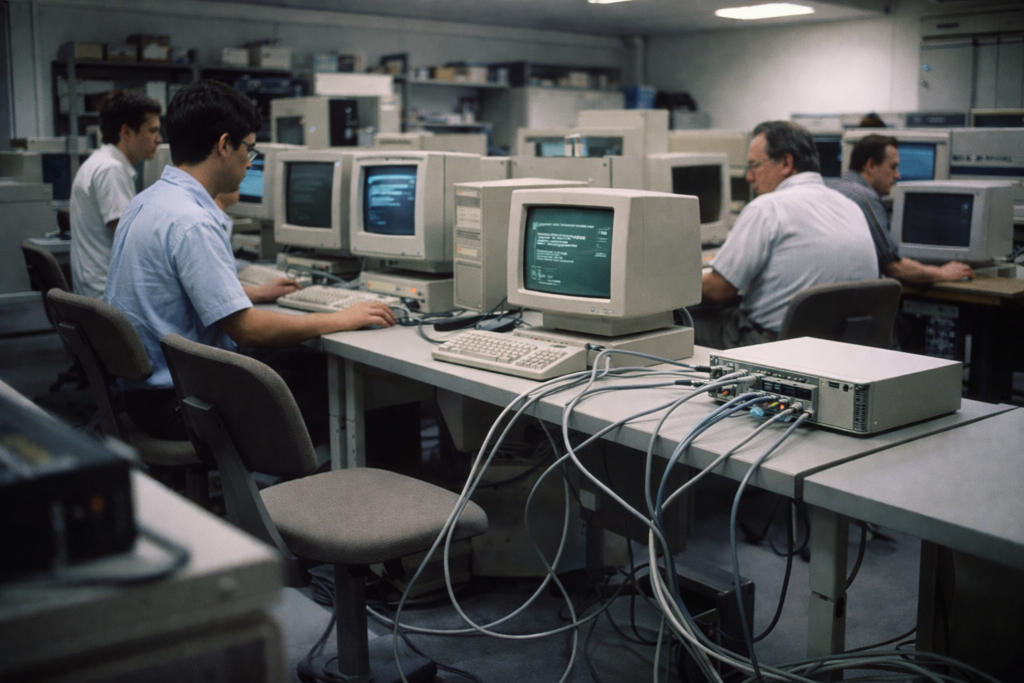
After ARPANET, other networks like NSFNET (National Science Foundation Network) were created to aid in academic and scientific cooperation. However, in contrast to ARPANET, where it was research-oriented (even though in defense), NSFNET linked universities and research centers in the United States. It has had:
- Increased bandwidth connections
- Used as a backbone between regional networks
NSFNET helped the formation of quite a few regional and university networks, which paved the way to the popular use of the Internet. Fiber-optic communications were also developed by the network and this significantly enhanced the speed and reliability of transmission of data. Towards the end of the 1980s, the network became the default backbone of the new Internet, which was now known as NSFNET.
The Birth of the World Wide Web
The Internet lacked an easy-to-use interface which could be utilized by the masses of people as it offered a potent infrastructure through which communication could be done. In 1989, Tim Berners-Lee at CERN developed the World Wide Web (WWW) that enabled users to access information via hyperlinks and browsers. Berners-Lee invented:
- Hypertext Transfer Protocol (HTTP)
- First web browser
- Web server
The open standards used in the Web that included HTML, HTTP, and URLs allowed faster adoption and democratized access to the knowledge. At the onset of the 1990s, universities, governments, and businesses started to use the Web to exchange:
- Documents
- Research
- Multimedia
The Web turned the Internet into a more specialized academic resource into a medium of communication and innovation the world over.
Commercialization and the Dot-Com Boom
The second phase in the Internet was commercialization. In 1991, NSF removed commercial traffic over NSFNET, opening the way to commercial Internet service by the private business sector. This move helped to develop the Internet Service Providers (ISPs) that enabled consumers to have direct access to the Internet.
The dot-com boom of the 1990s was associated with fast development of online companies and online startups. Companies such as:
- Amazon
- eBay
used the Internet to access the global market. It is also the period when:
- E-commerce emerged
- Online advertising developed
- Early social media sites appeared
The burst of the dot-com bubble in the early 2000s notwithstanding, it proved the potential the Internet has to revolutionize economies, introduce new industries, and connect people at the level never seen before.
High-Speed Internet Broadband
Due to the growth in Internet use, the drawback of dial-up connection became obvious. The development of broadband technologies, such as:
- DSL
- Cable
- Fiber-optic networks
allowed transferring data significantly faster, which allowed richer online experiences, such as:
- Video streaming
- Gaming
- Teleconferencing
The government and the partnership between the government and the companies and demand in the market led to the growth of broadband infrastructure at a high rate. It is also during this time that content delivery networks (CDNs) were developed and they made the delivery of content faster and more reliable. The Internet further entrenched itself in the society with the innovations that are made in online education, telemedicine, and digital media by the use of high-speed Internet.
Mobile Internet and Wireless Technologies
The development of Wi-Fi and mobile networks (3G, 4G, and 5G) altered the way human beings access the Internet. Mobile Internet provides:
- Access anywhere and anytime
- Opportunities for mobile commerce
- Location-based services
- Social networking
The use of smartphones and tablets has also revealed the issue of network security and scalability. Encryption protocols, firewalls, and other standards of secure communications have become very important with the number of connected devices in billions as they need to guarantee the safety of data and privacy of the users.
Internet Governance and Policy
Technological advances were not the only factors that could propel the growth of the Internet, governance and policy have been equally essential. Organizations such as:
- ICANN (Internet Corporation for Assigned Names and Numbers) – manages domain names and IP addresses
- IETF (Internet Engineering Task Force) – takes care of the standard protocols
Policy decisions on:
- Net neutrality
- Privacy
- Digital rights
affect how users’ access and interact with the Internet. International collaboration on cybersecurity and data protection has become increasingly important as the Internet is more integrated into global business and governance.
Cloud Computing, IoT, and the New Internet
The 2010s brought about cloud computing and Internet of Things (IoT), extending Internet use beyond desktops and mobile devices. Cloud providers such as:
- AWS
- Google Cloud
- Microsoft Azure
allow scalable data storage and processing for both startups and multinational companies.
IoT connects billions of devices, including:
- Smart home appliances
- Industrial sensors
allowing real-time communication and automation. These advances indicate that innovations and broad connectivity are enabled with the support of basic technologies such as TCP/IP and packet switching.
Contemporary High-Speed Internet and New Trends
The Internet today is a high-speed, global network supporting:
- Streaming
- Remote work
- Artificial intelligence
- Virtual reality
Emerging technologies such as:
- Fiber-optic networks
- 5G / 6G mobile networks
- Satellite Internet
will provide faster and more stable communication, enabling real-time collaboration worldwide. Future innovations, including:
- Quantum networking
- Edge computing
- Decentralized protocols
aim to improve security, reduce latency, and enable unprecedented scalability. These trends depict how historical events continue to shape contemporary Internet infrastructure and online experiences.
Conclusion
The history of the Internet, including ARPANET and the present-day Web, shows a process of innovation, cooperation, and policy-making. Early research networks, TCP/IP standardization, the World Wide Web, commercialization, broadband, and wireless technologies have collectively made the Internet a global resource.
The analysis of the historical development of the Internet helps to comprehend how the basic technologies and choices still shape modern connectivity, scalability, and innovation. Every innovation, from packet switching to cloud computing, is a stepping stone to the next, making the Internet a revolutionary tool in the digital era.