Bacteria has to live in the world full of viruses called bacteriophages that start an inexhaustible war even in unexplored depths of the ocean and the soil beneath our feet. This survival of the fittest was fought at an extremely high rate and bacteria have developed an extremely advanced level of immune system, known as CRISPR or Clustered Regularly Interspaced Short Palindromic Repeats. The adaptive immune system helps prokaryotes to identify, memorize, and kill the invading virus thus forming the roots of our now utilized technology used in genetic engineering which is considered as one of the most influential ones at present.
But how did these single cell organism evolve such a highly sophisticated system? And what made a strategy of microbial survival a biotechnological game-changer? This article talks about the interesting history of bacterial CRISPRCas system, whose discovery to its current application in the science world.
Introduction of Bacterial Immunity
In comparison with people with their highly intricate immune systems of white blood cell and antibodies, bacteria as single-celled organisms simply had to evolve the more simplified yet efficient means of addressing the problem of viral infection. Prior to the discovery of CRISPR, scientists believed bacteria experienced an inherent defense mechanism whose mechanism is analogous to non-specific restriction-modification systems, enzymes chop foreign DNA into it at particular locations. Nonetheless, these systems did not have a record of previous infections.
CRISPR altered this perception completely and introduced a kind of adaptive immunity in prokaryotes whereby the microbe would be able to memorize viruses it had been exposed to. As compared to the innate immunity that offers non-specific response, the CRISPR systems offer bacteria a mechanism of identifying and specifically responding to repeated viral threats.
This is what CRISPR is.
In essence, CRISPR is a sequence of repetitious patterns in DNA that is present in the bacterium and archaea genomes. These repetitions are punctuated by special chunks of DNA known as spacers. Each spacer represents a viral section of DNA that is a virus that had once stolen the bacterium or its ancestors. In storing small pieces of viral DNA they, in a sense, take a molecular mugshot of enemies.
The CRISPR arrays are correlated with CRISPR-associated (Cas) genes, which have the protein such as the well known Cas9 nuclease. The said proteins are thought to digest CRISPR RNAs (crRNAs) and implement the antiviral defense employed against viral DNA.
The Three Stages of CRISPR Immunity
There are three phases of CRISPR Immunity.
Before the discussion of CRISPR immunity, its three most important phases need to be unpacked, including adaptation, expression, and interference.
1. The process of getting new spacers is referred to as adaptation.
In the case that a virus infects a bacterium, the Cas proteins may identify and chop up the invading viral DNA. A small part of this viral DNA is next incorporated into the CRISPR array as a new spacer, and the bacteria immune memory is broadened. This measure will make sure that should the same virus hit again, the bacterium will be on standby.
2. Expression: generation of Guide RNAs
Upon the insertion of a spacer, the CRISPR array is transcribed as long RNA molecule which is further processed into smaller CRISPR RNAs (crRNAs). The crRNAs have a single-molecule sequence spacer that in effect will serve as a guide to identify and then target the associated viral DNA.
3. Interference: Invasion Targeting:
When the virus infects the organism once again (in case of the same or similar virus), crRNA identifies the Cas protein, which is directed to site of the corresponding viral DNA. Similar to Cas9, the Cas protein is able to chop up the viral DNA to eliminate the danger.
This three part system enables the bacteria not just to combat existing infection, but also forms an immunological remembrance against any past invaders.
The history of discovery of CRISPR by Scientists.
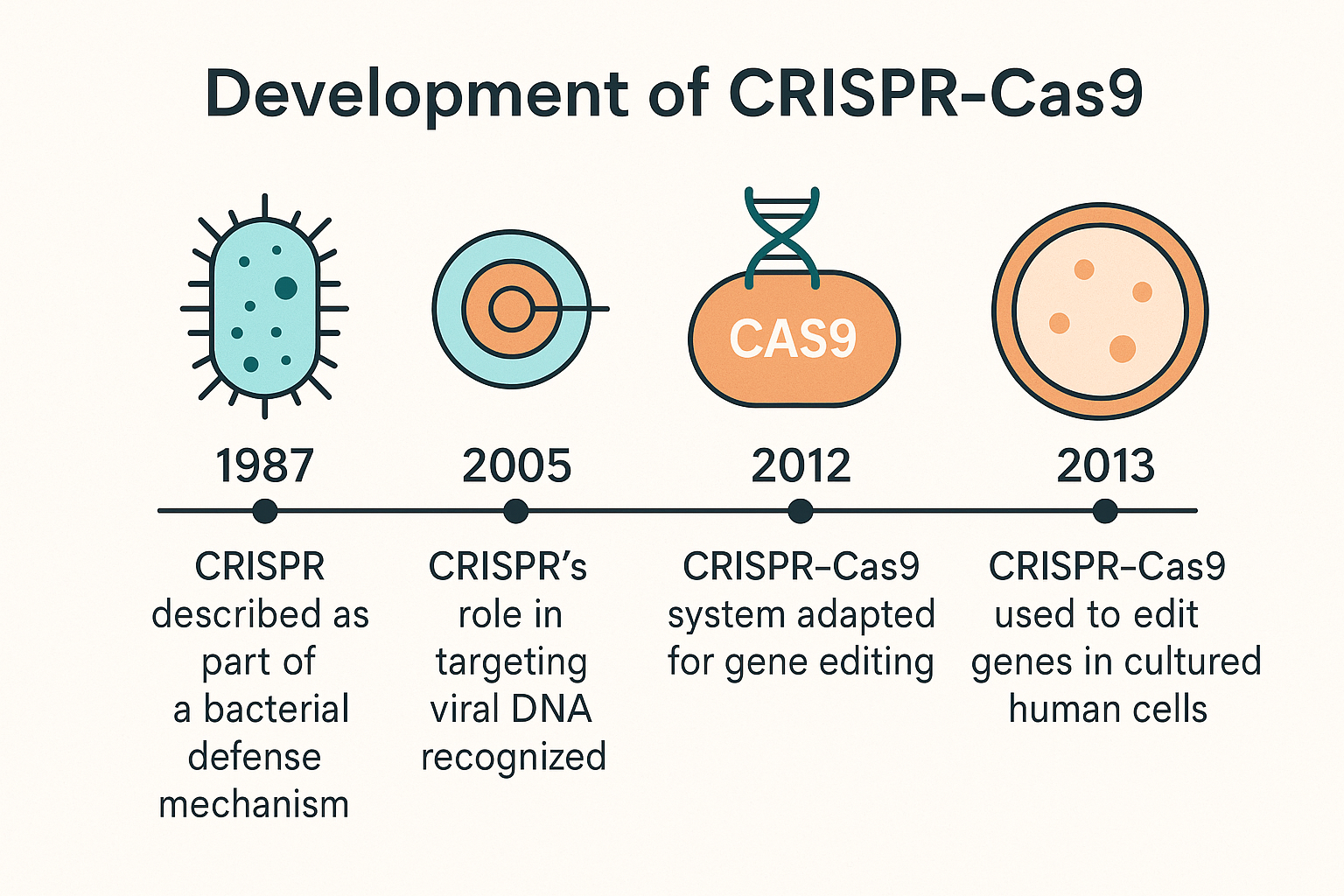
The history of CRISPR can be traced back to the late 80s when Japanese scientists caught some peculiar repeating DNA in the genome of Escherichia coli. In the following twenty years, these sequences were studied by scientists across the world, and they were universal in a great number of bacteria and archaea species.
That would change in 2005, when investigators would come to the conclusion that the unusual spacer sequences corresponded with segments of viral DNA. This identification ensured that CRISPR is an adaptive immune system which retains viral DNA in genome as a molecular memory. Experiments carried out of CRISPR in 2007 showed how it provides resistance to bacteriophages, validating the system in further establishing bacterial immunity.
An un-selfish executor: Cas Proteins: The CRISPR Executors
CRISPR and its memory would have no value without its enforcers, which are the Cas proteins. These specific enzymes play different roles in the basis of engineering with respect to CRISPR-Cas system:
Cas1 and Cas2: found in nearly all CRISPR systems, Cas1 and Cas2 are necessary to insert new spacers during the adaptation step.
- The most well-known of these is Cas9, a DNA-cutting enzyme to which it owes much of its fame, that is programmable.
- Different interference strategies are carried out in Cas3 (Type I systems) and Cas10 (Type III systems).
Cas proteins in different bacteria species also display a great variety, pointing at the evolutionary plasticity of the CRISPR-based defenses.
Evolutionary Importance of CRISPR
The systems of CRISPR do not stay in place: they are evolving under the impact of the continuous nature of an arms race between bacteria and viral predators. Phages create counter mechanisms that include anti CRISPR proteins, which suppress Cas enzymes. Bacteria in response, develop different versions of CRISPR-Cas defense strategies to counter such viral strategies. This co-evolutionary dynamism keeps them in the state of constant adaption and thus CRISPR is perhaps an excellent instance of the cleverness of nature.
Connecting Microbiology to biotechnology
The way man has turned to nature to take inspiration dates back to centuries ago. However, CRISPR is on a whole new level of biomimicry, the scientists have not merely cloned but repurposed the bacteria survival mechanism against our own ends.
Development of revolution in genome editing happened in 2012 when Jennifer Doudna, Emmanuelle Charpentier and Feng Zhang, separately showed that the CRISPR-Cas9 system can be reprogrammed to cut the DNA at a targeted site in eukaryotic cells. Designing synthetic guide RNAs to target particular genes, scientists may utilize Cas9 to make specific changes into the genome of plants, animals, or people
The Wonder of CRISPR (and how it is revolutionizing Science)
Already the CRISPR strength has transformed several disciplines:
- Medicine: Clinical trials are being used to test CRISPR-based therapy in genetic diseases such as sickle cell disease, beta-thalassemia and some cancers.
- Agriculture: Crops are being modified using CRISPR to be pest resistance, drought resistant and higher-yield without input of foreign DNA.
- Basic Research: Scientists can also study gene functions by using CRISPR which knocks out or alters specific genes on model organisms.
- Diagnostics: These tools are based on CR-ISPR and include SHERLOCK and DETECTR that could be used to diagnose infectious diseases (including COVID-19) quickly and in a highly sensitive manner.
Ethical Concerns on the Use of CRISPR
Just like any other strong kind of technology, the use of CRISPR presents significant ethical questions. These issues include the unintended effects of germline DNA editing of humans to equity in access to CRISPR-based medicine. It is of utmost importance that innovation should not be allowed to impose too much risk on humanity without ensuring that it assists and serves humanity.
What Makes CRISPR Origin Story Matter
Explanations of the bacterial origins of CRISPR are significant to emphasize the importance of basic research. By exploring nature without direct applications to be used, there are occasions when scientists discover something that subsequently changes whole sectors. The history of obscure bacterial sequences to becoming one of the greatest tools in biotechnology highlights the worth of science driven by curiosity.
Conclusion
This arms-race between microbes and their viruses which initially started as an evolutionary occurrence has transformed the modern spectrum of biology. The bacterial immune system called CRISPR is an illustration of the genius of nature-bacteria to change, to learn and to fight its own invaders tirelessly. Scientists have now made this ancient defense mechanism a clean, an easy-to-use yet an effective tool of genetic engineering and this new technology is set to do wonders in the fields of medicine as well as agriculture and much more.
The tale of CRISPR conceals the boundaries between the worlds of microbiology and biotechnology, teaching us that one would never assume that one of the biggest scientific discoveries lies in the tiniest nook of life. As we go deeper and learn more about the molecular tactics behind nature, we are likely to find out even stronger tools to deal with the challenges of tomorrow.