Introduction
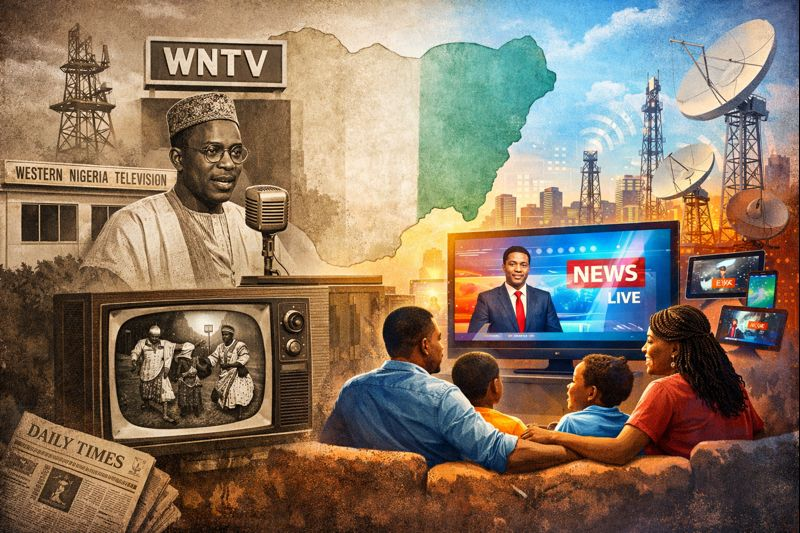
The advent of television broadcasting in Nigeria provided a dramatic turning point in the communication history of the country. In the pre-television days, information dissemination was dependent on the media, the print media and the radio, which though powerful, did not provide the visual immediacy that was provided by television. This all transformed in the year 1959 when Western Nigeria Television (WNTV), the first television station in Africa, was set up.
WNTV was initiated by the Western Region government under the leadership of Chief Obafemi Awolowo and it was developed as an educative, politically enlightening, and cultural tool. Its introduction never vaguely enriched the media landscape in Nigeria. It transformed the process of information, culture, and politics production and consumption.
This paper will discuss the historical background that gave rise to the formation of Western Nigeria Television, its cultural, political and social influences, and how the early television broadcasts in Nigeria can be compared to the current digital television. Through this development, the article outlines the long history of WNTV in the transformation of modern broadcasting in Nigeria.
The Nigerian Television Broadcasting as a History
Media Before Television Environment
The media space in Nigeria was dominated by the press and the radio broadcasting before the emergence of television. Print media, Iwe Irohin, West African Pilot and Daily Times, were also pertinent in the political mobilization and public education, whereas radio was used as the main electronic media of mass communication.
Radio worked well in reaching the literate and non-literate masses, predominantly in the rural regions, and this lacked visual appeal. At the end of 1950s, politicians appreciated the necessity of more active means which would be capable of synthesizing sound and images to improve communication with the population.
WNTV Has Political Motivation
Western Nigeria Television was heavily founded on the political and ideological activities. The government of the Western Region was interested in overcoming the influence of the federally controlled radio broadcasting that was believed to be prejudiced against the interests of the region. Television was consequently used as a strategic tool to propagate regional self-sufficiency, education, and cultural pride.
When Western Nigeria Television was launched in Ibadan on October 31, 1959, it placed Nigeria and Africa at the forefront of the television broadcasting industry. WNTV has been generally recognized by scholars as a groundbreaking experiment that proved the possibilities of television in postcolonial societies.
WNTV and Its First Days
Technical and Institutional Foundations
Western Nigeria Television started off with a small technical infrastructure on modern standards. Ibadan and the surrounding areas were first broadcast in black and white transmission with few programs to run daily. Irrespective of such limitations, the station was professionally run with trained staff, with many having undergone specialist training in foreign countries. The state-controlled system promoted that programming was in line with the development objectives and not commercial profit.
Programming Philosophy
WNTV was educationally and culturally mission-driven in terms of the programming content. The free primary education policy was promoted by educational broadcasts in the Western Region, and the culture was promoted by the cultural programs that presented the Yoruba traditions and music, drama and language. Regional development, governance, and services to people were the focus of news and current affairs programs. This strategy set WNTV apart from subsequent business-oriented stations that would focus on entertainment and advertising income.
Cultural Influence of WNTV
Encouragement of Indigenous Culture
Western Nigeria Television was making one of its biggest contributions through safeguarding and spreading indigenous culture. The local customs were brought to the living rooms of city dwellers by television dramas, traditional music performances and cultural documentaries. It was the first time that Nigerians could observe their traditions and languages on the screen and this strengthened cultural identity and pride. This was a cultural representation that was used to offset the dominance of foreign media content that was in place during the colonial era.
Language and Identity
The use of indigenous languages especially Yoruba by WNTV enhanced the linguistic identity and promoted the continuity of cultures. This was in contrast to the print media that mainly worked in English. Proving the local languages to be appropriate to use as a modern broadcasting language, WNTV also played a role in a wider discussion on cultural decolonization and national identity in post-independent Nigeria.
Political Influence of WNTV
Political Communication
WNTV was extremely important in the political communication in the late colonial and early post-independence periods. Political awareness was created through government policies, political speeches and enlightenment campaigns being played to people. Credibility and appeal to emotions were more effective through the visual quality of television and made political messages more compelling than radio only broadcasting.
Shaping Public Opinion
The Western Region government manipulated the content and the way stories were presented to influence the minds of people and solidify their political standing through WNTV. Although this was a cause of concern on the independence of the media, it also proved the strength of TV as a tool for setting an agenda. WNTV later would have a similar experience in influencing federal and regional governments to start their own television stations resulting in the rapid growth in the growth of television broadcasting in Nigeria.
Social Impact of WNTV
Transforming Family and Social Life
Television changed the way people socialize in Nigerian families. Families sat together in front of television sets watching shows, and this gave them a common viewing experience, which changed the patterns of leisure. Television has become a central point of social life and fashion, speech and behavior, especially in the city population, became dependent on it.
Education and Social Development
WNTV had educational programs that favored literacy, civic education and public health awareness. The school broadcasts also complemented classroom instruction, and public service announcements focused on such issues like hygiene, agriculture, and community development. These efforts made television a stronger instrument in development and not an entertainment medium.
Expansion of Television Broadcasting in Nigeria

From Regional to National Networks
Other regions had their own television stations established after the success of WNTV such as the Eastern Nigeria Television and Radio, ENTV, and Radio Television Kaduna, RTK. The television services were later amalgamated by the federal government into the Nigerian Television Authority, NTA, in 1977. This growth made television a country-wide commodity and standard programmes and wider coverage.
Commercialization and Privatization
The deregulation of broadcasts in 1990s brought in the private television stations which brought about the increased competition and diversification of shows. Although this changed viewer selection, it also diminished the powerful educational element that ensued from early television broadcasting.
A Comparison Between Early Television and the Contemporary Digital Broadcasting in Nigeria
Technological Advancements
Television in Nigeria started off on an analogue basis, with poor coverage and a fixed time schedule. Compared to it, the current digital broadcasting provides high definition broadcasting, satellite broadcasting, and demand. Digital television has increased access by cable, satellite, and online streaming, where any viewer is able to view the content at any time and place.
Expanding on Content and Audience Engagement
The content of WNTV was more of a development and government-based news, but the modern day digital television is more focused on entertainment, advertising, and ratings by the audience. The integration of social media has also changed how people view content further, since the viewers can now interact with the content and the broadcasters in real time. Although this interactivity increases involvement, it also brings up issues regarding the quality of content as well as cultural watering down.
Ethical and Regulatory Issues
The initial television was highly controlled by the government, and hence it never compromised with the goals of the people in terms of interest. The contemporary broadcasting takes place in more liberalized setting, as the regulation frameworks promote the freedom of commercial activities and the ethical principles. This change is similar to the larger shifts in the political and economic environment of Nigeria.
The Enduring Legacy of WNTV
The leading position of WNTV laid the basis of television broadcasting in Nigeria and Africa. Its focus on learning, culture, and government service showed how television can prove to be an instrument of national building. Even in the current digital broadcasting, where the media environment has undergone changes, the principles put forward by WNTV are still applicable. The legacy of the station may be seen in the continuous discussions concerning the role of media and its responsibility, cultural representation, and the purpose of broadcasting in democratic society.
Conclusion
In 1959, the Western Nigeria Television was launched, and this was a historic event in the media history of Nigeria. Western Nigeria Television was the first TV station in Africa, re-inventing communication by integrating visual narration and educational and political propaganda. Its cultural, political and social impacts were experienced way beyond the Western Region, and this contributed to the growth of television broadcasting in the country.
The updated digital television is both technologically superior and more accessible to people, but it has lost the developmental spirit that defined the initial broadcasting. The analysis of the WNTV legacy can be very helpful in the assessment of the development of Nigerian media and in pointing to the role that responsible and culturally based broadcasting can play in the modern digital era.