Introduction
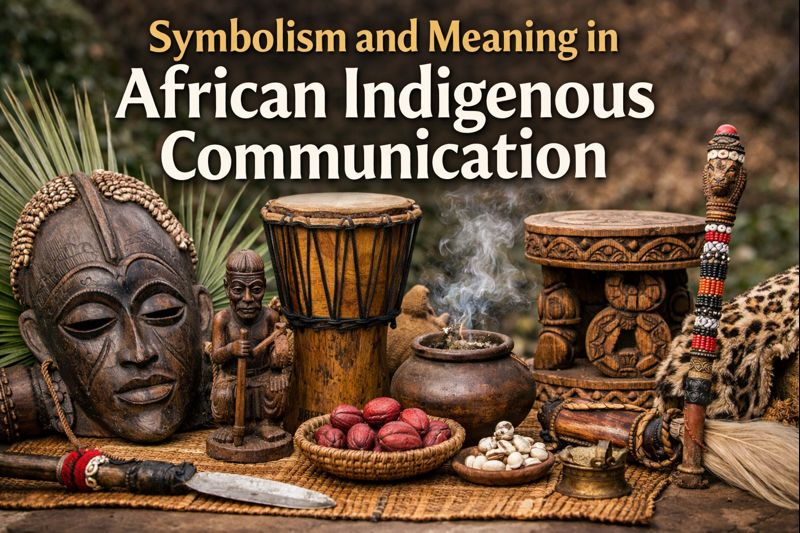
African native forms of communication are distinguished by the highly advanced use of symbolism in objects, colors, gestures, dress codes, and in rites, which have multiple meanings that go beyond what a person can express verbally. The paper is an analysis of how things like kolanuts, palm fronds, dress designs, body languages, color, musical instruments, and ritual symbols are effective communicative tools in traditional African societies. It describes how these systems solidified social order, spirituality, cultural identity, and authority. The analysis shows that symbolic communication is a highly developed cultural intelligence that is a part of African civilization and that is still relevant in modern African society.
In the traditional African society, communication goes beyond verbal communication. It is a complex system of symbols, objects, gestures, colors, and ritual performances that convey the meaning that is shared by society. Scholars repeatedly point out that the native African communication is intentional, structured, systematic and also rich in cultural norms and spirituality (Finnegan, 2012; Ugboajah, 1985). These symbolic practices had different purposes that included maintaining social ties and relationships, regulating behavior, preserving identity, political stability, and spiritual beliefs (Opubor, 1975; Samovar and Porter, 2004).
Symbolic communication continues to play a critical role in comprehending African societies as meanings are socially shared by culturally literate contacts and passed on through generations. These meanings are not incidental, they are instilled in the cultural knowledge systems whereby gestures, objects, colors, rituals, or body language serve as a channel of organized communication. According to scholars, these non-verbal cues in African communication systems must be comprehended in the realization of intellectual depth of the African indigenous societies as they serve as an effective means of social control, maintenance of identity, expression of spirituality, legitimacy of leadership, and social harmony.
Indigenous African Communication as a Foundation of Symbolism
Symbolism is one of the key pillars of the African native communication. Symbolic knowledge is important because it represents cultural knowledge, encodes values, and embodies complex meanings that dictate how people relate with each other (Opubor, 1975). Symbolic communication, in oral-dominated societies, was crucial in maintaining the clarity, emotional control, and respect towards authority, in addition to facilitating communities to transmit meaning without written language (Finnegan, 2012). These symbols were operating on established cultural constructs; thus, the interpretation required a common cultural context.
Kolanuts: Communication of Peace, Hospitality, and Social Integration
Kolanut is an extremely significant communicative and cultural tool of West African communities, especially Igbo, Yoruba, and Hausa. Its delivery is a formal communicative gesture which means hospitality, peace, goodwill, and acceptance. Unity, diplomacy, and moral responsibility are promoted through the ritualized procedure of offering, blessings, and sharing kolanut (Nwosu, 1987; Odugbo, 2015). The rejection of kolanut, with the exception of special circumstances, can mean hostility or rejection. Therefore, kolanut is a cultural language of greetings, respect, and social connection.
Palm Fronds: The Insignia of Divine Power and Social Control
Palm fronds are also an important type of symbolic communication throughout West and Central Africa. In Yoruba culture, palm fronds are symbols of sacred authority, spirituality and ritual protection (Olatunji, 1984). They convey limitations, religious action, or penalties imposed by the community when positioned at entrance points, shrines, or pathways. Equally, palm fronds can be used both as indicators of taboo areas, spiritual observance, or communal warnings given by the traditional organizations in Igbo cultures. They reinforce order, spirituality, and sanctity of a community values (Olatunji, 1984).
Color Symbolism: Emotional, Spiritual, and Cultural Language
In the African indigenous societies, colors are a communicative tool that has a culturally specific meaning. White is commonly a symbol of purity, peace, and spirituality; black is a symbol of ancestral power, spirituality, and continuity; and red is a symbol of vitality, power, danger, or ritual energy (Finnegan, 2012; Omoregie, 2018). Colors hold emotional intent and interpersonal anticipations during funerals, festivals, initiation rites, and chieftaincy ceremonies. Meanings are comprehended because they are internalized in culture and transmitted in society.
Silent Communication, Gestures, and Body Language
Body signs and facial expressions can be considered as important communication methods in the African society. Kneeling, bowing, prostrating, bending the head, or avoiding eye contact is a sign of respect, humility, and recognition of superiority (Samovar and Porter, 2004). Silence in itself can either convey assent, respect, consideration, or disapproval in different circumstances. The gestures are culturally regulated and need indigenous contextual knowledge to avoid wrong interpretation (Samovar and Porter, 2004).
Dress Codes: Identity, Authority, and Social Role Communication
The old African clothing is a symbol of message beyond the visual. Clothing indicates marital status, age, social strata, power, and cultural affiliation (Finnegan, 2012). Chiefs, priests, elders, and initiates have special items which are worn by them to demonstrate their legitimacy and status in their roles publicly. Symbolic accessories, such as beads, crowns, wrappers, and others, strengthen authority. Uniformed clothing during festivals indicates unity and even the masquerade attire is specially designed to symbolize the presence of ancestors and spirits (Okolo, 1993). Also, women’s attire is a proactive means of communicating their identities, whether they are married or not.
Sound Communication, Musical Instruments, and Sound Symbols
Sound symbols are also used in African communication. Messages are passed through drums, bells, horns, and gongs, which control communal life, signify danger, and enforce ritual power. Talking drums, as an example, are languages that simulate tones and transmit messages over distances, functioning as coded systems of meaning (Finnegan, 2012). These sound signals disclose the advanced indigenous knowledge of communication technology, way before the modern media.
Rituals, Festivals, and Sacred Symbols as a Communication System
Concentrated symbolic communication is represented by rituals and festivals. The masquerades serve the purpose of social morality and authoritative power as embodiment of the ancestors. Ritual sacrifices convey thanksgiving, supplication, or reconciliation with spiritual beings. Power, legitimacy, and cultural memory are transmitted through sacred items like staffs, calabashes, shrines, and masks (Okolo, 1993). These representational performances enhance identity, uphold moral values, and maintain continuity of culture.
Developing Academic Horizons and Relevance in the Present
Contemporary scholarship is seeing the symbolic African communication as a valid intellectual system just as much as the written communication traditions. Scholars argue that these symbols depict philosophical ideas, social governance, and epistemology framework that shaped community life (Ugboajah, 1985; Finnegan, 2012). They are a problem to colonial accounts that disparaged indigenous communication as primitive. Rather, symbolic systems exhibit strategic organization, cultural intelligence, and purposeful meaning construction.
Symbolic communication is still at play in modern Africa, as a way of leadership, resolving disputes, mobilizing communities, and expressing their culture. Several states continue to incorporate the traditional symbols in national ceremonies, diplomatic events, and cultural festivals. The practices will guarantee continuity between the traditional society and the modern society, and the fact is that the indigenous symbolic communication is not a thing of the past but a living heritage.
Summary and Conclusion
This paper has discussed the profound meaning and symbolism of African indigenous communication that tells us that the African traditional societies had a more complex way of communication, which was not through verbal means, but through a complex set of objects, gestures, sound, color, dress code, rituals and sacred performances. The kolanuts, palm fronds, and ritual objects, which were symbolically coded forms of communication, conveyed messages of peace, power, social order, morality, spirituality, and social identity. Colors were emotionally and spiritually charged, gestures, the absence of speech and the body language served as the organized methods of respectful and social control. Telling of identity, age, authority, and societal roles was done through dress code, distance communication was done through drums and sound instruments, and communal organization was enhanced through these sound instruments. The collective memory, moral authority, ancestral presence and social cohesion were embodied in festivals, rituals, and sacred symbols, which demonstrated that symbolic communication was an intelligent knowledge system and not a primitive activity.
To sum up, symbolic communication within African cultures is a very sophisticated and culturally based meaning-making system, which influenced the governance, spirituality, morality, social interaction, and harmony within the community. The modern academia recognizes these systems as a valid intellectual tradition that questions coloniality and affirms the African cultural sophistication. These aboriginal systems of symbols remain also useful in contemporary African societies as they preserve identity, strengthen leadership legitimacy, aid in conflict management, promote cultural perpetuation, and enhance community membership. The connection between the past and the present is further cemented by the fact that many African states and communities continue to use such symbols in national events and other traditional institutions, festivals and cultural practices.
Thus, the symbolic communication is a living and dynamic legacy, which represents African cultural intelligence, continuity in history and social philosophy. It demonstrates that African cultures have come up with the structured systems of communication which are deliberate, meaningful and traditionally embedded in common cultural consciousness and that messages were not only heard but also culturally experienced, comprehended and revered between generations.
References
Finnegan, R. (2012). Oral literature in Africa. Open Book Publishers.
Nwosu, I. (1987). Mass communication and national development in Nigeria. Frontier Publishers.
Odugbo, A. (2015). Symbolism in African traditional communication. Journal of African Cultural Studies, 27(3), 221–237.
Okolo, C. B. (1993). African social thought: Philosophy and symbolism. Cecta Publishers.
Olatunji, O. (1984). Symbolism in Yoruba traditional institutions. African Studies Review, 27(1), 89–101.
Omoregie, O. (2018). Color symbolism and cultural identity in African societies. Journal of Humanities and Social Sciences, 12(4), 45–57.
Opubor, A. (1975). The intelligibility of traditional media. In F. Ugboajah (Ed.), Mass communication, culture, and society in West Africa (pp. 45–61). National Commission Press.
Samovar, L. A., & Porter, R. E. (2004). Communication between cultures (5th ed.). Thomson Wadsworth.
Ugboajah, F. O. (1985). Oramedia: Indigenous communication in Africa. National Commission for Culture and Arts.