Introduction
Money saving is considered to be a thing that only the high-income or financially privileged people can do. Most people feel that when they are struggling to make a living, there is no way they can save. Nonetheless, this is not just a limiting belief, but a false belief. The fact is that it is habits and understanding smart saving strategies that make wealth rather than income level. It does not matter how much you make in small or large amounts, the skill to save always and in a systematic manner may change your life financially.
This article discusses real-life, practical, and enabling saving tips which every individual can use. Whether you have a high or low income, you will learn to accumulate wealth in small steps, automating your savings, reducing unnecessary expenses and financial barriers, set financial goals and eliminating the mindset that can lead you to poverty.
Why Saving is Important at Every Income Level
Saving does not only mean hoarding money but it is all about establishing stability, less stress and freedom. Small savings can:
- Guard you against emergencies.
- Assist you in evading debt.
- Help you to invest in opportunities.
- Bring a sense of security.
The saving habit is much more significant than the saving amount. A person who will save on a small scale will have amassed more wealth than the person who earns more and wastes money, this can be achieved using Smart saving strategies.
Begin with Simple Financial Direction.
You must understand the reason why you are saving before you can make effective savings. This is where it is necessary to set financial goals.
Understanding Financial Goals
Money purpose is provided by financial goals. The absence of them makes saving look like a burden. It is significant and inspiring with them.
Financial goals are of three types:
- Short-term objectives (0 – 1 year): Emergency fund, rent, groceries.
- Medium-term (1-5 years): Education, travelling, business start-up.
- Long-term objectives (5 years or more): Purchase of a home, retirement.
Anchor Resource of Goal setting.
This guide to setting financial goals should help you define and prioritize your goals better.
Make Your Goals SMART.
Make certain that the following are your goals:
- Specific – Clearly defined (e.g., save ₦200,000)
- Measurable – Trackable progress
- Achievable -Realistic to your income.
- Relevant: Relates to your life.
- Time-bound- Establish a deadline.
The less time you need to save time, the less time you have to waste.
Automate Your Savings to Be Consistent.
Automation is one of the best methods of saving money, particularly when you are not very disciplined.
How Automation Works
Automation of your savings is simply the process of arranging a system that will automatically transfer the money in your income account to your savings account. This could be:
- A certain sum per week or month.
- A percentage of your income.
- Daily transaction savings rounded off.
The Power of Automation
- Eliminates the spending temptation.
- Builds consistency effortlessly
- Makes saving a habit.
It pays off in the long run even when you begin small maybe 2000 a week. It is not the size that matters, but consistency.
Pay Yourself First
The majority of the population spends and saves what remains. The opposite of this is true as the successful savers save and then spend the rest.
Implementation of this Strategy
When you get your income:
- Instantly reserve some amount as savings.
- It should be treated as an expense that cannot be negotiated.
- Make your expenditures match your available amount.
This change of mindset makes saving a priority and not a secondary thing.
Apply the 50/30/20 Rule (Flexible Version).
Budgeting does not necessarily need to be complex. Your finances can be managed using a smart saving strategies such as the 50/30/20 rule:
- 50% needs (rent, food, transport)
- 30%.Wants (entertainment, lifestyle)
- 20% and savings and debt repayment.
Adapting to the Reduced Incomes
This is because with a tight income, your needs can consume over 50%. That’s okay. The goal is to:
- Reduce wants gradually
- Goal is to achieve a consistent 5-10 percent reduction.
It is always good to save something than nothing.
Reduce Spending and Do Not Reduce the Quality of Life.
Being prudent does not imply that we lead a miserable life. It is making sure that you are conscious of your money.
Concrete Means of cutting down costs.
- Monitor your expenditure: Determine unnecessary costs.
- Prepare more food at home: Save on food expenses.
- Chop off not used subscriptions: Streaming, apps, memberships.
- Shop in large quantities where necessary: Save on necessities.
- Take a bus, taxis or carpool.
Pay Attention to Value, Not Price.
Long-term value should be considered rather than selecting the cheapest one all the time. It is better to pay a little more on long-lasting items and save money in the long run.
Build an Emergency Fund.
A safety net is required before you invest or aim at achieving big financial objectives.
What is an Emergency Fund?
Emergency fund is money that is saved as a result of sudden expenses that include:
- Medical bills
- Job loss
- Car repairs
- Urgent travel
How Much to Save?
Aim for:
- Starter goal: ₦50,000–₦100,000
- long-term goal: 3-6 months of living expenses
Begin small and develop slowly. Even a small emergency fund will allow you to avoid going into debt.
Leverage High-Yield Savings Options
All savings accounts are not equal. Traditional accounts normally have very low interest rates and this means that your money is growing very slowly.
What Are the High-Yield Savings?
These are savings accounts or financial products that have a better interest rate than the normal accounts.
Benefits
- Quicker increase in your savings.
- Passive income in the form of interest.
- Better safeguarding against inflation.
Examples to Explore
- Competitive interest rates of digital banks.
- Fixed deposit accounts
- Cooperative savings schemes
It is always worth comparing options and making sure that they are safe and controlled.
Grow Your Revenue (Where you can)
Although saving plans are effective, working towards more income will help you to gain momentum.
How to Increase Your Revenue
- Working as a freelancer or side hustles.
- Selling of products or services.
- Learning new skills
- To work part-time.
However, in the long run, even little incremental sources of income can make a huge difference in terms of savings.
Be Consistent, Not Perfect.
The greatest error that individuals commit is to surrender after failure. Unanticipated costs, crises, or errors may derail your savings plan but they do not need to stop it.
Tips on How to Keep up
- Bounce back.
- Rework your strategy rather than giving up on it.
- Celebrate small wins
Perfection is always defeated by consistency.
Avoiding the Major Obstacles in Saving
1. Low Income
Solution:
- Begin with minimal amounts.
- Pay attention to cost reduction.
- The first key to eating well is to build a habit.
2. Irregular Income
Solution:
- Percentage saving rather than amount saved.
- Construct an inventory when earnings are high.
3. Unexpected Expenses
Solution:
- Prefer an emergency fund.
- Predictable expenses should be used with sinking funds.
4. Lack of Discipline
Solution:
- Automate savings
- Set clear goals
- Track progress regularly
Using Sinking Funds for Planned Expenses
Sinking funds are savings made towards the likely future expenses.
Examples
- School fees
- Rent
- Holidays
- Car maintenance
You save bit by bit as opposed to scrambling in search of such money when such costs come along.
Monitor Your Improvement.
Checking on your savings can make you get motivated and responsible.
`Effective Tracking
- Use a notebook/budgeting application.
- Check on your savings weekly or monthly.
- Adjust your plan when necessary.
Having an idea of how you are moving forward, even the slightest growth, can help your confidence and dedication.
Cultivate Wealth Beyond Saving
It takes saving, but it takes growth to create wealth.
Investment After Saving
- Get investments in assets (stocks, real estate, businesses)
- Learn about financial literacy.
- Bring diversification to your income.
Saving provides you with the money to exploit wealth building opportunities.
Develop a Healthy Money Mind.
The way you think is very important to your wealth.
Shift Your Thinking
- From I cannot save to I can start small.
- From Supposed I will save later to I will save now.
- From I don’t earn enough to I will make do with what I have.
An optimistic active attitude will change your financial behavior.
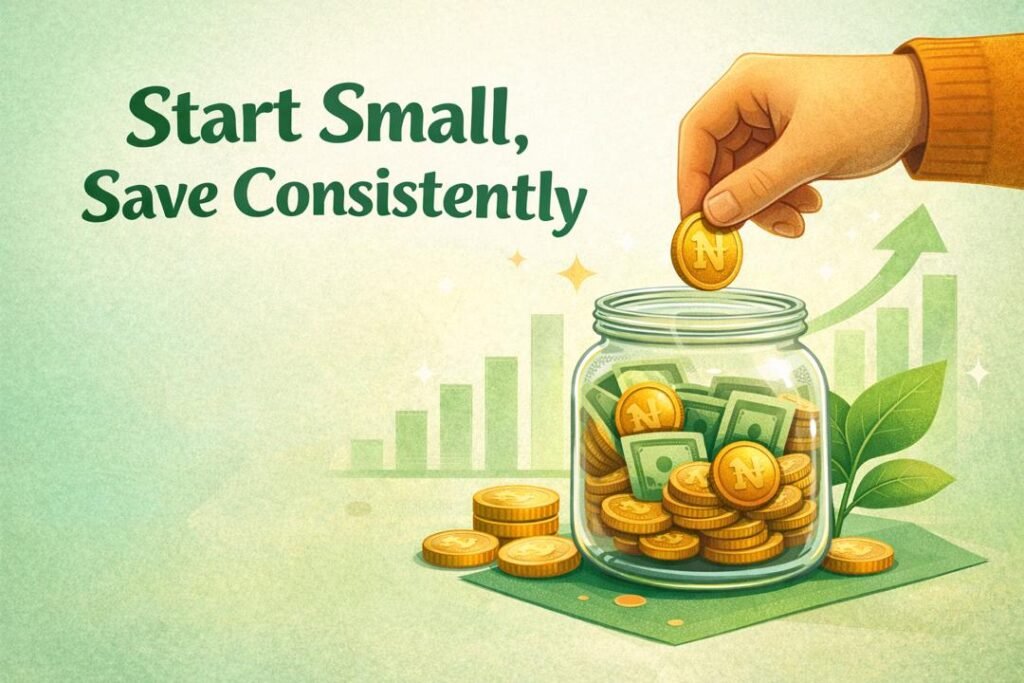
The Influence of Small Steps
The influence of small savings is very easy to underrate. However, with time they accumulate to large quantities.
Example
Saving ₦5,000 monthly:
- In 1 year: ₦60,000
- In 5 years: ₦300,000 (excluding interest)
Introduce interest and consistency and the outcomes are even more effective.
Conclusion
It is not how much you earn that is important, rather it is how you spend what you earn that counts in saving money. With the help of smart saving strategies such as automating your savings, focusing on your financial objective, eliminating unnecessary costs, and being consistent, you can create a solid financial base no matter what level of income you have.
The path to financial prosperity and success starts with one step. Begin small, remain dedicated and continue to get better. In the long term, you are going to be adding up to something significant.
Keep in mind, it is not a one-day affair to get rich, but it is built daily, through hard work, will, and good judgment.
Get more well researched information on Smart saving strategies here.