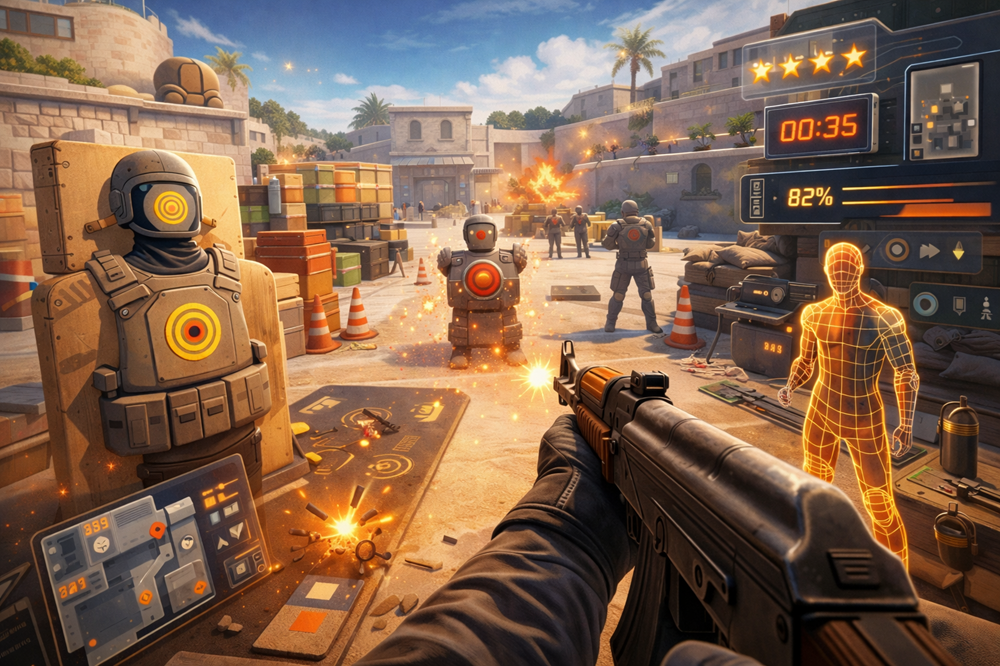
Modern competitive shooters are often associated with strict rules, rankings, and high-pressure matches. However, behind this competitive surface lies another important layer of gameplay: experimentation. Sandbox features, practice tools, and offline commands allow players to explore mechanics freely, understand systems deeply, and improve skills without the stress of live competition.
Counter-Strike 2 continues this tradition by offering a variety of ways for players to interact with the game outside of ranked matches. These options transform CS2 into more than a competitive shooter — they turn it into a learning environment where curiosity and experimentation are encouraged.
Why Sandbox Exploration Matters for Skill Development
Learning in a high-pressure environment can be inefficient. When every mistake is punished immediately, players often repeat habits without fully understanding why something works or fails. Sandbox modes and practice commands remove this pressure, allowing players to slow down and observe mechanics in isolation.
This approach mirrors how skills are developed in other disciplines. Musicians practice scales before performing, and athletes drill fundamentals before competing. In games, sandbox exploration plays a similar role, creating a space where learning is intentional rather than reactive.
Freedom to test mechanics without consequences
Clear observation of cause-and-effect relationships
Reduced stress during the learning process
Understanding Weapon Mechanics Through Practice
Weapons in CS2 are defined not only by damage values, but by timing, animations, and interaction rules. Understanding these details can dramatically improve consistency in real matches. Practice environments allow players to study weapon behavior without distractions.
Guides discussing knife commands often focus on educational use cases. By spawning specific weapons or testing interactions, players gain insight into hit registration, range, and animation timing. This knowledge translates directly into better decision-making during live rounds.
Learning hitbox behavior and reach
Practicing movement and timing
Understanding animation delays and recovery
Experimentation as a Path to Mastery
Many experienced players attribute their improvement not to endless matchmaking, but to focused experimentation. By isolating mechanics and testing boundaries, they build a mental model of how the game operates. This understanding reduces guesswork and increases confidence during competition.
Discussions around cheats for cs2 often intersect with broader technical conversations about engine behavior, system limits, and sandbox testing. In many cases, these discussions are driven by curiosity and analysis rather than purely competitive intent.
When players understand systems deeply, they rely less on instinct alone and more on informed decision-making. This shift marks the transition from casual play to deliberate mastery.
Community Knowledge and Shared Learning
Sandbox learning rarely happens in isolation. Players share discoveries, document findings, and compare observations with others. Over time, this collective knowledge shapes how the community understands the game.
Community-driven guides and discussions often highlight efficient ways to practice, common misconceptions, and subtle mechanics that are easy to overlook. By learning from others, players accelerate their own development and avoid unnecessary trial-and-error.
Balancing Practice and Competition
While experimentation is valuable, it works best when paired with real gameplay. Practice builds understanding, but competition tests execution under pressure. Players who balance both tend to improve more steadily than those who focus exclusively on one side.
Using sandbox tools strategically allows players to enter competitive matches better prepared, reducing frustration and improving consistency over time.
Conclusion
Counter-Strike 2 offers more than competitive matches — it provides tools for exploration, learning, and mastery. Sandbox features and practice commands allow players to understand mechanics deeply and improve intentionally. When combined with community knowledge and real match experience, experimentation becomes one of the most effective paths to long-term improvement.
Frequently Asked Questions
Why is sandbox practice important in competitive shooters?
Sandbox practice allows players to focus on mechanics without pressure, leading to clearer understanding and faster improvement.
Do practice commands really help in real matches?
Yes. Understanding weapon behavior, timing, and movement through practice improves decision-making and consistency during competition.
How much time should players spend experimenting?
There is no fixed rule, but short, focused practice sessions combined with real matches are usually most effective.
Is community knowledge important for learning?
Absolutely. Learning from others reduces mistakes, highlights hidden mechanics, and accelerates overall progress.