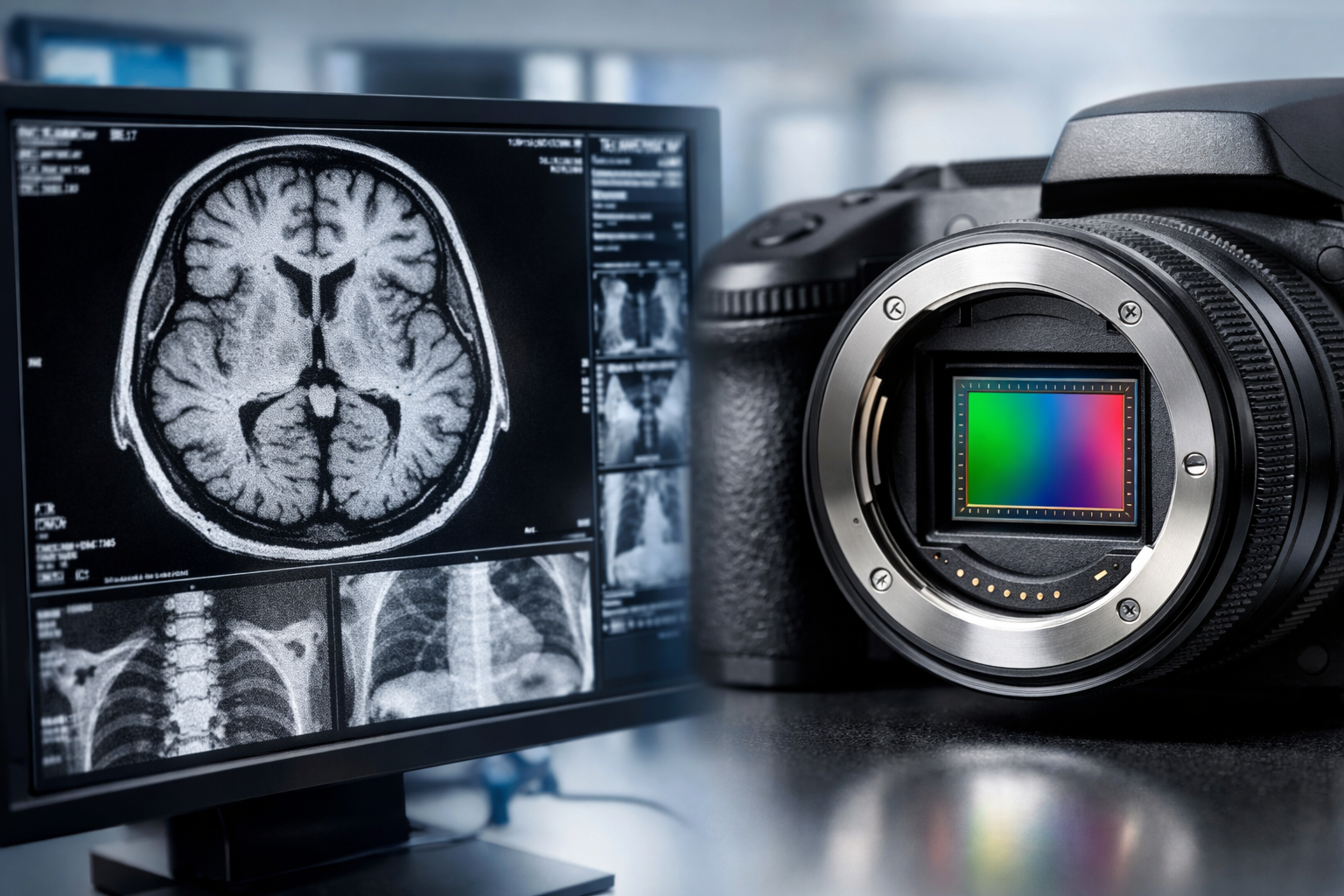
Quality imaging forms the basis of various applications in medical diagnostics, remote sensing, photo and industry inspection. It is not just the camera or the imaging device that defines the quality of the image but also a number of inherent parameters that will determine how effectively the object can record and display the visual information. The leading factors of clarity and interpretability of images are the spatial resolution, contrast and noise among these. The knowledge of these parameters is necessary to efficient engineers, technologists and end-users who intend to maximize imaging systems to particular uses.
Spatial Resolution: The Sharpness of Image Details
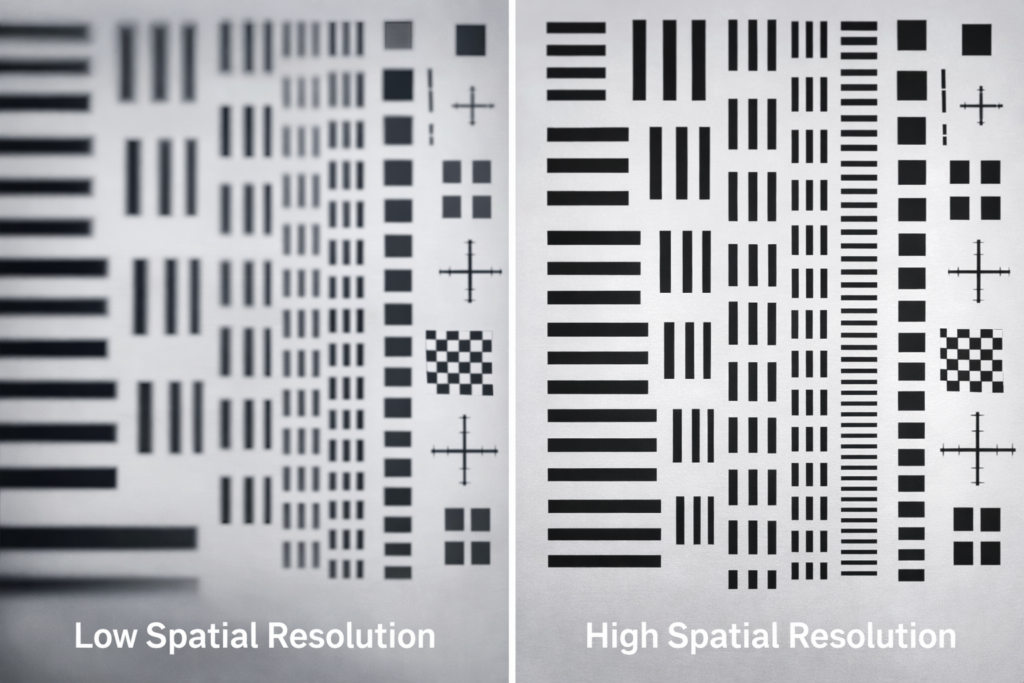
Spatial resolution is the capacity of an imaging system to differentiate small objects in an object. Simply speaking, it defines the extent to which an image can be discerned in detail, and the proximity of features that can be distinguished. The small structures can be easily distinguished through high spatial resolution, which is essential in medicine imaging, satellite and microscopy.
Spatial resolution is frequently measured in terms of line pairs per millimeter (lp/mm) with optical systems, pixel pitch with digital sensors, or ground sampling distance (GSD) with satellite images. Increased spatial resolution is usually achieved by using superior optics, increased pixel density in digital sensors and accurate signal processing.
Influencing Factors In space resolution
- Optical Quality: It depends heavily on the quality of the lens, the size of aperture and diffusion. Even high-density pixel sensors may not be able to focus on details due to poor optics.
- Sensor Characteristics: The size of the pixels and the overall number of pixels in the sensor have a direct impact on resolution. The smaller pixels have lower levels of light, and this could be at the expense of sensitivity versus detail.
- Sampling and Digitization: The Nyquist theory states that the sampling rate should be high enough to record all the information in the scene without aliasing effects.
- Motion and Stability: Despite high-resolution systems, blurry images may occur when the capturing is in motion, of either the subject or the camera.
- Practical Implications: High spatial resolution can be used in medical imaging to allow radiologists to identify minute lesions or microfractures. In satellite imaging, it is used in recognizing the pattern of roads, buildings or vegetation on the images taken either on the surface.
Contrast: Making a contrast between the Bright and Dark
Contrast refers to the difference in the luminance or color which causes an object to stand out against a background. It defines which features can be seen in an image, which influences the aesthetic value and the diagnostic ability. Lack of contrast can cause small detail to be absorbed into the background making the picture useless as an analysis tool.
Types of Contrast
- Subject Contrast: The natural variation in the reflectivity or emission of the objects under imaging. As an illustration, the bone would be brighter in X-ray images as compared to the soft tissue because of its density.
- System Contrast: This is set by the imaging device; sensor response, lens transmission, and image processing algorithms.
- Dynamic Range: A dynamic range improves contrast since it enables both very dark and very bright areas to be recorded without saturation and clipping.
Measuring Contrast
Measures of contrast can be determined by the use of measures like the Michelson contrast, which is determined as:
C=Imax[?]IminImax +IminC = (Imax – Imin)/(Imax + Imin) maximumand minimumintensity levels in the imagewhere ImaxImaxImax and IminIminImin. A high contrast enhances vision but should be moderate as too much contrast may obscure fine details.
Importance of Contrast
- Imaging Medical imaging: Both contrast and imaging enhance the ability to detect tumors, blood vessels or abnormalities in soft tissue. In CT and MRI imaging contrast agents are typically employed so as to highlight certain structures.
- Photography: Good contrast makes the subjects stand out clearly against the background enhancing visual appeal and clarity.
- Industrial Inspection: It is also common that in order to detect defects in materials there must be enough contrast between flaws and the material that surrounds the flaws.
The Unwanted Intrusion in the Image Noise
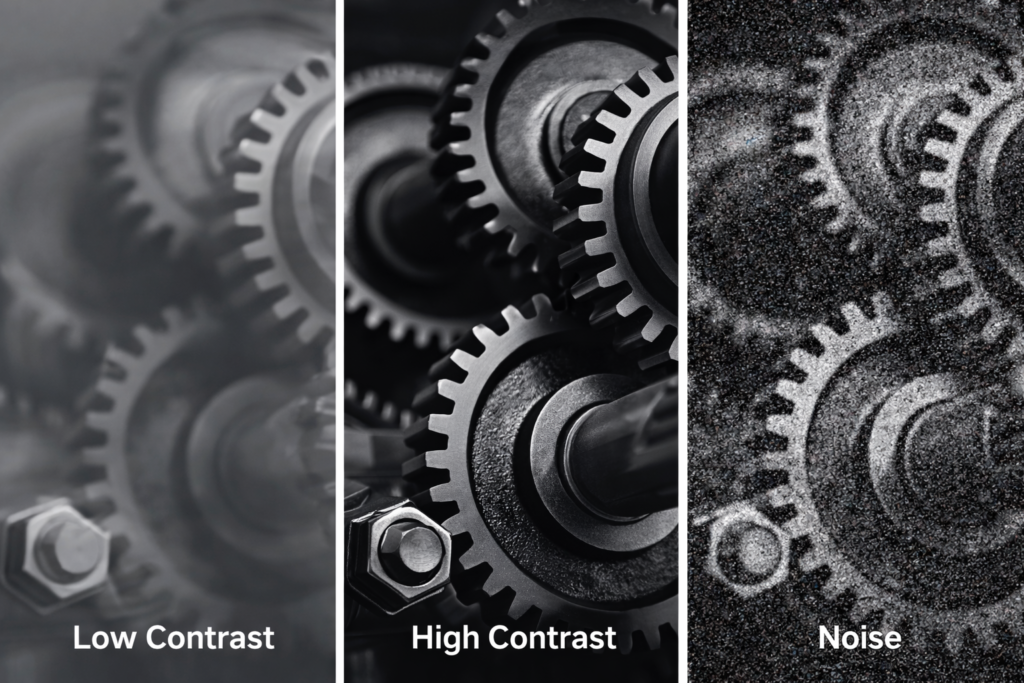
Noise is defined as the random variations of pixel intensity that lower the quality of the image. It may result in blurred essential information and lower levels of diagnostic accuracy. All imaging systems contain noise and are caused by various factors such as sensor limits, the environment, and electronic noise.
Types of Noise
- Shot Noise: This is also due to the discrete nature of light; it is more noticeable in low light situations.
- Thermal Noise: This comes about as a result of heat productions in the electronics of the sensor, particularly in long-exposure imaging.
- Quantization Noise: Consequences of converting analog signals to the discrete pixel values.
- Fixed Pattern Noise: Recurring variations as a result of different sensor response.
Noise Reduction Strategies
- Hardware Solutions: Noise at the source can be minimized by the use of larger pixels, cooling sensors, and better electronics.
- Software Solutions: Image processing methods such as averaging, filtering and denoising algorithms are used to reduce noise after capture.
- Balancing Exposure: The optimal exposure levels can be used to enhance the signal to noise ratio (SNR), and lower the perceptible noise.
- Effects on Image Quality: A high noise level may obscure subtle features in medical imaging, or may lead to a less accurate recognition of objects in remote sensing. In its turn, minimum noise enhances clarity, thus, making spatial resolution and contrast effective.
Connection between Resolution, Contrast and Noise
Although all of the parameters influence the image quality individually, they are interconnected. For example:
- As pixel size is reduced to enhance spatial resolution, the intensity of light per pixel could decrease, which means that noise is maximized.
- Post-processing contrast can help boost contrast but it can also overplay noise unless it is used carefully.
- Noise can be reduced by filtering which can cause the fine details to be blurred and reduces the spatial resolution.
Therefore, a trade-off of image quality is the delicate balance of these parameters. Engineers are often confronted with a trade-off: the maximum resolution can be obtained at the expense of noise; or the minimization of noise can be obtained at the expense of resolution or contrast.
Efforts to maximize Image Quality
Sensor and Optics Design
- Lenses of good quality: Reduce aberrations and diffraction, increasing the resolution, and contrast.
- Improved sensors Back-illuminated CMOS sensors are available with larger pixel sizes and high dynamic range, making these sensors able to balance sensitivity and detail.
- Optical filters: These filters increase the contrast by passing on particular wavelengths that are pertinent to the application.
Image Processing
- Noise Reduction Algorithms: This category includes Gaussian filtering, wavelet denoising, and deep learning-based methods that can reduce noise without damaging the resolution.
- Contrast Enhancement: Histogram equalization, adaptive contrast stretching, edge enhancement enhance the visibility of features.
- Super-resolution Techniques: It is possible to use computational algorithms to recover high-resolution images with several low-resolution images.
Application-Specific Balancing
Various imaging conditions put importance on varying parameters:
- Medical Imaging: The spatial resolution and contrast are essential to the accuracy of the diagnostic quality, but too much noise should be reduced.
- Remote Sensing: In both mapping and analysis, the resolution of the mapping is required to be done in space, whereas signal-noise ratio should be controlled under different atmospheric conditions.
- Photography and Videography: Photographic contrast can either be given precedence, yet high-resolution detail is also desired, particularly in professional photography.
Practical Examples
- X-ray Imaging: Microfractures may be visualized due to the high spatial resolution, whereas soft tissues may be visualized due to contrast agents. The use of optimized sensor design and exposure settings reduces noise.
- Satellite Remote Sensing: Multi-spectral and hyperspectral sensors are based on the fact that the fine features of the terrain can be identified with high spatial resolution. The noise reduction together with contrast adjustment will guarantee proper land use as well as vegetation index interpretation.
- Microscopy Microscopy: In fluorescence microscopy, cellular structures are resolved by spatial resolution, and feature detection is enhanced by contrast-enhancing stains and noise-reduction algorithms.
Trends in Image Quality Optimization in the future
The tradeoffs between spatial resolution, contrast and noise are ever-growing better with advances in computational imaging, artificial intelligence and sensor technology:
- Super-Resolution with AI: Super-resolution can be improved using AI to direct the resolution beyond the hardware constraints.
- Adaptive Noise Reduction: Real-time programs use changing filtering depending on the content of the scene.
- Smart Contrast Enhancement: AI models do not overdo contrast optimization and do not enhance noise.
- Integrated Sensor Design: New technologies are integrating more than one sensor or spectral band together in order to get the best image quality of certain tasks.
Such innovations are enabling the possibility to get images at unprecedented levels of clarity with trade-offs being alleviated.
Conclusion
Image quality is a multidimensional phenomenon that is mainly characterized by spatial resolution, contrast, and noise. Each of the parameters is essential in identifying the clarity, interpretability, and usefulness of images in medical diagnostic, remote sensing and photography fields.
The knowledge of the interactions among these factors enables the engineers and technologists to plan and design imaging systems to suit particular applications. Although trade-offs are an unavoidable part of the world, the technology of sensors, optics, and computational imaging constantly comprises new technologies, which allow obtaining extremely high-resolution, high-contrast, and low-noise images and surpass the existing limits.
Having learned these basic parameters, the professionals will be able to guarantee that the images obtained are not only aesthetically pleasing, but also are diagnostic and analytical.