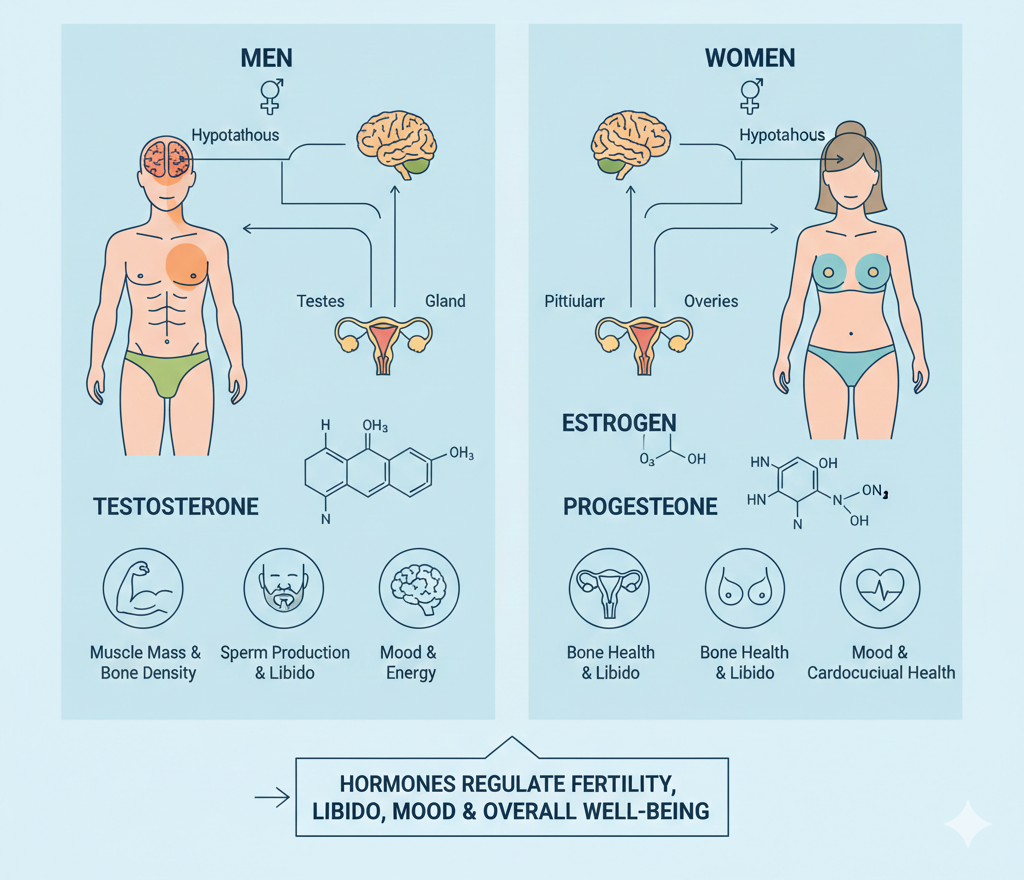
The reproductive health plays an important role in general well-being, and it is shaped by a complicated mechanism of hormones that react to sexual development, fertility, and physiological balance. These hormones dictate the changes taking place between puberty and adulthood to old age. Reproductive hormones influence the physical appearance in both men and women, reproductive ability, and sexual performance. The knowledge of the functioning of these hormones helps to understand the manner in which the body aids in reproduction, as well as adapting to life changes in various stages of life.
The endocrine system is the system that operates through the reproductive hormones, with the glands emitting chemical messengers into the bloodstream. These hormones work on certain organs and tissues in order to control the reproductive processes. Despite the slight interrelations between men and women in the context of reproductive hormones, the functions and patterns of release are diverse and thus leading to the differences in reproductive roles. A review of these similarities and differences assists in explaining how sexual health and fertility is preserved through the lifespan.
Learning about Reproductive Hormones
Reproductive hormones are chemical agents that coordinate sexual advancement, the functioning of the reproductive body parts and fertility. These affect puberty, gametogenesis, menstrual, spermatogenic and aging related hormonal fluctuations. In women, these hormones are majorly produced by the ovaries and in men, they are produced by the testes, coordinated by the brain.
The processes of the hypothalamus and pituitary gland have the leading roles in the regulation of the release of reproductive hormones. They organize signals, which will regulate the production of hormones at the correct levels and times. This rule enables the reproductive processes to be efficient and adjusting to the needs of the body.
Readers can learn more about the way these hormones work in the body with this detailed explanation. This article gives a full overview of the role of these hormones in the sexual development and fertility.
Female Reproductive Health and the Role of Estrogen
One of the main reproductive female hormones is Estrogen that plays a key role in sexual development and reproductive activity. It is primarily produced by the ovaries and it is the one who develops the female secondary sexual attributes e.g. the development of breasts and body shape changes.
In addition to physical growth, the estrogen controls the menstrual cycle by helping the uterine lining to grow in case of possible pregnancy. It also affects bone density, skin health, and cardiovascular functioning which points to its broader health impact.
In the course of the menstrual cycle, estrogen levels change, which are evidence of the body readiness to ovulation and possible conception. Such changes are necessary to ensure reproductive balance.
Progesterone and the Menstrual Cycle
Progesterone is the hormone that is used in collaboration with estrogen to balance the reproductive cycle and to sustain pregnancy. Once the ovulation has taken place, progesterone prepares the uterus to receive the implantation by stabilizing the uterine lining. In case of pregnancy failure, the level of progesterone reduces, and the uterine lining is shed off in menstruation.
Progesterone is also involved in the control of mood, body temperature and development of the breast tissue. Its impacts supersede reproduction and help to create an emotional and physiological equilibrium.
Normal levels of progesterone are vital in normal menstrual cycles and fertility.
The Menstrual Period and Menstrual Control
Menstrual cycle is a monthly process, which is regulated by coordinated hormonal changes. It is a set of phases controlled by estrogen, progesterone, and pituitary gland released hormones. These stages involve the growth of the follicles, ovulation and uterine preparation.
The brain and ovaries are connected through hormones assuring that every stage follows another. This is the exact regulation which enables the body to be fertile and reproductively ready.
Hormone imbalance could break the cycle and impact fertility and general reproductive health.
Testosterone and Male Reproductive Health
The main reproductive hormone in men is testosterone which is secreted primarily by the testes. It is in charge of developing the male secondary sexual traits such as growth of body muscle, deep voice and growth of facial hair.
Testosterone is also an important element in sperm production and sexual functioning. It is helpful in libido, energy, and preservation of reproductive tissues. Although people tend to link testosterone with the health of men, women also have it, albeit in lower quantities, which makes them stronger in bones and generally healthier.
Male fertility and sexual health are important in having balanced levels of testosterone.
Sperm Production and the Control of Hormones
Spermatogenesis or sperm production is done in the testes and is controlled by testosterone and other hormones that are reproductive. This will start during puberty until at adulthood.
The pituitary gland sends hormonal cues to the testes which are kept producing sperm. Testosterone helps the sperm cells to develop and in the reproductive environment that is required to ensure fertility.
Hormonal regulation disorders may lead to decreased sperm quality/quantity, which impacts on reproductive potential.
Comparison of Men and Women Hormonal Functions
Even though both men and women have a few reproductive hormones, their release pattern and physiological effects are different. Women have hormonal levels of hormones that oscillate to ensure ovulation and menstruation. Testosterone levels in men are comparatively constant to maintain the production of sperm.
Such variations are signs of differentiated reproductive functions and beckon to identify the common hormonal basis which controls sexual health. These contrasts can be used to understand how reproductive hormones can be adjusted to meet various biological requirements.
Puberty Hormonal Changes
The onset of reproductive maturity is the puberty and the stimulus behind it is the production of hormones. Reproductive hormones in both sexes stimulate physical growth and development of reproductive organs as well as development of secondary sexual characteristics.
Estrogen in females triggers the development of the breast and the development of menstruation. Muscle growth and production of sperm in males are stimulated by testosterone. The hormonal alterations equip the body with the ability to procreate.
Puberty in the body occurs differently in individuals but has similar hormonal patterns.
Hormones and Fertility
Fertility requires the presence of hormonal equilibrium. Regular ovulation and healthy uterine environment are required in women to conceive. Sperm quality and quantity in men requires the regular support of hormones.
Hormonal disorder may disrupt fertility through ovulation, menstrual cycle, or production of sperm. The hormonal explanation of fertility allows to understand the frequent reproductive problems.
Hormonal Alterations Throughout the Lifespan
The age-related changes in reproductive hormones are natural. Menopause Guide is a loss of estrogen and progesterone hormones in women, which is the termination of fertility. These modifications can affect bone, metabolism, and mood.
In men, testosterone concentration progressively declines with age, which influences muscle mass, energy levels, as well as sexual functioning. Though the fertility might not be affected, reproductive health can be affected by hormonal changes.
These changes are associated with body adjusting itself to various stages of life.
Hormones and Sexual Health
Hormonal balance is wholly associated with sexual health. The hormones that affect the reproductive organs and libido as well as sexual response. Healthy sexual functioning and emotional well-being is supported by the presence of the balanced levels of hormones.
The interference with the production of hormones can also impair desire, performance, or reproductive ability. The awareness of the hormonal nature of sexual health also shows the significance of endocrine control.
Maintaining balance of Hormones
The brain and the reproductive glands are involved in the coordinated communication which ensures hormonal balance. The hormone production and performance are affected by lifestyle factors that include nutrition, sleep and stress management.
These healthy habits contribute to maintaining health measures, which helps to maintain stable hormones, resulting in reproductive health and health in general.
Conclusion
Reproductive hormones are both essential in developing sexuality, fertility, and reproductive health in men and women. Estrogen, progesterone, and testosterone direct the changes that take place during the periods between puberty and adulthood that influence the ability to procreate and the sexual functionality.
Despite differences in hormonal patterns between males and females, they all utilize specific endocrine regulation to ensure the reproductive balance. The study of the mechanisms of reproductive hormones is a source of useful information on sexual health and fertility as well as the biological processes involved in human reproduction throughout the lifespan.



For the reason that the admin of this site is working, no uncertainty very quickly it will be renowned, due to its quality contents.