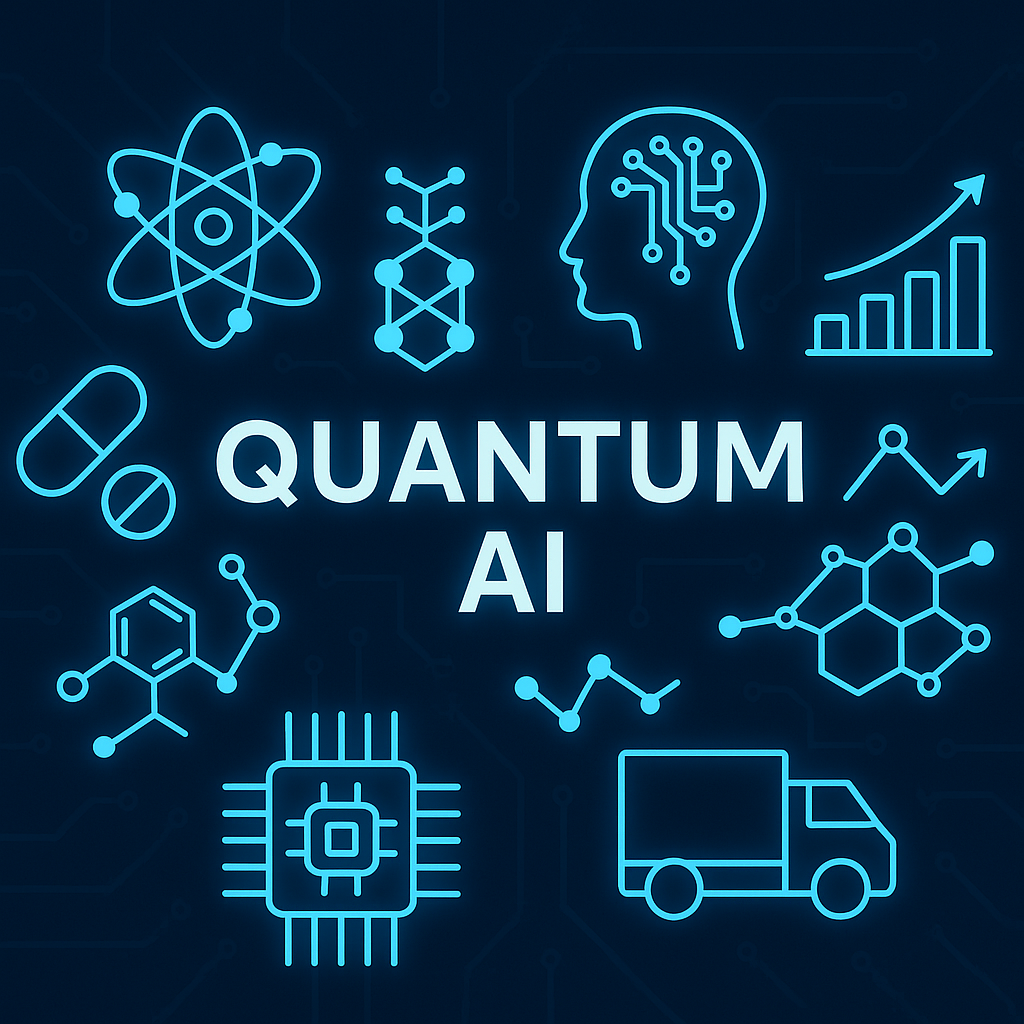
Quantum AI—a powerful convergence of quantum computing and artificial intelligence—is rapidly transforming what’s possible across several key industries. From accelerating the discovery of life-saving drugs to optimizing multi-billion-dollar financial portfolios, the integration of quantum mechanics with machine learning is poised to unlock efficiencies and innovations previously considered out of reach.
While still an emerging field, Quantum AI is already proving its worth in real-world scenarios. This article explores its current and potential applications across pharmaceuticals, finance, logistics, and materials science—providing a glimpse into how the future is unfolding today.
If you’re curious about the full scope of Quantum AI and its industry-changing potential, you can explore one of Europe’s most advanced platforms in space.
What Is Quantum AI?
It is useful to know the differences between Quantum AI and traditional kinds of AI or computers before looking at applications.
Using quantum mechanics, such as superposition and entanglement, quantum computing processes huge amounts of data at the same time. Artificial intelligence is different in that it learns from information to help make accurate decisions or predictions.
With Quantum AI, machine learning models are allowed to work in extremely high-dimensional areas using exponential resources. When traditional methods are not enough because of the problems’ complexity, machine learning can often help find solutions much faster.
Revolutionizing Drug Discovery and Molecular Modeling
Faster Simulations for Molecular Interactions
Developing a new drug usually takes more than ten years and involves a huge amount of money. Simulating the interactions among molecules is one of the biggest problems in modeling drugs. Using quantum AI, scientists can reduce the time needed for modeling molecules because it is easier for them to do this at the quantum level than classical computers.
Case Study: Roche and Cambridge Quantum
Roche is working with Cambridge Quantum (as part of Quantinuum) aiming to improve predictions about how molecules can interact. It seems that using Quantum AI in drug screening can result in discovering more good drugs while needing fewer resources and taking less time.
Understanding the Folding of Proteins and Related to Diseases
Exploring protein folding is necessary to help deal with problems like Alzheimer’s and Parkinson’s. DeepMind’s innovative use of AI solved many problems, but when paired with quantum computing, the ground can be broken even further. Advancements in quantum-assisted neural networks might allow researchers to learn about more complicated folding and reveal more about biology.
Quantum AI in Financial Modeling and Risk Management
Portfolio Optimization
While managing a huge number of assets, financial institutions carefully evaluate how risky and profitable each one is. Traditional algorithms reach their limit when they try to determine the best way to assign students because there are too many possibilities to consider. On the other hand, Quantum AI can look into all these possibilities at the same time.
Trading scenario using the theoretical approach of Quantum Monte Carlo
Just imagine that a hedge fund is able to use a quantum-powered Monte Carlo simulation to analyze many trading situations swiftly. When the results go into a machine learning model, traders can get strategies that come with fewer risks and achieve better results.
Fraud Detection
Currently, AI is used to find fraud signs, but Quantum AI is promoted as being able to find even more indications since it analyzes more simultaneous correlations.
JPMorgan is using Quantum Algorithms in its research.
JPMorgan Chase together with IBM are investigating quantum algorithms to boost their fraud prevention. Using this method, they try to detect financial transactions showing unusual features that conventional systems might miss.
Logistics and Supply Chain Optimization
Route and Inventory Planning
In logistics, route optimization and inventory forecasting are complex problems with many variables—from weather to warehouse capacity. Classical AI can help, but it often relies on approximations. Quantum AI can analyze all feasible combinations and outcomes simultaneously, leading to more accurate and responsive logistics networks.

Case Study: DHL and Quantum Routing
DHL has begun pilot projects using quantum-inspired optimization algorithms for routing deliveries. With Quantum AI, these algorithms can learn from dynamic variables (like traffic and delivery windows) to provide the most efficient route configurations in real time.
Warehouse Automation
Quantum-enhanced reinforcement learning models can manage autonomous robots more effectively by evaluating numerous potential actions in parallel. This can significantly increase the efficiency of warehouse operations, especially during peak seasons.
Accelerating Materials Science and Engineering
Discovering New Materials
Quantum AI plays a pivotal role in discovering and designing new materials with specific properties, such as superconductors or ultra-light alloys. It enables scientists to simulate and analyze atomic interactions at a depth that classical methods cannot reach.
Case Study: Volkswagen and Quantum Chemistry
Volkswagen has partnered with D-Wave to use Quantum AI in simulating chemical reactions for battery materials. Their goal is to develop electric vehicle batteries that are more efficient and longer-lasting, reducing production costs and improving sustainability.
Enhancing Manufacturing Processes
Quantum AI can be used to fine-tune manufacturing variables—like temperature, pressure, and composition—by running simulations that account for billions of possibilities. This results in more efficient, less wasteful, and higher-yield production lines.
Theoretical Breakthroughs and Future Scenarios
Personalized Medicine
Imagine a future where Quantum AI tailors treatment plans based on your DNA, lifestyle, and real-time health metrics. Such systems would simulate outcomes of various treatments at the molecular level, helping doctors make more accurate, personalized decisions in seconds.
Global Climate Modeling
Current climate models are computationally intensive and struggle with long-term accuracy. Quantum AI could process multivariable models far more quickly and accurately, helping policymakers anticipate and mitigate the effects of climate change more effectively.
Challenges and Considerations
While the potential is immense, the real-world deployment of Quantum AI still faces several hurdles:
- Hardware Limitations: Quantum computers are still in early development, with limited qubit coherence and error correction capabilities.
- Talent Gap: There’s a shortage of professionals skilled in both quantum computing and AI.
- Cost: Quantum hardware and cloud-based solutions are currently expensive and primarily accessible to large organizations or academic institutions.
- Regulation: With new capabilities come new ethical and regulatory questions, particularly in finance and health sectors.
The Road Ahead: Collaborations and Platforms
Multiple stakeholders—including governments, tech giants, and startups—are investing heavily in Quantum AI. Initiatives like IBM Quantum Network, Microsoft Azure Quantum, and startups such as Rigetti and IonQ are pushing the frontier.
Open-source platforms and international collaboration are also playing a key role in democratizing access. This growing ecosystem is likely to accelerate breakthroughs and real-world deployment.
Conclusion: A Quantum Leap into Practical Intelligence
Quantum AI is not just a futuristic concept; it’s a fast-emerging tool with real, measurable impact across critical industries. From enabling faster drug development to making supply chains more resilient, its potential is only beginning to be tapped.
As hardware improves and AI algorithms adapt to this new computational landscape, we can expect even more dramatic transformations in the coming decade. Businesses, researchers, and governments should start exploring how to integrate these tools today to stay ahead of the curve.
To dive deeper into the possibilities and platforms enabling this evolution, visit Quantum AI and explore how your industry could benefit from this powerful convergence of technologies.
Want to future-proof your organization? Begin by understanding Quantum AI’s fundamentals and identifying potential pilot projects that can provide measurable ROI. The quantum revolution is no longer theoretical—it’s happening now.