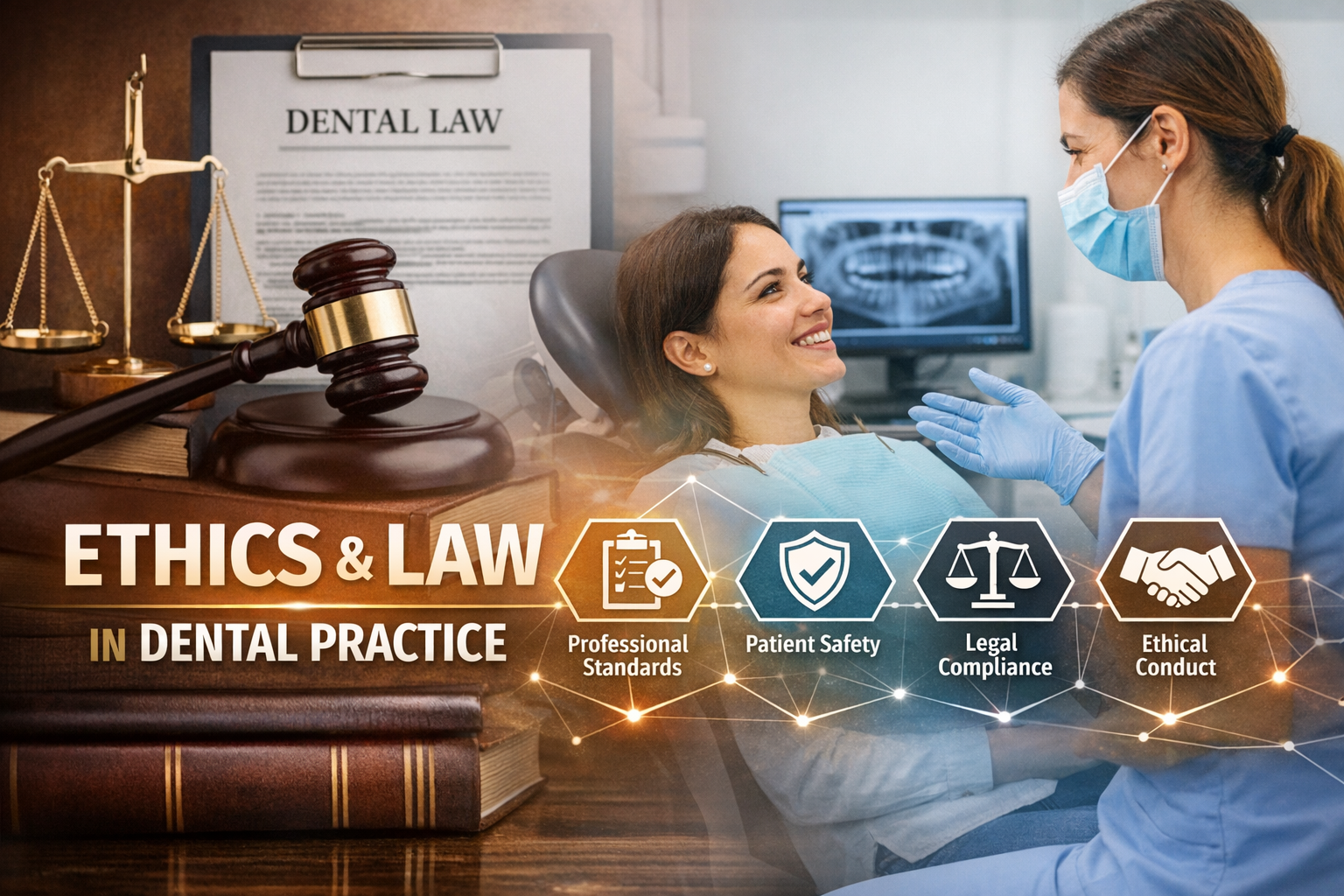
Dentistry is not only a technical field of healthcare, but also a moral, social, and legal profession, to patients and the community at large. At the corner of ethics, professionalism, and law each dental professional is – an intersection that describes trust, accountability, and quality of care. Dentistry and jurisprudence guarantees that professional decision making is not driven by proficiency or convenience, but by morality and law. Collectively, these factors cushion patients against injuries, guard practices of practitioners against mischief, and affirm the confidence of the population on oral health systems.
This paper will discuss the interplay between moral values, legal policies and professional ethics that regulate dental practice in forming responsible dental care. Having this insight, dentists will be in a position to navigate the hardships of situations as they come, meet the requirements of the regulatory environment, and make a positive impact in community life.
Professionalism in Dentistry
Professionalism in the field of dentistry is a set of values, actions, and duties that characterize the profession and make it a reliable healthcare service. It goes further than clinical competence and encompasses honesty, respect, accountability and commitment in the welfare of the patients.
Essentials of Dental Professionalism
In the field of dentistry, the concept of professionalism has a basis of a number of attributes:
- Competence and lifelong learning: Dentists are supposed to ensure the current clinical knowledge and skills by undertaking a continuous process of professional development.
- Integrity and honesty: Ethical practice should be honest and should be communicated truthfully, should be billed openly and should not be misleading.
- Respect of patients: This involves respect of autonomy, cultural diversity, privacy and informed decision-making.
- Responsibility and accountability: Dentists should be willing to accept responsibility for their actions and results, even in case of mistakes or negative events.
These are qualities that constitute the moral personality of the dental practice and which shape practitioners in the daily clinical engagements.
Dental Practice Ethics – Moral Foundationalism
Dental ethics offers professional decision-making morality. The ethical principles assist practitioners in making decisions regarding the ethical dilemma that arises when there is a conflict between clinical interests, financial interests, and personal interests.
Important Ethical Ideals in Dentistry
Majority of the ethical codes in dentistry are based on four popular doctrines:
- Autonomy: Shows respect to a patient’s right to make an informed choice concerning their care.
- Beneficence: Doing what is in the interest of the patient.
- Non-maleficence: To do no injury or to reduce harm whenever a possibility.
- Justice: Promoting equal access to care, equity and non-discrimination.
These principles affect the choice involving treatment planning, consent, confidentiality, and professional boundaries. Through ethical practice, patient welfare is kept as the main focus of dental care.
Jurisprudence in Dentistry
Jurisprudence is defined as a collection of laws, regulations and legal precepts that control the behaviour of the professions. In dentistry, jurisprudence determines the legal scope that the practice of ethics should take place.
Obligations of Dental Professionals
Dental practitioners are exposed to various levels of legal responsibility which include:
- Laws of licensing and registration: Dentists should be legally licensed and registered by the corresponding regulatory authorities to be able to practice.
- Scope of practice legislations: Laws stipulate what a dentist or other member of the team of a dentist can do.
- Health and safety laws: There is a mandatory compliance with the infection control, radiation safety, and workplace laws.
- Laws on data protection and confidentiality: The records of patients should be processed in compliance with privacy and data protection regulations.
The breach of these legal requirements may lead to disciplinary measures, civil liability or to a criminal penalty.
Ethical Standards to Guide Dental Practices
Professional standards fill the gap between ethics and law, to convert values of ethics into enforceable standards of behaviour. In order to control conduct, to dictate acceptable conduct, and to safeguard the populace, regulatory authorities provide norms that direct practice.
Moreover, under the first half of this discussion it is necessary to mention the importance of internationally recognized standards like the professional standards governing dental practice, which present clear responsibilities in regard to patient care, communication, professionalism, and team work. These standards are practical tools that would be used to harmonize the ethical ideals and legal compliance.
Purpose of Professional Standards
Professional standards will seek to:
- Defend patients against unsafe or unethical treatment.
- Advance uniformity and excellence within dental services.
- Give clear directions on how to handle the ethical and legal dilemma.
- Knowing and punitive procedures.
Through these standards, the practitioners in dentistry are able to show their adherence to ethical excellence, as well as legal accountability.
Enlightened Consent and Legal Responsibility
Informed consent is one of the most important fields in ethics and law of dentist practice. Patients are entitled to informed consent to treatment ethically. In legal terms, the lack of valid consent may amount to negligence or battery.
Components of Informed Consent
To be valid, consent has to be:
- informed: The patient is provided with simple information regarding the diagnosis, treatment, risks, benefits, and alternatives.
- Voluntary: The choice made is not pressured or forced.
- Competent: The patient possesses the mental ability to make a decision.
The requirement of professional standards to record consent attentively boosts transparency of ethics as well as creating legal defense of dentists.
Malpractice, Professional Liability and Negligence
Professional negligence and malpractice is also covered in dental jurisprudence. Negligence is a situation where the dentist violates a duty of care, which leads to injury to patients.
Major Elements of Dental Malpractices
In order to prove negligence, there are generally four elements taken into consideration:
- Duty of care: There was a professional relationship.
- Breach of duty: The level of care has not been observed.
- Causation: The violation resulted in damage.
- Damages: This patient had a quantifiable loss or injury.
Ethical practice helps mitigate the chances of negligence through the promotion of mindful decision-making, free communication, and respect to patient safety.
Information Security and Privacy
The ethical aspect of confidentiality is a legal issue as well. Patients entrust dental workers with personal and medical information that is sensitive and this trust should be guarded.
Ethical and Legal Aspects of Confidentiality
Patient autonomy and dignity are observed by ethical confidentiality. On a legal level, the laws to do with data protection govern the gathering, storing and dissemination of information concerning patients. Violation of confidentiality may lead to legal punishment and professional discredit.
Dental workers are expected to maintain secure records keeping systems, restrict access to authorized employees and they should disclose information when it is legally or ethically warranted.
Professional Conduct and Disciplinary Processes
Professional standards are controlled by regulatory bodies that regulate professional behaviour by disciplinary means. These procedures are not aimed at punishing but safeguarding the masses and ensuring that the profession is not a sham.
Reasons for Disciplinary Action
Typical grounds of disciplinary action comprise:
- Misconduct or unethical conduct by a professional.
- Operating in areas where one is not competent.
- Violation of patient confidentiality.
- Unethical or corrupt behaviors.
The knowledge of jurisprudence gives dental practitioners an opportunity to value the outcomes of unethical or illegal acts and promotes active adherence.
Role of Accountability in Dentistry
The cohesive factor between ethics, law and professionalism is accountability. The dentists will be responsible to patients, governing bodies, employers and the society.
Forms of Accountability
- Professional accountability: Adherence to codes of ethics and professional values.
- Accountability to law: Legal conformity and action on law.
- Social accountability: Donations to the health of the population, the availability of care, and trust in the community.
Responsibility promotes reflective practice, which makes dentists learn not to repeat the same mistakes and work on the quality of care.
Using Ethics, Law and Professionalism in Everyday Practice
Ethics, law and standards are not issues, but uniting the three together in practice is the greatest challenge that dental professionals face. Ethical sensitivity can be used to highlight the possible dilemmas, there is legal knowledge to establish limits, and some professional standards could give practical advice.
Strategies for Integration
- Routine instruction on ethics and dental jurisprudence.
- Knowledge of contemporary professional standards and rules.
- Free interaction with patients and colleagues.
- Ethical decision and reflective practice models.
This kind of integration fosters legal, safe, and patient-centered care.
Conclusion
Ethical practice consists of two inseparable pillars namely, professionalism and jurisprudence in the field of dentistry. Ethics offers a guide to morality, law sets up enforceable limits and professional standards translate both into day to day expectations. Together, they safeguard patients, help practitioners to make responsible decisions and increase trust of the population in dentistry.
Dental professionals can work in the contemporary healthcare environment with integrity and responsibility by knowing and adopting professional standards that govern dental practice. Legal compliance and ethical behavior are not opposing principles; they are complementary to each other and can help to maintain accountability, professionalism and excellence in dental care.