Programming is commonly considered a highly complicated technical art that entails learning such languages as Python, Java, or C++. Although syntax is a very significant part of the code, it is not the beginning of successful programming. As a matter of fact, writing programs starts with good problem solving skills and not just writing code. Any given programmer before writing a single line of code, has to initially de-compose a problem, examine it and develop a solution. It is the ability to arm problems in a logical and systematic manner, which is what is actually behind the success of any kind of programming activity.
In this article, we shall take you through the thought process of going through the problem, decomposing it into smaller parts, determining limitations and developing rational steps then coding. This article focuses on highlighting structured thinking, which can be done to demonstrate that programming is actually problem-solving, and the ability to analyze the problem efficiently will result in more efficient, accurate and maintainable code.
Mental Process of a Problem-Solving in Programming
The initial process in successful programming is to first get a clear picture of the problem that you are attempting to resolve. It does not matter whether you are creating a basic calculator or a complicated web app, or a machine learning model, you must have a clear picture of what should be done. As an example, we shall follow through the problem-solving process in programming.
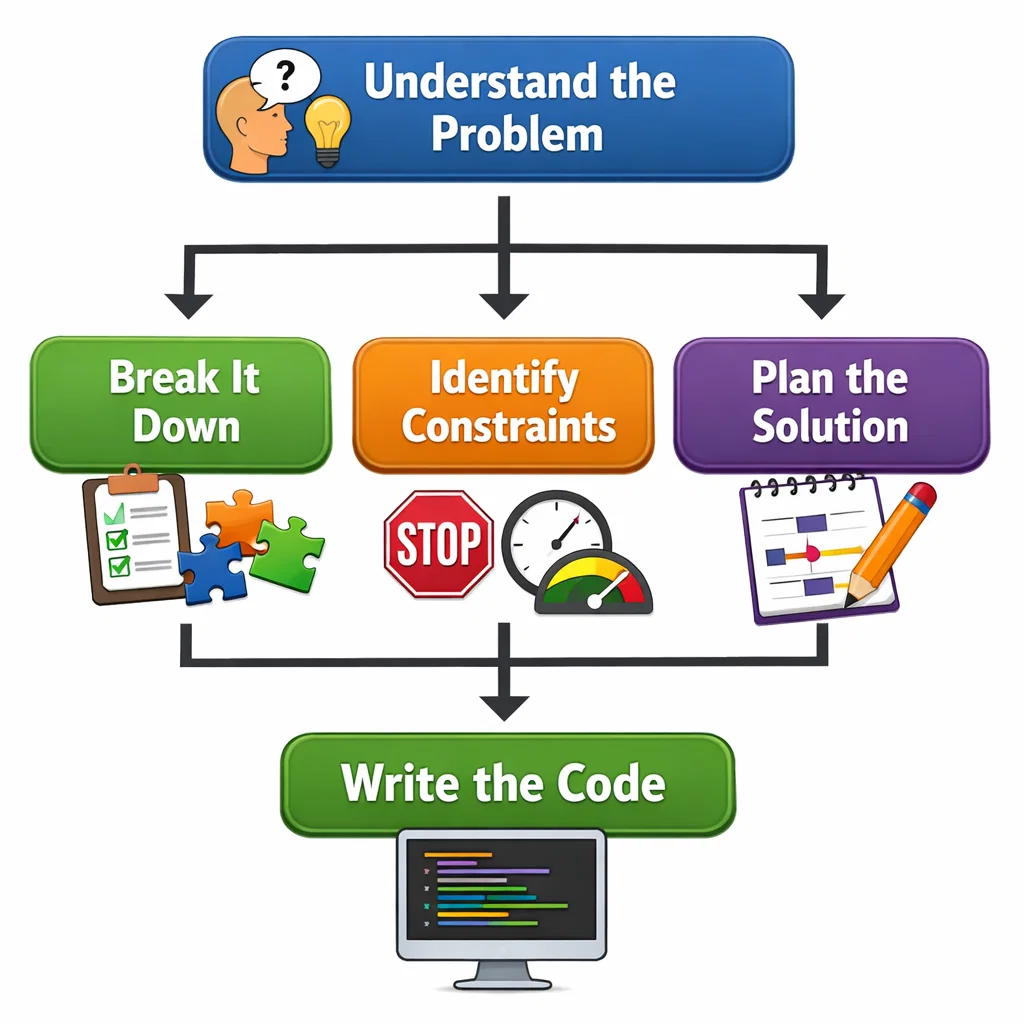
Step 1: Knowledge of the Problem
You need to compose any code with the understanding of the problem statement. Read it several times and find the important points:
- So what is it that needs to be resolved?
- What are the inputs and outputs?
- Are constraints (e.g. time, memory or performance) involved?
An example would be, say you are asked to write up a program that calculates the total of the integers between one and N you need to have a clear idea of what is being requested of you: You are requested to write a program that will compute the total of all the integers in a given range, where N is a positive integer.
This knowledge is essential since problem definition assists in avoiding the squandered effort in the future.
Step 2: Dissection of the Problem into Smaller Parts
After the realization of the problem, the second thing is to break down the problem into smaller and easily manageable tasks. This is a popular technique of solving problems, which is known as divide and conquer.
As an illustration, when you are to add up the sum of the integers, 1 up to N, you are able to split it up into:
- Input Check: N should be a positive integer.
- Sum Calculation: Devise a way of computing the sum of integers between 1 and N.
- Output: Print or return the result.
The separation of the problem into smaller components will facilitate easier designing, implementing, and testing of each component aids in this separation. This simplifies the process and eases the process of debugging significantly.
Step 3: Constraint and Edge Case determination
Determining any limitations or limit cases in the problem is also an important step in the process. An example is that does the program require very large numbers, or does the program have a performance limit on the time it can take to tackle the problem?
- Time Complexity: When the problem has bulk data that requires large data sets, then you might be required to seek an effective algorithm that will not take too much time.
- Space Complexity: Does it have restrictions on memory? In that case, you should take into consideration data storage and manipulation by the program.
By pointing out these constraints, you will be able to create a more efficient solution in the first place, and minimize the probability of inefficiencies or mistakes in the future.
Step 4: Planning Logical Steps and then writing Code
The answer to this is now that you have analyzed the problem, you broke it into smaller bits and therefore the next step that is urgent is to come up with the solution, before you start coding. This is by developing a high level plan which is a map of the logical steps that will be taken by your program.
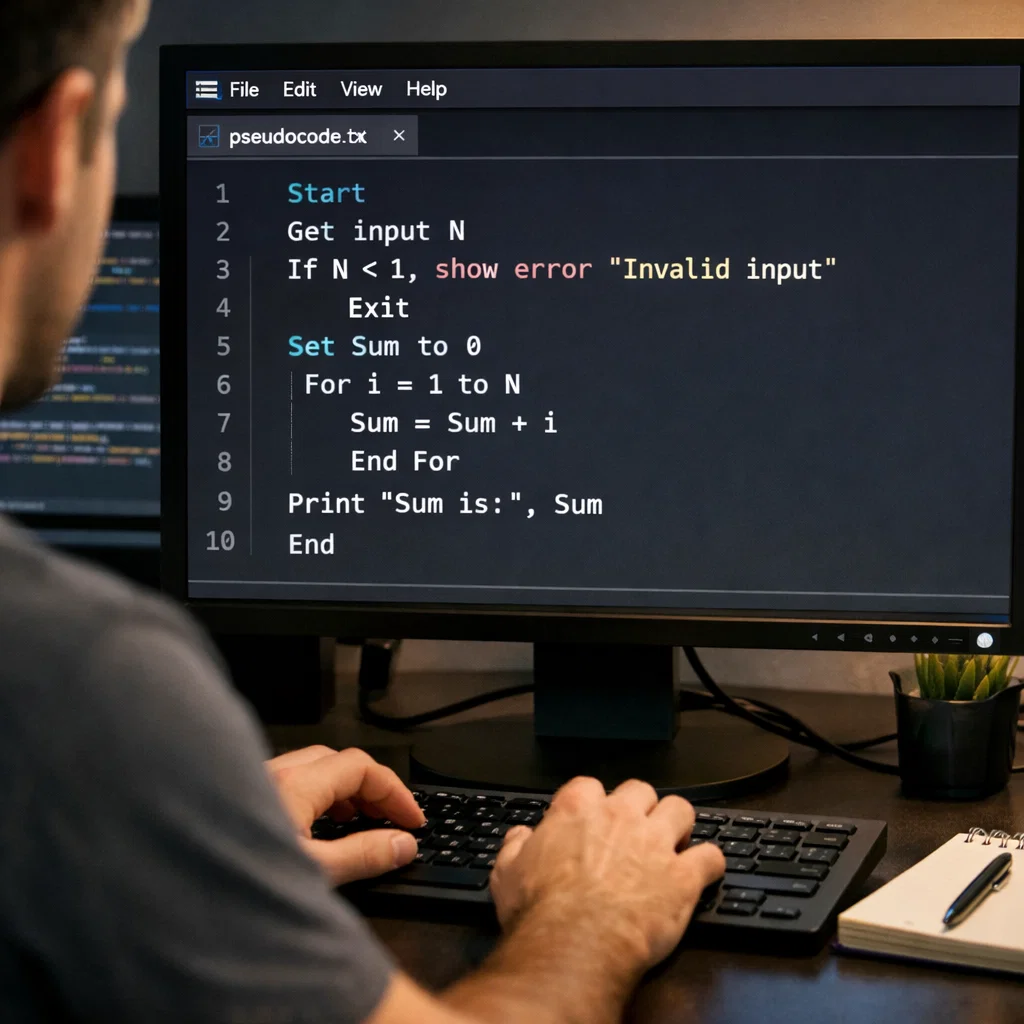
The easiest and most effective approach to designing the solution is by writing the code in pseudocode, that is, a written description of the actions your program will perform in a plain language. Pseudocode also lets you concentrate on your solution.
The pseudocode could be as follows, e.g. in the case of the sum calculation program:
Start
Get the input value N
In case N is less than one, show an error.
Initialize sum = 0
Add the number to sum, addition-wise, to every number between one and N.
Display the value of sum
End
By means of this pseudocode it is possible to have a clear blueprint of what the program is to do, which makes it easier to translate into actual code later. At this stage, you are creating a logical plan before you write code making sure your program is designed and well-planned.
Step 5: Refining the Plan
After having the draft of your pseudocode, you can continue to refine it. An example would be to ask yourself whether you can find more effective methods of calculating the sum (e.g. a mathematical formula of the sum of the first N numbers). This will enable you to optimize the solution before implementation to be sure you are developing a high quality program.
It is at this stage that most beginners fail to put several considerations to the problem solving. It is possible to jump to the code and refine the plan later, resulting in inefficient, buggy, and hard to maintain code. These risks are reduced by simply planning your solution ahead of time.
The Significance of Problem-Solving Skills in Programming
Although learning the syntax of a programming language is very crucial, it is your skill to handle problems that will make you a great programmer. We shall discuss the reason as to why problem-solving is essential in programming.
Improved Code Efficiency
Writing efficient code is more likely when you fully comprehend the problem and design a logical solution to it prior to writing the code. You do not have to write a quick-and-dirty solution that can work at least short term but will crash with the pressure; you can write the best solution right away.
An example of this is that it is better to have a mathematical formula (e.g. sum = N (N+1)/2) to add accelerated numbers instead of adding them one by one.
Fewer Bugs and Errors
With first planning of the solution, there is a better chance of early detection of errors. Some logical errors, like the failing to address edge cases, or misunderstanding the constraints of the problem, are easier to identify at the design stage.
Also, a clear plan will aid in keeping your plan straight and this makes the process of debugging easier when everything goes wrong.
Scalable and Maintainable Code
Maintaining and scaling up code is simpler with well-designed code. The de-structuring of the problem and the concentration on a rational format will make your code modular, simple to read, and flexible to future updates or extensions.
A well-planned and designed program will also have a higher shelf life and will also be easier to comprehend, edit and enhance by other developers.
Advice on How to Be a Better Problem Solver in Programming
The following are some practical suggestions that may be used to enhance your problem-solving skills:
- Exercise: As often as you can get into the habit of solving problems, the more you will become a good problem solver. Practice on coding puzzles at sites such as Leetcode, Codewars, or HackerRank.
- Divide Problems into Smaller Parts: One should always divide a complex problem into smaller and easier parts. This will aid in breaking one bit of the whole problem and it will be easy to design and execute the solution.
- Flowcharts and Diagrams: Sometimes, the visualization of the problem can help you to see better how the components relate to each other. Complex logic can be simplified using flowcharts and diagrams among other visual tools.
- Learn by Observation: Learn how other programmers solve problems. Learn their code and their way of thinking, in order to enhance yours.
Conclusion
Conclusively, good programming is not simply knowing syntax, it is creating good problem solving skills. Problem analysis, decomposition into smaller tasks, recognition of constraints and the logical structuring of steps to be undertaken before codes are written is very important in the development of efficient, maintainable and error free codes. With the ability to figure out these methods of solving problems, amateurs can gain a solid base of becoming great programmers and solving problems more efficiently.
Always keep in mind that good programming is based on the creation of logical steps prior to writing code.