Introduction
Preparation of Final Accounts is a very important element of what accountants do that which brings out in the open, which allows for open books, responsibility, and also the base for which better decisions may be made. Within the context of a one person business, a volunteer group or a non profit, a public company a large or small charity, what is put forth is that which has a solid foundation in the principles of account, in the how we present our records, and also what each of these different groups’ aim to achieve with which we can work.
This article is a complete resource which puts together guides on preparation of final accounts of many types of organizations. We go into detail about main financial reports and also point out the variations in accounting practices which in turn equip the reader to do accounts preparation in any setting with confidence.
Also in that regard we see that preparation of final accounts which is to detect errors, to prevent fraud, and to see that all financial activities are recorded as they should be. Also it is a way to put forth financial info in a standard way to owners, members, donors, and regulators. This article is a detailed guide to the preparation of final accounts for many types of organizations.
Understanding Final Accounts
At the end of each accounting period we prepare financial reports which present in a summary form the financial performance and position. These also typically include:
- Income Statement (Trading and Profit Loss).
- Balance Sheet (Financial Standing Report).
- Supporting accounts like Receipts and Payments or Income and Expenditure accounts.
These structures and purposes of the reports vary by profit or non profit entity.
Main Points in the Preparation of Financial Statements
Before we get into the specific entity types, we should go over the basic principles of financial statement preparation:
- Accrual Concept: At the time of earning or incurrence income and expenses are recorded.
- Consistency Principle: Accounting methods should be the same over time.
- Prudence Concept: Prudence in reporting which means do not overstate income or assets.
- Going Concern: We assume the company will remain in operation.
These principles are the framework for which transactions are reported in all organizations.
Final Accounts for Sole Traders
Overview
A sole trader is an individual that runs a business. The main goal is profit which in turn guides the financial reports.
Components of Final Accounts
1. Trade Account
This account reports out gross profit or loss.
Format:
- Sales
- Less: Cost of Goods Sold (Opening Inventory Purchases Direct Expenses Closing Inventory).
Gross Profit=Sales-Cost of Goods Sold
2. Profit and Loss Account
This is what determines the net profit or loss which in turn includes indirect expenses.
Includes:
- Administrative expenses (rent, salaries)
- Selling and distribution expenses
- Other incomes (discount received, commission)
Net Profit=Gross Profit + Income – Expenses
3. Balance Sheet
This is the business financial picture.
Framework:
- Assets: Non-current (equipment, furniture), Current (cash, inventory).
- Liabilities: Accounts payable, loans.
- Capital: Adjusted for net income and withdrawals.
Example Adjustments
- Depreciation of assets
- Accrued expenses
- Prepaid expenses
- Bad debts and provisions
Key Characteristics
- Profit-oriented
- Uses accrual accounting
- Focus on owner’s equity
Final Accounts for Clubs
Overview
Clubs are non-commercial organizations that come together for social, recreational, or cultural reasons. They do not seek profit but rather to serve their members.
Unique Features
- Without capital; instead there is an accumulated fund.
- Income comes from subscriptions, donations, and events.
Key Financial Statements
1. Account of Receipts and Payments
Here are details of all cash transactions.
Features:
- Cash-based
- Includes everything from payments to receipts (capital and revenue).
- No distinction between accounting periods
Format:
- Receipts (subscriptions, donations, entrance fees)
- Payments (rent, utilities, equipment purchase)
2. Income Statement and Expense Account
This is an alternative to a profit and loss report for non-profits.
Features:
- Prepared on an accrual basis
- Includes only revenue items
- Determines surplus or deficit
Surplus = Income – Expenditure
3. Account of Assets and Liabilities
Shows assets, liabilities, and accumulated fund
Accumulated Value Calculation:
Opening Fund + Surplus-Deficit= Closing Balance.
Adjustments
- Outstanding subscriptions
- Subscriptions received in advance
- Depreciation
- Accrued expenses
Example Income Sources
- Membership subscriptions
- Fundraising events
- Donations
Key Characteristics
- Non-profit oriented
- Focus on accountability
- Uses some combination of cash and accrual methods.
Final Accounts for Charities
Overview
The Charities they do are to provide social benefits like education, health care, or poverty relief. In financial reporting, charities stress transparency and care in use of funds.
Sources of Income
- Donations and grants
- Legacies
- Fundraising activities
Financial Statements
1. Account of Receipts and Payments
Like businesses clubs issue this financial report.
Includes:
- All cash inflows and outflows
- Capital and revenue items
2. Income Statement and Expenses Report
This reflects operational performance.
Includes:
- Revenue from donations for general use.
- Expenses related to charitable activities
Excludes:
- Capital receipts (e.g., building donations)
3. Balance Sheet Report
Presents:
- Assets (cash, property, investments)
- Liabilities
- Accumulated fund or reserves
Special Considerations
Restricted vs. Unrestricted Funds
- Restricted Funds: For certain uses only.
- Unrestricted Funds: May be used at the organization’s discretion.
Capital vs. Revenue Items
- Capital assets (e.g. building donations) are reported on the balance sheet.
- Revenue items are reported in the income and expense account.
Key Characteristics
- High level of accountability
- Emphasis on donor transparency
- Detailed reporting requirements
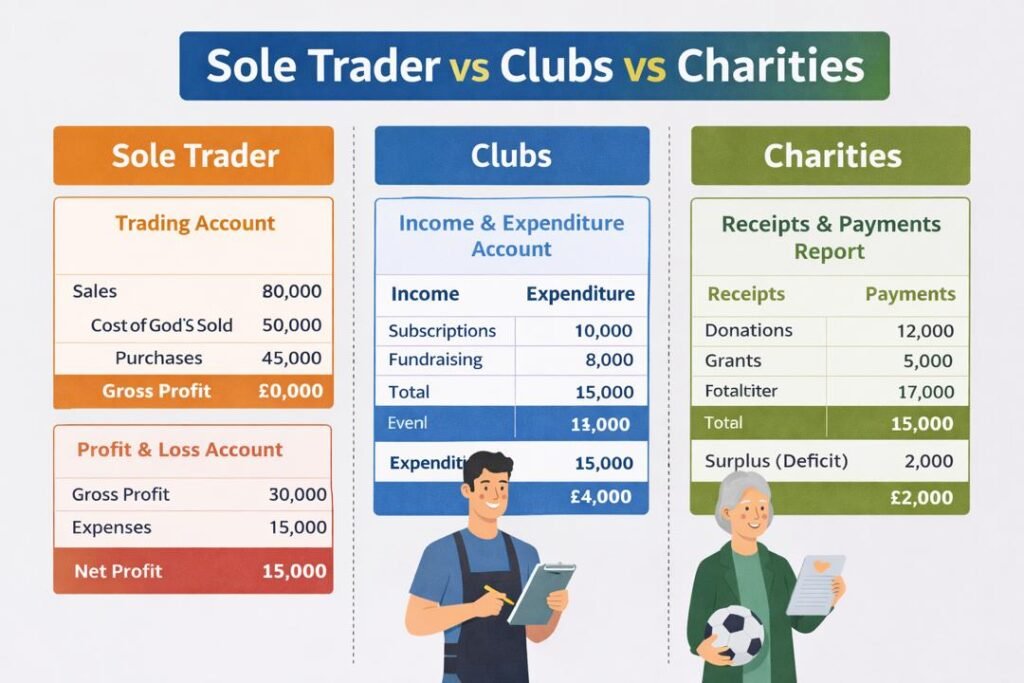
Differences between Sole Traders, Clubs and Charities
Goal
- Sole Traders: Earnings based.
- Clubs: Member support.
- Charities: Public welfare.
Annual Reports
- Sole Traders: Trading, Income Expenses, Balance Sheet.
- Clubs: Accounts Receivable and Payable, Income and Expenditure, Balance Sheet.
- Charities: Like clubs which also include fund accounting.
Tax Revenue Collection
- Sole Traders: Revenue from sales.
- Clubs: Subscription and events income.
- Charities: Grants and donations.
Structure of capital
- Sole Traders: Owner’s equity.
- Clubs/Charities: Built up fund.
Accounting Framework
- Sole Traders: Cash equivalent basis.
- Clubs/Charities: Cash and accrued.
Step-by-Step Guide to Preparing Final Accounts
Step 1: Collect Financial Information.
- Source documents (receipts, invoices)
- Ledger accounts
- Trial balance
Step 2: Adjustments to General Ledger.
Make required changes for:
- Accruals and prepayments
- Depreciation
- Bad debts
Step 3: Prepare Affiliated Accounts.
- Sole traders: Trading and results of operations.
- Clubs/charities: Reports and transactions accounts, income and outgoings accounts.
Step 4: Prepare Financial Statements (Balance Sheet).
Classify assets and liabilities appropriately.
Step 5: Review and Check.
- Ensure accuracy
- Check balancing figures
- Confirm compliance with accounting principles
Practical Tips for Accuracy
- Proper Record: Keeping Consistent bookkeeping which in turn reduces errors.
- Use of accounting software: This does the math for you.
- Separate out Capital and Revenue Items: Also do not put them in the wrong category.
- Regularly Reconcile Accounts: For consistency.
- Grasp organizational goals which in turn will inform the tailored reports.
Common Errors to Avoid
- Mixing up cash and accrual methods improperly.
- Ignoring adjustments
- Misclassifying income or expenses
- Omitting liabilities
- Incorrect valuation of assets
Conclusion
Sole traders, clubs and charities report very different final accounts which we put down to their different goals, income sources, and reporting requirements. Also sole traders are into profitability which isn’t the case for clubs and charities which instead report on what they do for the community.
Through the study of the structure and purpose of each type of financial report, which may be a trading account, income and expenditure account, or receipts and payments account, accountants and learners are able to put together precise and relevant reports.
In terms of preparation of financial reports we have found that which not only increases compliance, but also improves financial decision making and organizational transparency. Through practice and attention to detail we also see that any individual may develop the skills required to handle financial reporting in a variety of entities.
In addition to meeting the basic reporting requirements, with the preparation of financial statements one also attains the skill to analyze financial data, part of which is to support in decision making and at the same time to see to it that the organization complies with the set accounting rules. Also we see that it improves financial discipline and which in turn allows organizations to better allocate resources and plan for long term sustainability. In fact what we see is that accuracy in preparation of final accounts comes from consistency, attention to detail, and a clear understanding of the type of each transaction. At the same time whether it is a small business or a non-profit organization we see these skills as essential for financial integrity.
In the end what we put into practice and study of final accounts is not a theoretical exercise but a very much a valuable element of the real world which improves transparency, builds trust and in turn supports the full success of any organization.
Get more well researched information about the Preparation of Final Accounts here.