Introduction
It is easy to become confused when handling money and particularly when you are starting. With daily needs, unplanned costs, and long-term financial objectives, it is an easy task to lose track of the spending of your money. Budgeting comes in there. The first step to control your finances and create a stable, stress-free financial life is to understand the personal budgeting basics process.
Budgeting is not about limiting oneself or taking pleasure away but it is making decisions about your money. When it is done right, it provides you with clarity, confidence and control.
This article will give you the programs on the fundamentals of budgeting on how to keep track of your income, how to divide the expenses, and how to make a realistic financial plan. You will also discuss trendy budgeting techniques such as the 50/30/20 rule, zero-based budgeting, and the application of digital budgeting software.
What Is Budgeting?
Budgeting is a process which essentially involves a plan on how you are going to spend and save your money. It makes sure that your income is spent well to meet your needs, sustain your wants and save towards the future.
A budget helps you:
- Understand your financial position.
- Avoid overspending
- Store up in case of emergency and targets.
- Reduce financial stress
- Build long-term wealth
Budgeting gives answers to the question that you may have always posed yourself on where your money goes at the end of the month.
The Importance of the Fundamentals of Budgeting
It is worth knowing the personal budgeting basics and their significance before delving into the methods and tools.
These fundamentals include:
- Knowing your salary.
- Keeping a budget.
- Categorizing your expenses
- Establishing achievable financial objectives.
- Modifying your plan when required.
Within the framework of the most sophisticated budgeting techniques, these basics will not work. Take them as the base of your financial house, everything rests on them.
Step 1: Monitor Your Revenue.
The initial process of developing a budget is to know precisely the amount of money you are bringing into the picture.
Sources of Income
Your revenues can be based on:
- Salary or wages
- Freelance or side work.
- Business profits
- Allowances or stipends
- Investment returns
Net vs. Gross Income
It is important to always look at your net income which is the amount you get after tax deductions. This is the money that is actually at your disposal.
The Importance of Tracking Income
When you do not know how much you earn then you cannot plan how much you can spend and save. Everything is predetermined by the correct income tracking.
Step 2: Monitor Your Expenses.
Then you must know what is going on with your money. This is a very eye-opening step since most of the people do not estimate their expenditure.
How to Track Expenses
To keep track of your expenses you can:
- Getting them written down every day.
- Using a spreadsheet
- Reviewing bank statements
- Using budgeting apps
At least one month, monitor your expenses to have a clear picture.
Common Expense Categories
- Housing (rent, utilities)
- Food (groceries, dining out)
- Transportation
- Entertainment
- Healthcare
- Debt payments
- Savings
Variable vs. Fixed Expenses
- Fixed costs: Remain unchanged every month (rent, subscriptions)
- Variable expenses: Vary on a regular basis (food, entertainment)
Knowing this difference will enable you to find the places where you can reduce.
Step 3: Classify Your Expenditure.
After you have kept a record of your expenses, classify them into categories. This assists you to create patterns and establish problem areas.
For example:
- You may cut on spending too much on going to restaurants.
- In case you have high transport expenses, you can consider other options.
Categorization converts raw data into actionable data.
Step 4: Establish Financial Objectives.
Budgeting is not only about spending, but it is an accomplishment of your objectives.
Types of Financial Goal
- Short-term: Saving to a phone, rent or travel.
- Medium-term: Purchase of an automobile or debt repayment.
- Long-term: Home ownership or retirement.
SMART Goals
Make your goals:
- Specific
- Measurable
- Achievable
- Relevant
- Time-bound
Examples: Save 200000 in 6 months is preferable to save money.
Step 5: Select a Method of budgeting.
Budgeting does not have a one-size-fits-all methodology. Various techniques suit different individuals. Three of the popular ones are listed here:
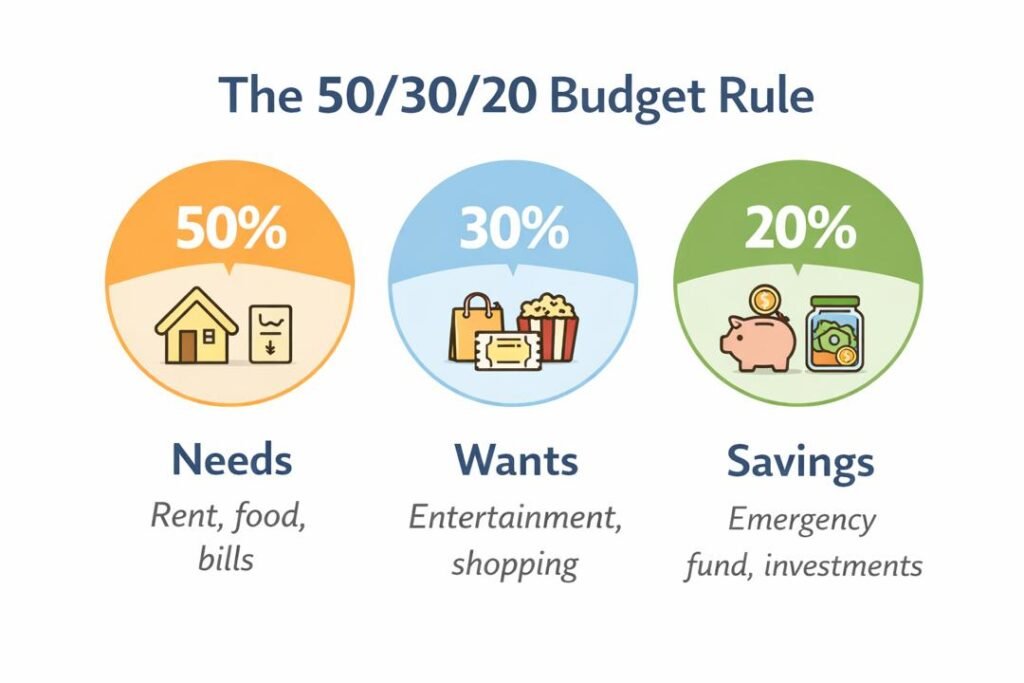
The 50/30/20 Rule
This is among the easiest ways of budgeting particularly to a new person.
How It Works
Separate your income into three groups:
- 50% Needs: Rent, food, bills.
- 30% Wants: Entertainment, shopping
- 20% Savings/Debt: Emergency fund, investments.
Benefits
- Easy to follow
- Flexible
- Helps to equal expenditure with saving.
Example
If you earn ₦100,000:
- ₦50,000 for needs
- ₦30,000 for wants
- ₦20,000 for savings
This is a perfect technique when you would like to have a single form without excessive details.
Zero-Based Budgeting
Zero-based budgeting is more elaborate and it involves planning each naira.
How It Works
You consider each unit of income a job till you get a balance of 0.
Income – Expenses = Zero
This does not imply that you spend all the money but everything you have including savings.
Benefits
- Total control over your cash.
- Eliminates wasteful spending
- Encourages intentional decisions
Example
If you earn ₦100,000:
- Rent: ₦30,000
- Food: ₦20,000
- Transport: ₦10,000
- Savings: ₦20,000
- Miscellaneous: ₦20,000
Total = ₦100,000
Envelope System (Add-On)
This is a traditional approach that is still effective.
How It Works
You separate money into envelopes that are used to categorize such elements as food, transportation, and entertainment.
When the cash in an envelope is exhausted you cease to spend under that category.
Benefits
- Prevents overspending
- Builds discipline
- Easy to understand
Digital Budgeting Apps
Budgeting has become simpler and efficient with the help of technology.
Characters of Budgeting Apps
- Expense tracking
- Automatic categorization
- Bill reminders
- Goal setting
- Financial insights
Benefits
- Saves time
- Reduces manual errors
- Provides real-time updates
Popular Options
The following are some of the frequently used apps:
- Mint
- YNAB (You Need A Budget)
- PocketGuard
- Goodbudget
Select an application that suits your lifestyle and budget requirements.
The Building of a Realistic Budget
A budget will only be effective when it is realistic.
Budgeting Tips to Develop a Workable Budget.
- Begin with your actual spending behavior.
- Don’t slice all at once.
- Reserve the right to fun.
- Plan against unforeseen costs.
Emergency Fund
You should always have an emergency fund in your budget. Aim 3-6 months expenses.
This helps you against financial crises in the event of loss of job or medical crisis.
Reducing Unnecessary Spending
Among the largest advantages of budgeting is the wasteful spending.
Typical Cost reductions to make
- Eating out frequently
- Impulse shopping
- Unused subscriptions
- Unreasonable use of data or utility.
Practical Tips
- Prepare more meals at home.
- Use shopping list.
- Delays major purchases by 24 hours.
- Compare prices prior to purchase.
Even minor adjustments will bring about tremendous savings in the long run.
Being on Track with Your Budget
Budget making is one thing and budget adherence is another thing.
How to Remain on Track
- Go over your budget weekly.
- Adjust when necessary
- Celebrate small wins
- Keep your mind on your objectives.
Accountability
You can:
- Share your ambitions with somebody close to you.
- Use reminder applications.
- Track progress visually
The secret to success is consistency.
Common Budgeting Pitfalls
Despite the intentions, errors might occur.
1. Being Too Restrictive: When you have a too tight budget, you will probably give up. Allow some flexibility.
2. Ignoring Irregular Expenses: Prepare on repair, gifts and emergencies.
3. Not Tracking Spending: A budget that lacks tracking is useless.
4. Surrendering Too Early: Budgeting is a process that requires time to master. Be patient.
Adjusting your Budget over Time
Your finances will be different and your budget should be of that nature.
How and When to Revise Your Budget
- Growth or decline in earnings.
- New financial goals
- Major life changes
Why Flexibility Matters
A fixed budget may become obsolete. It is relevant and effective due to regular updates.
The Long-Term Advantages of Budgeting
Not only will learning the personal budgeting basics make you successful in the present, but also in the future.
Benefits Include:
- Financial independence
- Reduced stress
- Better decision-making
- Increased savings
- Debt freedom
Budgeting of time becomes a routine and not a burden.
Conclusion
The first step to controlling the finances is to have knowledge and practice of the personal budgeting basics. Following up on your income, keeping an eye on your outlays and selecting a budgeting approach which fits your lifestyle and objectives, you are able to create an effective financial plan which will help you live in a certain way and achieve your goals.
You can use 50/30/20 rule, zero-based budgeting, or digital application; however, all that matters is consistency. Budgeting is not about excellence, but improvement.
By keeping on perfecting your strategy, you will be more confident in your financial choices, you will spend less money on what you do not really need and you will build a safer future. It is important to remember that each little step you make today will take you a step closer to financial freedom tomorrow.
Get more well researched information about personal budgeting basics here.