Introduction
In a contemporary world of the business environment which is highly dynamic and competitive, organizations are supposed to have high levels of transparency and accountability. Financial information is critical to the stakeholders, including investors, creditors, regulators, managers, and even the general population, to analyze the performance of a business. This is where Objectives of Financial Accounting plays a crucial role.
Financial accounting refers to the subdivision of accounting that deals with the record keeping, classification, summation and reporting of financial transactions of an organization in a standardized and well organized way. It is primarily meant to give useful financial information to external users who lack direct access to the internal records of the organization. Financial accounting, in contrast to management accounting, which is primarily designed to service internal purposes, aims at generating general-purpose financial statements, which can be interpreted and be trusted by a broad group of users.
The purpose of financial accounting is important as it clarifies the reason why financial reporting is present and how it can serve to enhance a decision-making process in the economy, corporate governance, and regulation. Financial accounting is more than numbers and is also about communication, trust and accountability in business.
In an attempt to delve further into this matter, this paper looks into the main objectives of financial accounting, why financial reporting guarantees transparency and accountability and the relevance of financial statements in the evaluation of profitability, liquidity and solvency.
Objectives of Financial Accounting
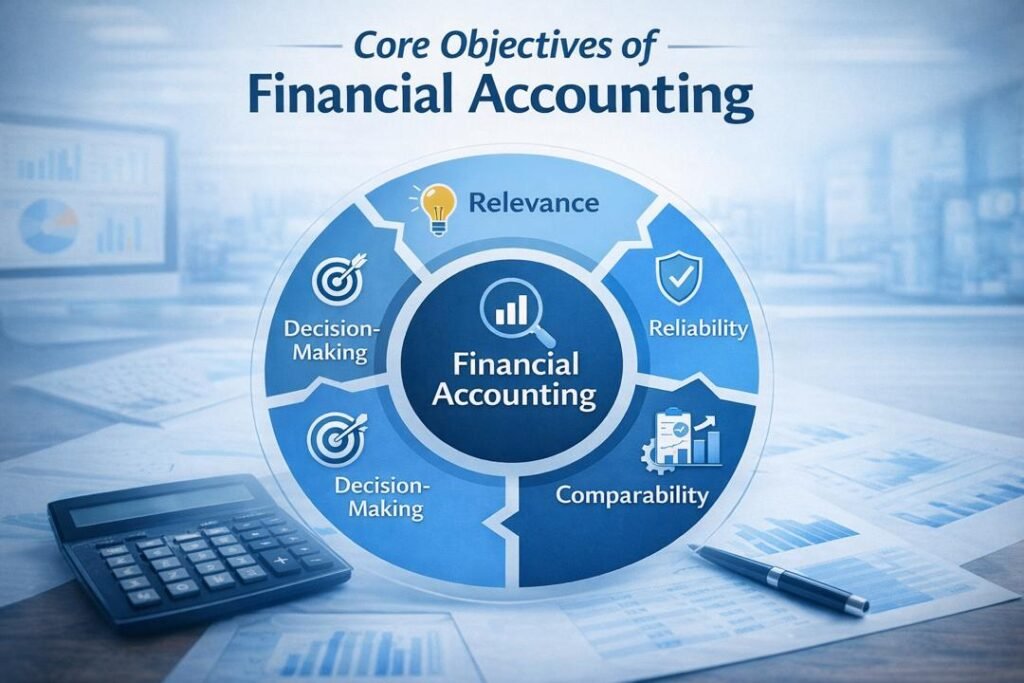
Financial accounting is primarily intended to give non-malevolent information that can be used to make decisions. Nevertheless, this general intention can be subdivided into a few objectives. These goals influence the manner in which financial information is presented, prepared and interpreted.
To Provide Sufficient Financial Information
Relevancy in financial accounting is one of the most significant goals of that accounting. Relevance refers to the fact that the information must be able to affect the choices of the users. Financial information is said to be relevant when it assists the users:
- Predict future performance.
- Affirm or assess previous judgments.
- Evaluate financial status and performance of business.
As an example, an investor can look at the amount of revenue and profit to determine whether to purchase shares in a given company and a lender can use financial ratios to determine whether or not the company can repay a loan. When the information does not influence the decisions, then it becomes useless.
Timeliness is also necessary in relevance. Financial data should be offered in time. Delayed financial statements can fail to portray the present reality of a business and hence make bad decisions.
To Secure Trustworthiness and Faithful Representation
The other most important goal of financial accounting is to make sure that the financial information is dependable and that it reflectively portrays the economic reality of the organization. Reliability implies that users should rely on information when they make use of it.
The reliable financial information ought to be:
- Free from material errors.
- Free from bias.
- Depending on evidence that can be verified.
As an example, when a firm claims to own some assets, then, they should really exist and should be appraised following accepted accounting principles. This goal is urgent as the untrustworthy information may mislead the stakeholders and lead to financial losses or prosecution.
Faithful representation also suggests that financial statements must capture the substance of transactions and not the legal form. This principle makes sure that there is no distortion in the financial reality.
To Promote Comparability
The other significant goal of financial accounting is comparability. The financial information must enable users to make comparisons:
- How the same company has performed in various periods.
- The performance of various firms within the same industry.
This is done by applying uniform rules and frameworks of accounting. Users are able to make meaningful comparisons when companies prepare their financial statements in the same way.
As an illustration, when the two companies have disparate approaches to the valuation of the inventory, the figures of profits might not be similar. The standardization promotes the consistency and improves the utility of financial information.
To guarantee Understandability
The purpose of financial accounting is to convey data in a form understandable to the users possessing an acceptable level of understanding of business and accounting. This is not the simplification of complex transactions and it is the presentation and the organization of information in an understandable way.
The financial statements are often accompanied by note and explanations that assist the users in the interpretation of the figures. Understandability is aimed at guaranteeing that the financial information is not only accurate, but accessible.
To Support Decision-Making
Fundamentally, financial accounting is present to assist in economic decision-making. Accounting information is used by the user of financial statement to make decisions like:
- Investments to be made in a company.
- Is it worth lending money to a business?
- The question is whether it is worth maintaining business with a certain organization.
Financial accounting decreases the uncertainty by presenting relevant, reliable, comparable and understandable information enhances the quality of decisions.
How Financial Accounting Promotes Transparency
Transparency is a term that is used to describe how an organization shares its financial operations. Financial accounting, one of the biggest aims of financial accounting is to facilitate transparency in terms of enabling the disclosure of financial information and its fair presentation.
The disclosure of Financial Information
Financial accounting demands organizations to report significant financial data in financial statements including:
- Balance Sheet.
- Income Statement (Profit and Loss Statement).
- Statement of Cash Flows.
- Statement of changes in Equity.
The statements give a complete picture of the organization in terms of its financial performance and position. They show how resources are acquired, utilized and the extent of profit or loss made.
Reducing Information Asymmetry
Information asymmetry is also minimized through transparency, where one party possesses more information than the other party. To illustrate, the managers tend to be aware more about the company than the investors do. The gap is reduced through financial accounting, which makes information that is standardized accessible to all stakeholders.
The less the information asymmetry, the more the markets will be efficient and the less the chances of deception among stakeholders.
Developing Trust and Credibility
Open financial reporting fosters trust between the organizations and the stakeholders. Investors will be inclined to invest in the companies that present reasonable and full financial data. In the same manner, lenders feel more assured when lending money to transparent businesses.
In the absence of transparency, the stakeholders might develop suspicions of fraud, manipulation, or lack of good performance.
Promoting Accountability through Financial Accounting
Accountability implies that the organizations should be answerable in relation to the actions they take and that the organizations should explain the utilization of the resources they use. Financial accounting is a key ingredient in advancing accountability.
Stewardship Function
The stewardship function is one of the conventional functions of financial accounting. Managers are the custodians of resources the shareholders and creditors supply. These resources demonstrate the financial statements in terms of effectiveness.
In such cases, shareholders will doubt the effectiveness of management in case a company is showing persistent losses. Financial accounting gives the proof that is required to assess the performance of managers.
Monitoring and Control
Regulators and auditors as well as government agencies also utilize financial statements to monitor business activities. This helps prevent:
- Money laundering and mismanagement.
- Tax evasion.
- Financial mismanagement.
Objectives of financial accounting helps in promoting ethical business operations and corporate governance through accountability.
Supporting Investment and Credit Decisions
Financial accounting has one of the most viable purposes that support investment and lending decisions.
Investors
Financial statements are used to evaluate by investors:
- Profitability.
- Growth potential.
- Risk levels.
An investor can use, as an example, earnings trends, return on equity and dividend history before making a decision to invest in a company.
Creditors and Lenders
The lenders care about the debt repayment capability of the company. They measure financial data to assess:
- Liquidity (capacity to fulfill short term obligations).
- Solvency (capacity to fulfill long-run liabilities).
- Cash flow stability.
Investors and lenders would not have any basis on which they can rely on to make such decisions without financial accounting.
Compliance with Regulatory Standards
Financial accounting also strives to make it legal and regulatory compliant. In most countries, companies are expected to prepare financial statements in line with an acceptable accounting standard.
Regulation and Standardization
Standards issued which direct financial reporting are provided by regulatory bodies and professional accounting organizations. These standards provide uniformity, comparability and equity of financial statements.
Adherence to the following standards:
- Protects investors.
- Enhances market confidence.
- Minimizes possibility of financial scandals.
Legal Obligations
Several organizations are under the law required to publish audited financial statements. Noncompliance may lead to fines, penalties or even lawsuits.
Financial accounting can, therefore, assist organizations to fulfill their legal obligations and remain legitimate.
Importance of Financial Statements in the Evaluation of the Business
The primary product of financial accounting is financial statements. They are very important in determining the financial stability of a company.
Assessing Profitability
Profitability is the capability of a business to make a profit out of the operations. The main instrument of measuring profitability is the income statement.
Key indicators include:
- Gross profit.
- Operating profit.
- Net profit.
These numbers enable the stakeholders to conclude whether the company is efficient and sustainable in the long term.
Assessing Liquidity
Liquidity is a measure of how a firm can cover the immediate financial liabilities. Liquidity is measured using the statement of financial position and statement of cash flows.
Some of the common liquidity ratios are:
- Current ratio.
- Quick ratio.
- Cash ratio.
A high liquidity ratio means that a business entity is able to settle its debts in the due time period whereas a low liquidity ratio can be an indication of a firm undergoing financial difficulties.
Assessing Solvency
Solvency is the capacity of a company to fulfill the long term obligations. It shows the financial stability of the business in general.
Indicators used to measure solvency include:
- Debt-to-equity ratio.
- Interest coverage ratio.
- Long-term debt ratio.
A company that is successful will have higher chances of surviving economic crunches and remain in business.
Broader Economic and Social Importance
Other than personal businesses, financial accounting has more implications to the economy and society.
Efficient Distribution of Resources
Financial accounting is useful in resource allocation due to its ability to give dependable financial information. The investors are able to channel the cash to the most productive business which results to economic growth.
Financial Stability
Correct financial reporting is also helpful in promoting financial stability through the minimization of uncertainty and elimination of market failure. Markets will operate efficiently when the stakeholders trust the financial information.
Public Confidence
The corporate sector is also encouraged to instill public confidence in financial accounting. Accountable reporting enhances transparency, which helps the population to know that companies are ethical and responsible.
Challenges in meeting objectives of financial accounting
The purposes of financial accounting are not applicable in reality as they can be clear but not always easy to accomplish.
Complicated Business Transactions
Contemporary business deals may be intricate, and they may entail investment tools, global activities, and cyber assets. Such transactions need professionalism and skills to be accurately recorded and reported.
Subjectivity and Estimates
Certain accounting amounts are estimated and are determined speculatively like depreciation, provisions and valuations of assets. The estimates can impact on reliability and comparability.
Risk of Manipulation
It is always possible that the managers can distort financial information to make the performance look better. This is the reason why auditing and regulation are important constituents of financial reporting.
Conclusion
Financial accounting has much more than mere recording of financial transactions. The purpose of financial accounting is to present relevant, reliable, comparable, and understandable financial information that will assist the decision-making process, facilitate transparency and keep accountants accountable.
Financial reporting allows organizations to report their performance and position on a broad spectrum of stakeholders. This communication fosters trust, helps in investment and lending decisions, compliance with regulations and helps in efficient operations of the financial markets.
Financial statements are the key useful tools in measuring the profitability, liquidity and solvency, thus unavoidable in measuring the performance and financial health of the business. Objectives of financial accounting is a foundation of a modern system of business and economics, despite the difficulties that appear because of its complexity and subjectivity.
Get more well researched information on the objectives of financial accounting here.

