Abstract
Human rights promotion and protection are the main pillars of democratic governance, social justice, and sustainable development. The mass media is an important factor in promoting human rights awareness by increasing awareness to stop abuses, educating the people, and making the government responsible. Media institutions shape the way people comprehend human rights problems and how policy is formulated through news reporting, investigative journalism, documentaries, and digital platforms. The paper discusses the role played by the mass media in the creation of human rights awareness using the known communication theories and the qualitative research approach founded on the analysis of the secondary data. There was a systematic review of the journal articles, academic books, and institutional reports to establish the patterns of media practices concerning human rights advocacy. The results demonstrate that mass media are very effective in increasing visibility, education, and accountability, but ethical issues, and political pressure and structural constraints limit their performance. To enhance the media in the protection of human rights, the media should have a greater responsibility through strengthening of the media freedom and professional responsibility.
Keywords: mass media, human rights awareness, media ethics, accountability, social responsibility.
Introduction
Human rights are widely accepted values that aim at safeguarding human dignity, equality, and freedom. Though there are legal frameworks that guarantee us, the actual delivery of human rights lies in social awareness and social participation. Mass media have emerged as one of the key institutions of communication about human rights norms and influencing the discourse in this regard.
The role of mass media in the protection of human rights has increased greatly in modern societies because of the growth of technology and the emergence of online communication systems. The old media news stations like newspapers, radio, and television stations now coexist with the online news sources and social media, which allows the spreading of information and reporting of abuses in real time. Such changes have brought more attention to state and non-state actors and more voices of the marginalized groups.
In spite of its significance, media attention to human rights is affected by censorship, political influence, economic restrictions, and the jeopardization of the safety of journalists. This paper explores the role played by the mass media in helping people be aware of their human rights, and critiques the ethical and structural limitations that restrain the success of the mass media.
Literature Review
Media and Human Rights Discourse
Mass media are constantly noted in scholarly literature as a major player in the discourse of human rights. The media conceptualization by McQuail (2010) describes the media as a watchdog institution that checks the power in place and reveals injustice. By making personal misery a societal issue, human rights reporting instigates the environment of social reaction and discussion.
According to Herman and Chomsky (1988), human rights coverage in the media is usually selective and is influenced by political and economic interests. This viewpoint describes the variation in the visibility of various forms of human rights abuse. However, empirical research proves that long-term media reporting has a strong impact on the social perceptions and policy agenda (McCombs and Shaw, 1972).
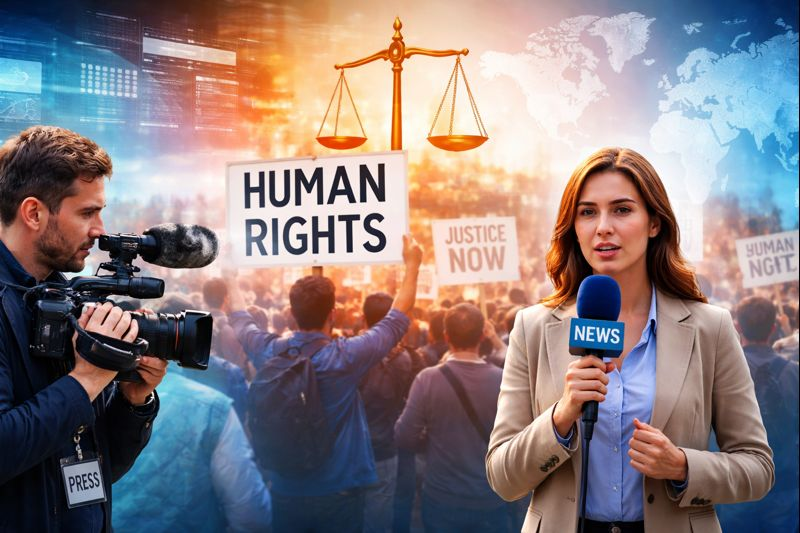
Media as a Human Rights Educative Tool
In addition to exposure, mass media also play an educational role in educating citizens on their legal rights and international human rights standards. UNESCO (2018) stresses that civic knowledge and participation in democracy are improved thanks to rights-based journalism and public interest broadcasting. The contents of educational media allow citizens to be aware of the violations and know the systems they can use to redress.
The media that works best in the development society is community media and radio, since in the said societies literacy might be low and access to digital media might be unavailable. These media outlets disseminate the inclusive human rights education by employing local languages and culturally relevant formats.
Media, Accountability, and Investigative Journalism
Investigative journalism is vital in making authorities responsible in matters related to human rights abuses. Norris (2014) observes that continued media attention brings about transparency and makes institutions act on claims of misconduct. There are many cases of judicial investigations, resignations, and modifications of policies caused by investigative media coverage, which proves the concrete effect of media interference.
Theoretical Framework
Agenda-Setting Theory
The agenda-setting theory describes the effect of the media on the priorities of society, as it dictates the priorities of the population. Considering human rights, popular and regular news elevates human rights violations to issues of social and political interest, which form the social response.
Framing Theory
The theory of framing dwells on the ability of media discourses to impact interpretation. When the analysis of human rights abuses is framed as a structural issue and not an accident, it can create more intense interaction with the audience and a call to action.
Social Responsibility Theory
The social responsibility theory focuses on the moral responsibility of the media to act in the interests of the citizens. Accuracy, fairness, and sensitivity are emphasized in this theory, especially when dealing with sensitive groups of people and traumatic events.
Methodology
This paper will use primary data analysis as a qualitative research methodology. The systematic search of academic journal articles, scholarly books, and reports of international agencies like the United Nations and UNESCO was reviewed. The criteria used in the selection were that they had to be relevant to media practices, cover human rights, and ethical journalism.
The content analysis has been used to reveal common themes in the sources reviewed. These topics were media exposure of maltreatment, popular education, consequences of accountability, and ethical and structural issues. This method enables the profound investigation of the patterns and correlations among the existing scholarship, which guarantees the validity and analytical rigor.
Findings
The results in this section are based on the qualitative analysis of the content of the reviewed journals, books, and institutional reports.
Media Exposure and Visibility of Violence Against Human Rights
The literature reviewed reveals that the mass media are always at the center of gaining more visibility for human rights violations. It has been demonstrated by studies by McQuail (2010) and Norris (2014) that investigative journalism and continuing news coverage are capable of turning abuses into an individual event into a national one. UNESCO (2018) also emphasizes that visual documentation and eyewitness reporting would help to increase credibility and emotional appeal.
These results imply that media exposure acts as a driver of publicity, civil movement, and foreign focus.
Media as a Human Rights Educational Source
Investigation of the sources reviewed has shown that the mass media play an important role in educating the masses on human rights. Literary sources reveal that explanatory journalism, community media, and public affairs programs enhance the knowledge of the citizens on the legal protection and international conventions. The results by McCombs and Shaw (1972) indicate that repeated exposure enhances issue salience and comprehension.
In reports by UNESCO, it is pointed out that learning impact is greatest when learning materials are in local languages, contextual, and available.
Media Accountability and Response by the Institution
The results depict that media scrutiny tends to bring institutional responsibility. Norris (2014) includes stories of investigative reporting that led to official investigations, prosecutions, and policy changes. Nevertheless, Herman and Chomsky (1988) observe that the structural issues like the type of ownership and political power, lead to selective accountability, which constrains similar results.
Ethical and Structural Constraints
In the literature reviewed, two constraints are evident and it includes ethical issues and structural constraints. Journalists are censored, harassed, and subjected to threats to their safety, and reporting suffers due to ethical dilemmas of privacy to the victim and sensationalism. All these influence the intensity and coverage of human rights.
Discussion
The results are quite consistent with the agenda-setting theory because they show that the constant media coverage promotes human rights issues to human and political priorities. The matters covered regularly have higher chances of prompting institutional reactions.
Taking the framing perspective of the discussion, the presentation of violations matters a lot in the interpretation by the people. Accountability and systemic injustice frames lead to greater engagement compared to those that explain abuses as isolated incidents.
The social responsibility theory is also supported by the findings and highlights the ethical responsibilities of the media. Whereas the mass media can be used to enhance justice and transparency, credibility and effectiveness are compromised through ethical failure and pressure of the structures. It is thus needed to strengthen professional standards and institutional protections.
Conclusion
The mass media is very important in enhancing human rights awareness by revealing violations, educating people, and keeping the authorities on their toes. Nevertheless, its usefulness is restricted by ethical issues, political meddling, and the structure. Freedom of the media, security of journalists, and professionalism are key in improving the role of the media in the protection of human rights and development of democracy.
References
Herman, E. S., & Chomsky, N. (1988). Manufacturing consent: The political economy of the mass media. Pantheon Books.
McCombs, M. E., & Shaw, D. L. (1972). The agenda-setting function of mass media. Public Opinion Quarterly, 36(2), 176–187. https://doi.org/10.1086/267990
McQuail, D. (2010). McQuail’s mass communication theory (6th ed.). Sage.
Norris, P. (2014). Why electoral integrity matters. Cambridge University Press.
UNESCO. (2018). Journalism, “fake news” and disinformation: Handbook for journalism education and training. UNESCO Publishing.