Introduction
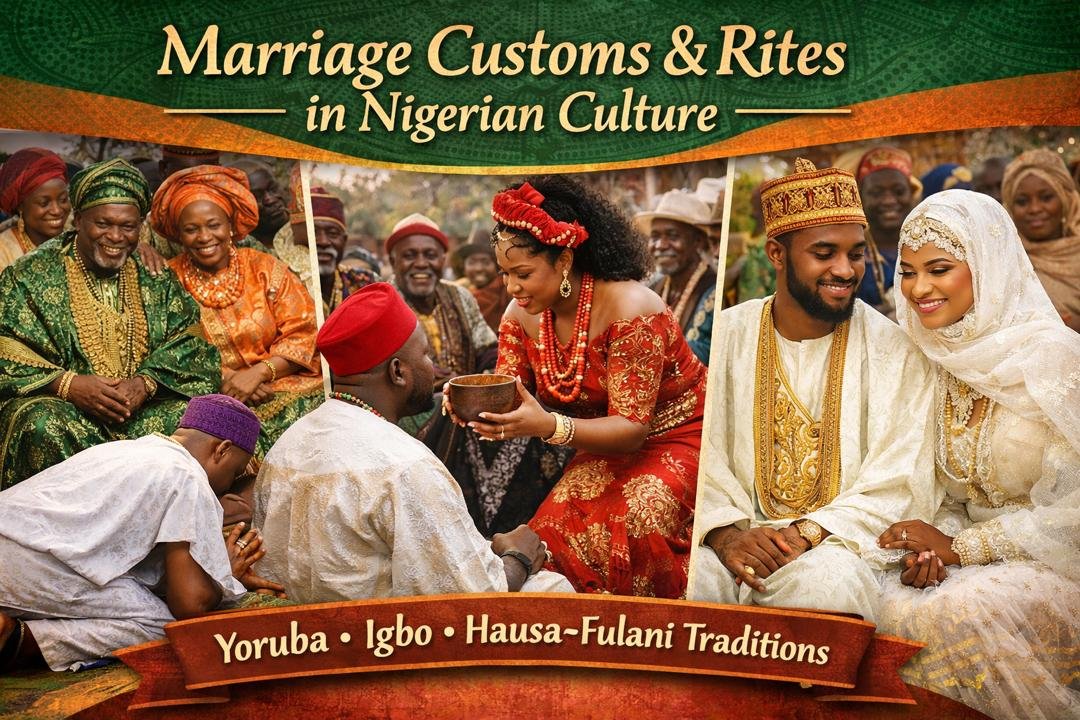
Nigerian marriage customs forms one of the most important social institutions in the Nigerian society. It transcends a personal association between a man and a woman and serves as an outline of societies, families, and generations, gluing them. With more than 250 ethnic groups that live together in Nigeria, the marriage practices and traditions in Nigeria are varied in terms of their forms, symbolism, and practices. Nevertheless, the differences do not reduce the common values that marriage implies across cultures: respect of family, continuation of line, social stability, strengthening of cultural norms. In this article, the author looks at the traditional factors of marriage in Nigerian ethnic groups of choice, courtship, bride price and the ceremonies, and evaluates how marriage helps to bond the family structure, maintain lineage, and cultural continuity within the Nigerian society.
The Nigerian Marriage Customs and its Cultural Meaning
The marriage in the traditional Nigerian societies is considered to be a sacred and mandatory life cycle. It entails the change to full adulthood and it is granting social responsibility and recognition. In some cultures, an adult person, even without a spouse and of any wealth, can still be regarded as incomplete. Nigerian marriage customs is not just about romantic fulfillment therefore but about social, cultural, and ancestral fulfillment expectations.
The traditional marriage system of the Nigerians focuses more on group participation as opposed to Western marriage systems which focus more on individual choice. The marriage process involves families, elders and even whole communities. It is a common way of making sure that marriage is not made light and couples are not abandoned without a group of kinship ties.
The traditional marriage activities in Nigeria are important in understanding how marriage can be a stabilizer in the society, which helps in maintaining the old practices, though new realities are being incorporated.
Courtship Practices in Nigerian Marriage Customs
Courtship among the Yoruba
The Yoruba of southwestern Nigeria have a culture of courtship that is usually initiated by the interest, usually seen in the interactions between the communities or families. During pre-colonial periods, the role of spouse selection was predominantly held by the parents and elders, as they were the only ones who understood compatibility in the character and family reputation as well as moral standing. Although the modern Yoruba society gives more freedom of choice, family consent is indispensable. When a man shows interest, the representatives of his family are sent by the name of alarina (go-betweens) to address the family of the woman. This official greeting is one which shows seriousness and respect. In courtship, there is an element of decorum, patience and discipline, which is an expression of the Yoruba beliefs in reverence to the aged and communal peace. The behavior before marriage is strictly controlled since the wrong action on the part of either gender may be a source of embarrassment to the two families.
Courtship among the Igbo
The courtship in Igbo culture is very symbolic. It is usually informal though culturally valid only when there is a formal involvement of families. The official declaration of marriage intention is the so-called iku aka (knocking on the door). Groom family makes their visit to bride family with gifts like kolanuts and drinks to display goodwill.
One interesting aspect about Igbo courtship is the attention paid to background research. To keep a taboo history, like slavery lineage, genetic diseases or social wrongdoing, families ask about each other background. This is done following the Igbo tradition of holding the view that marriage is not only a joining of individuals but also a whole bloodline.
Hausa-Fulani Culture of Courtship
The Hausa-Fulani of northern Nigeria have Islamic teachings and cultural conservatism which permeate courtship. Only interaction between men and women who are not married is traditionally restricted and the family is also involved at an early stage. Suitors usually initiate their interest via the middlemen e.g. parents or guardians.
The stage of engagement, also known as na gani ina so (“I have seen and I like), is the indication of formal intent. Islamic law must have consent of the bride, although the guidance of the family is at the center stage. Modesty, chastity, religious compatibility are stressed in courtship to strengthen moral discipline and social order.
Bride Price and its Cultural Meaning
The Symbolism of Bride Price in Nigeria
A traditional marriage in the Nigerian cultures involves bride price as a primary factor. On the contrary, it is not the buying of a woman as many individuals believe. Instead, it represents gratitude to the family of the bride that they took care of and brought up their daughter. The marriage is validated in terms of bride price and this gives the union legal and cultural status. Bride price also formalizes the bond between families and gives the husband some form of traditional rights especially when it comes to the lineage and inheritance. The type and the value of the bride price differ greatly among ethnic groups depending on the values and economic status in a particular area.
Bride Price in Igbo Society
Bride price is known as ime ego in the Igbo culture. It is a long procedure and it consists of items listed down by the family of the bride. Such items can be money, livestock, clothes, drinks and foodstuffs. The negotiation process is done in a respectful manner and in most cases instances are mediated by elders to avoid conflict.
The symbolic significance of bride price is very strong despite the fact that modernization has affected certain areas of the process. Bride price also validates the marriage and children conceived through the marriage are fully accepted as members of the lineage of the husband.
Bride Price in the Yoruba Society
The Yoruba bride price which is sometimes called owo ori is usually small. The Yoruba people do not believe in too much demands and the marriage is not supposed to be a burden in terms of finances. Other things given by the family of the groom include kolanuts, alligator pepper, salt, honey and palm wine, among others.
These products are moral in nature i.e. sweetness, preservation and prosperity. The simplicity of the bride price in the Yoruba culture is an indication of the cultural beliefs that people approach marriage based on character, compatibility and mutual respect and not money.
Bride Price Hausa-Fulani Culture
In the Hausa-Fulani, the bride price is called sadaki and is informed by the Islamic teachings. Contracted payment is given directly to the bride unlike other cultures where the family of the bride is paid a sum on her behalf. Such an act supports financial independence and integrity of the woman in marriage.
Sadaki is the sign of the need of the groom to take care of his wife and guarantee her support. It also strengthens Islamic principles of equity, consent and respect to women.
Rituals and Wedding Festivities
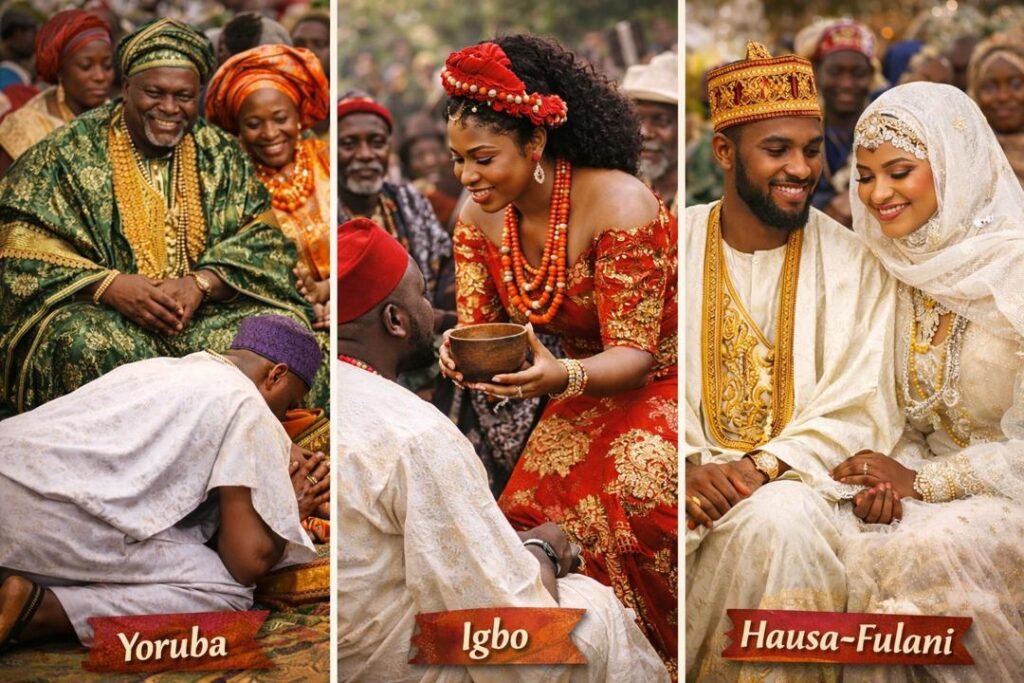
Yoruba traditional marriage is an event known as igbeyawo, which is a symbolic and colorful ceremony. It is normally celebrated in the family house of the bride, and is presided over by elders. The groom and family members prostrate to demonstrate humility and respect and fertility, longevity and harmony are also prayed.
There are also rites like tasting of honey, salt, pepper, which refer to the sweet and difficult periods of the life of a married couple. Giving and receiving of gifts and blessing strengthens togetherness in the union. Traditional clothes, music and dance make the celebrating experience even more enjoyable.
Igbo Traditional Wedding Ceremony
Igbo marriage rites are a vibrant community event and focus more on approval and acceptance. One of the most important rituals is the wine carrying ritual where the bride tries to find her groom in the crowd and offers him a cup of palm wine. This performance marks her free will. As soon as the groom accepts and drinks the wine the marriage is culturally sealed. The seniors use prayers and blessings focusing on fertility, respect, and unity. The ritual emphasizes the necessity of communal consent and community responsibility.
Hausa-Fulani Wedding Ceremony
The Hausa-Fulani marriage rituals are quite simple and spiritual in nature. Nikah ceremony is performed under the guidance of an Islamic cleric in front of witnesses. The marriage contract is read out and permission is granted.
Congratulations can be made afterwards but greater attention is paid to a religious celebration instead of a show. During festivities, gender division prevails, which is an aspect of modesty in culture and religion.
Marriage and strengthening Family Ties
In Nigeria, the institution of marriage is a potent tool of relationship construction and maintenance. Marriage creates alliances, which advance cooperation, mutual support and conflict resolution among the families. In-laws now become extended family members and have common responsibilities.
The elders serve advisory purposes providing guidance in marriage conflicts and other life issues. This network of support also minimizes marital instability and strengthens the cohesion of the community and couples do not feel alone in the fight.
Lineage and Ancestral Continuity Preservation
In the Nigerian culture, lineage is one of the major goals of marriage. Any child born in a recognized traditional marriage is said to be a legitimate heir, with the right to inheritance, social identity and ancestry.
Marriage is considered as being a spiritual agreement between the living as well as the ancestors. This ideology acts to strengthen the holiness of the union and the duty of individuals to maintain family dignity and family lineage.
Strengthening the Culture and Social Values
Marriage practices are also used as an avenue of passing cultural norms as respect to the elderly, gender roles, faithfulness, patience and collective responsibility. Couples are socialized through rituals and teachings on acceptable behavior patterns that enable social order to exist.
Traditional marriage customs still impact on the Nigerian society even with modernization, urbanization, and globalization. A lot of couples hybridize between religious, civil, and traditional ceremonies in keeping with the adaptability of culture but not complete rejection of the culture.
Conclusion
The Nigerian marriage customs demonstrate the ethnic diversity of the country and the deep social values. In the marriage rituals, the traditional couple system of courtship and bride price, the wedding ceremonies, as well as the emphasis of the family, preservation of the intergenerational lineage and the cultural continuity all characterize the traditional marriage practices. Even though traditions are diverse among different ethnicities, their aim is always similar: to ensure closer social connections, to justify the constitution of families, and to establish moral and cultural standards.
Traditional marriage is an important institution in modern-day Nigeria as it helps individuals to relate to their families, communities, and their ancestry. Knowing these practices, a person learns more about the cultural roots that condition the formation of the Nigerian identity and social life.
Get more well researched information about Nigerian traditional marriages here.