Introduction
Successful project managerial work is anchored on key processes of project delivery. No matter what type of industry it is construction, information technology, healthcare, education or business transformation, the capacity to deliver a project successfully is subject to the extent to which well-organized processes are adhered to and combined. Project management does not and will not be only about getting things done, it is about using systematic procedures that will make sure that objectives are met within stipulated limitations in the form of time, cost, scope and quality.
This paper describes and explains the key procedures in project delivery and what each stage does to bring the whole success and how they interrelate in a well-organized project management context. This knowledge of these processes facilitates collaboration between project managers and project stakeholders, minimize risks, maximize efficiency, as well as, generate a high degree of stakeholder satisfaction.
Project Management Project Delivery
Project delivery is a term that is used to denote the entire process involved in transforming an idea or requirement into an eventual product, service, or outcome that satisfies stakeholders. The standardized processes, tools, and structures like the Project Management Body of Knowledge (PMBOK) or PRINCE2 or Agile or hybrid models inform delivery in a project management environment.
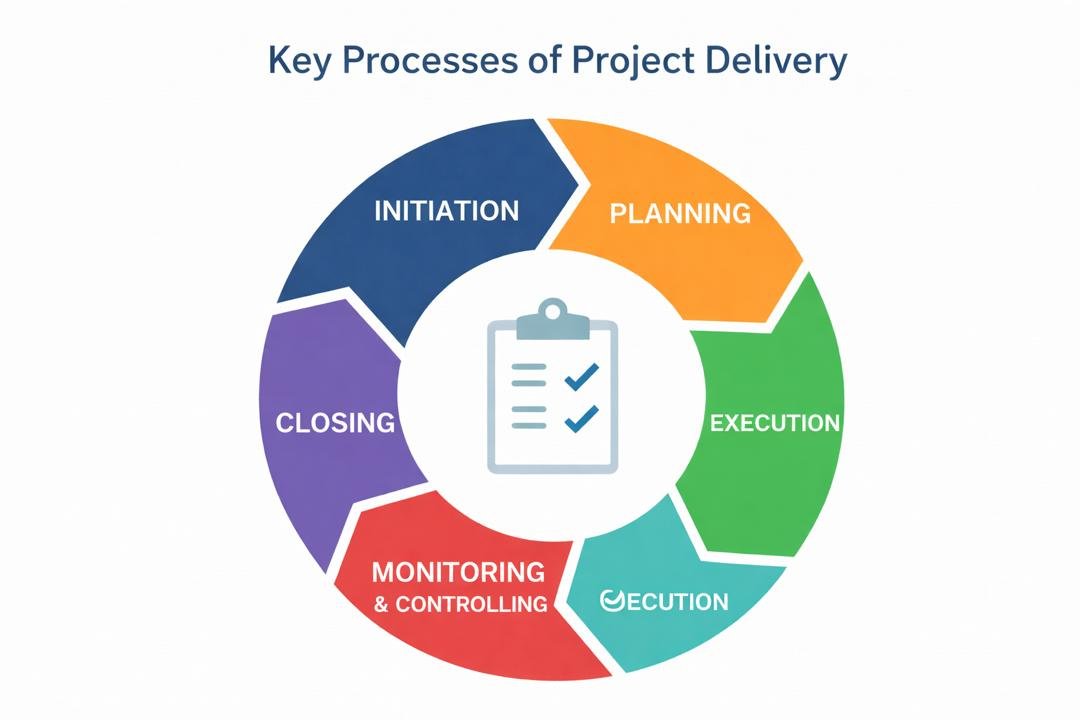
Project delivery includes, at its very essence, a lifecycle comprised of five large process groups:
- Initiation
- Planning
- Execution
- Monitoring and Controlling
- Closing
These processes are not independent processes; they are related and repetitive. One phase is informed by the next and the feedback loops enable modification to be made during the project lifecycle.
In the practice of professional project management, understanding the key processes of Project delivery is being extremely critical in attaining consistency, prediction, and success that can be measured.
Project Initiation Process
Significance and Intention of Initiation
The initial phase in project lifecycle is the project initiation which forms the basis of all the other activities. This process aims to formally give the project a definition, as well as approve the existence of the project.
Initiation provides answers to such basic questions as:
- What is the need to implement this project?
- What problem does it solve?
- Who are the stakeholders?
- What are the upper level goals and restrictions?
The significant processes in this stage are:
- Project Charter: Project charter is a document that gives the project the authorization and gives the project manager the authority to utilize the organizational resources.
- Identifying Stakeholders: Stakeholders are any person who has a certain interest or has control in the project as far as the sponsors, clients, team members, suppliers, and end users.
- High Level Definition of Objectives and Scope: This aids in defining the objective of the project and limits what the project will include and what it will not include.
Importance of Initiation
When the initiation phase is carried out poorly, chances are that the objectives will be unclear, expectations will usually be unrealistic and the scope will also change later in the project. Getting things off on the right foot will mean that every involved party knows what the project is and what it is about, making it less likely to cause confusion and will entice more dedication.
Project Planning Process
Meaning and Role of Planning
Planning is arguably the most important stage in the project delivery. It entails the transformation of high level goals into a step by step roadmap to be followed during execution. Planning phase outlines the manner of undertaking the project, monitoring and controlling of the project.
The primary aim of planning is to minimize uncertainty and equip the project staff to deal with possible risks and challenges.
Key Planning Components
The scope of project planning includes some of the following areas which are interrelated:
a. Scope Planning
This determines what is to be and what is not to be done. Projects are decomposed into manageable parts using such tools as the Work Breakdown Structure (WBS).
b. Schedule Planning
This is done by listing the activities, estimating the time required and creating a schedule by means of software such as Gantt charts or network diagrams.
c. Cost Planning
This approximates the amount of finances needed and develops a project budget.
d. Resource Planning
This is how it dictates the human, material, and technical resources required.
e. Risk Planning
Possible risks are determined, examined and mitigation measures are formulated.
f. Communication Planning
This determines the way of sharing information with the stakeholders.
g. Quality Planning
This establishes quality standards and the manner of attaining and measuring it.
Importance of Planning
Planning has a direct impact on the project success. A well-developed plan:
- Enhances communication within members of a team
- Reduces time wastage and expenses
- Helps foresee the opportunity to have troubles
- Gives a point of reference on improvement.
Lack of proper planning leads to a reactive but not proactive execution and thus the chances of failure are high.
Project Execution Process
Meaning and Scope of Implementation
The stage of actual execution of plans is known as project implementation. It entails the process of organizing people and resources to implement the project undertakings that are stipulated in the project plan.
This is the most visible phase, because it incorporates the actual task leading to the deliverables.
Key Activities in Execution
The key execution activities would be:
- Task Implementation: Delivering the work packages that will be carried out in project plan.
- Team Management: Delegating work, inspiring team associates, and conflict resolution.
- Stakeholder Engagement: Keeping in touch with stakeholders and dealing with expectations.
- Quality Assurance: Having work which is of defined standards.
- Procurement Management: Purchasing outside commodities and services where necessary.
Importance of Execution
Implementation converts an idea into a physical outcome. Leadership, communication, and collaboration are critical to the execution process. Well laid plans will not work well with management that is poorly directed. Strong execution;
- Enhances productivity.
- Builds team morale.
- Ensures that there is congruence between project objectives and work.
- Strives to keep up with project completion.
Supervising and regulating Process
Meaning and Purpose
Execution is accompanied by monitoring and controlling. This will help in ensuring that the performance on the project is in accordance with what the plan stated and that any deviation is detected and eliminated in good time.
It answers questions such as:
- Are we on schedule?
- Are we within budget?
- Are the quality standards being adhered to?
- Is the management of risks effective?
Important Monitoring and Controlling Activities
a. Performance Measurement: Earned value analysis, performance measurement using Key Performance Indicators (KPIs), and progress reports
b. Change Control: The ability to control scope, schedule or cost variations using formal approvals
c. Risk Monitoring: Assessing the risks identified and identifying new risks
d. Quality Control: Deliverables Inspection of deliverables to meet standards.
e. Communication and Reporting: Letting the stakeholders know the status of the progress.
Significance of Monitoring and Controlling
This is a process that serves as a control system of the project. In its absence, issues can be discovered too later when they are difficult to correct.
Efficient surveillance and management:
- Major failures are caused by small problems.
- Facilitates the making of informed decisions.
- Ensures accountability.
- Eases the fears and misconceptions of stakeholders.
Project Closing Process
Meaning and Role of Closing
The last stage of project lifecycle is project closure. It is the process of projecting the project formally, and by making sure that all the objectives are achieved.
This stage can be considered another neglected one, but this is necessary in terms of organizational learning and stakeholder content.
Key Closing Activities
- Deliverable Acceptance: Getting the formal consent of the client or sponsor.
- Documentation and Reporting: Composing conclusive reports and revising company books.
- Resource Release: Resettling of team members and setting free equipment.
- Lessons Learned: Assessing what has been successful and what has been bad.
- Administrative Closure: Sealing of contracts and financial accounts.
Importance of Closing
- Proper project closure: Checks whether the project objectives have been met.
- Eliminates unaddressed problems to carry over.
- Improves performance of future projects by learning.
- Offers a feeling of fulfillment to the stakeholders and team members.
- There is interaction between the project delivery processes.
Among the most crucial issues related to project management, it is critical to realize that these processes are not linear. They dynamically communicate during the project life cycle.
For example:
- The changes in the plan might be necessary because of the issues observed in the course of monitoring.
- Unanticipated risks found in the execution can lead to further planning.
- Scope can also be modified by stakeholder feedback of the execution.
This communication provides a cycle of improvement in which learning and adaptation result in improved results in projects.
The combination of the key processes that support the project delivery would make sure that all the decisions that are made are informed and that risks are dealt with proactively and that the resources that are available are utilized effectively.
Importance of Disciplined Process Management to Projects
Disciplined process management denotes the process of using procedural approaches, norms and best practices to apply uniformly to the entire project lifecycle.
Improved Efficiency
Standard processes minimize redundancy of work and eradicate guess work. Teams are aware of what to do, when to do it as well as how to do it hence saving on time and resources.
Higher Quality Outcomes
The quality planning and control will make sure that the deliverables will be at the pre-determined standards. Forming the continuous monitoring, defects can be tracked at the initial stages.
Better Risk Management
The formal risk processes enable the organizations to foresee the issues and come up with mitigation measures rather than responding to the crisis.
Engagement of Greater Stakeholder Contentment
Transparency, clear communication, and predictable outcomes result in trust amongst the stakeholders. Once expectations are well managed then there will be increased satisfaction.
Organizational Learning
The experience in one project can be applied in future projects and this will ensure that the project management practices continue to improve and ultimately become mature.
Project Delivery Problems and The Processes Problems
Project delivery is subject to various challenges in spite of the structured processes:
a. Scope Creep
Unplanned fluctuations in project scope may cause schedule and cost overruns. This risk is managed with the help of change control processes.
b. Resource Constraints
Time can be impacted by scarce resources. The planning and monitoring of resources will guarantee maximum utilization.
c. Communication Gaps
Misunderstandings come about as a result of poor communication. This problem is addressed by communication planning and communication reporting.
d. Risk and Uncertainty
The unforeseen happenings are unavoidable. Their effects are mitigated by the risk management processes.
The key processes of Projects delivery in a systematic way offer a system of addressing them instead of addressing them in an ad-hoc manner.
Conclusion
The undertaking key processes of Project delivery is not simple yet it is manageable under controlled and disciplined procedures. The five main process groups, which are initiation, planning, execution, monitoring and controlling, and closing are a blend of a system that helps a project to succeed at all levels up to closing.
Knowledge and practice of the key processes involved in project delivery allow project managers to achieve efficiency in their work, quality, risk management and satisfying the stakeholders. These processes enable project management to become a professional, predictable, and value-based practice and not a trial-and-error activity.
The contemporary dynamic and competitive world is such that organizations that believe in disciplined project delivery processes stand in a better position to attain strategic objectives, change with the times, and bring about sustainable outcomes.
Get more well researched information about project management here.