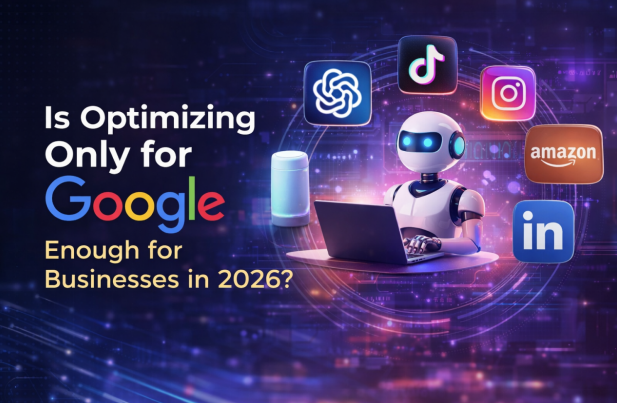
For over two decades, digital visibility has revolved around one central assumption: if you win on Google, you win online. That assumption is starting to crack.
In 2026, search is no longer confined to a single platform. Users are discovering information across AI assistants, social platforms, marketplaces, voice interfaces, and even direct recommendation engines. Google is still dominant, but it is no longer the only gateway to visibility. And yet, many businesses continue to optimise as if nothing has changed.
The problem: a single-platform mindset in a multi-platform world
Traditional SEO strategies are deeply Google-centric. Keyword research, backlink building, and technical optimisation are all of it is designed around how Google ranks and displays content.
But user behaviour has evolved.
Today, people:
- Ask AI assistants for recommendations instead of searching manually
- Discover brands through Instagram, YouTube, and LinkedIn
- Use marketplaces like Amazon as search engines
- Rely on voice queries and chat interfaces for quick answers
This creates a gap between where businesses are optimising and where users are actually searching.
If your entire strategy is built around Google rankings, you are effectively ignoring a growing share of discovery channels.
The impact: invisible brands in visible markets
The consequences of this shift are subtle but significant.
First, businesses risk losing visibility outside traditional search. A brand that ranks well on Google may still be absent from AI-generated answers, social discovery feeds, or voice search results.
Second, dependency on Google creates vulnerability. Algorithm updates, SERP changes, and AI-generated summaries can reduce traffic overnight. When a single platform controls your visibility, your growth becomes fragile.
Third, the nature of competition is changing. You are no longer just competing for rankings, you are competing for attention across ecosystems.
A potential customer might:
- Discover a product through a YouTube review
- Validate it through an AI assistant
- Compare options on a marketplace
- And only then visit a website
If your brand is missing at any of these touchpoints, you lose influence in the decision journey.
The shift: from SEO to search ecosystem optimisation
The smartest marketers are already adapting to this reality.
Instead of focusing only on Google, marketers are now adapting to a broader search ecosystem, including how SEO strategies are evolving to rank in AI-driven tools, where visibility depends on structured, answer-ready content rather than just rankings. That includes
- AI search platforms (ChatGPT, Gemini, etc.)
- Social search (Instagram, TikTok, YouTube)
- Marketplace search (Amazon, Flipkart)
- Voice search and smart assistants
- Traditional search engines
This does not mean SEO is dead. Far from it.
It means SEO is evolving into something bigger, a system that connects content, platforms, and user intent across multiple channels.
The solution: building a multi-platform visibility strategy
To stay competitive in 2026, businesses need to rethink how they approach visibility.
1. Optimise for answers, not just rankings
AI-driven platforms prioritise clear, structured, and authoritative content. This means your content should be designed to answer questions directly, not just rank for keywords.
Answer-first content improves your chances of being featured in AI-generated responses.
2. Expand beyond website-centric thinking
Your website is still important, but it is no longer the only place where your brand lives.
You need to create content that works across platforms:
- Short-form videos for discovery
- Long-form content for authority
- Structured content for AI extraction
- Visual content for engagement
Each format serves a different role in the search journey.
3. Build platform-specific authority
Different platforms reward different signals.
- Google values backlinks and technical SEO
- YouTube values watch time and engagement
- AI systems value clarity and trustworthiness
- Social platforms value relevance and interaction
A strong strategy recognises these differences instead of treating all platforms the same.
4. Strengthen brand signals
As search becomes more fragmented, brand recognition becomes more important. Users are more likely to trust and choose brands they recognise across platforms. Consistent messaging, tone, and presence help reinforce credibility.
5. Work with experts who understand the full landscape
Adapting to this shift requires more than incremental changes. It requires a strategic overhaul. This is where philadelphia seo consulting services become valuable. Instead of focusing only on traditional rankings, they help businesses build integrated visibility strategies that align with how modern search actually works.
This includes combining SEO, content strategy, AI optimisation, and cross-platform distribution into a unified system. The goal is not just to rank on Google; it is to show up wherever your audience is searching.
The future: search everywhere, strategy everywhere
If the past decade was about mastering Google, the next decade is about mastering visibility itself. Search is no longer a destination. It is woven into how people think, ask, explore, and decide. Businesses that continue to optimise only for Google will not disappear overnight. But they will slowly become less visible in the places that matter most. The ones that adapt, that build multi-platform, AI-aware, user-centric strategies, will define the next era of digital growth.”