Oral health is part of the general health and well-being, which determines nutrition, communication, socialization, and living standards. Oral diseases are one of the issues that are most prevalent in the world despite their significance, affecting individuals of all ages and socioeconomic statuses. It is vital to know the causes of such diseases, their most prevalent people, and their distribution among populations in order to prevent and control them. This is where oral health epidemiology comes in.
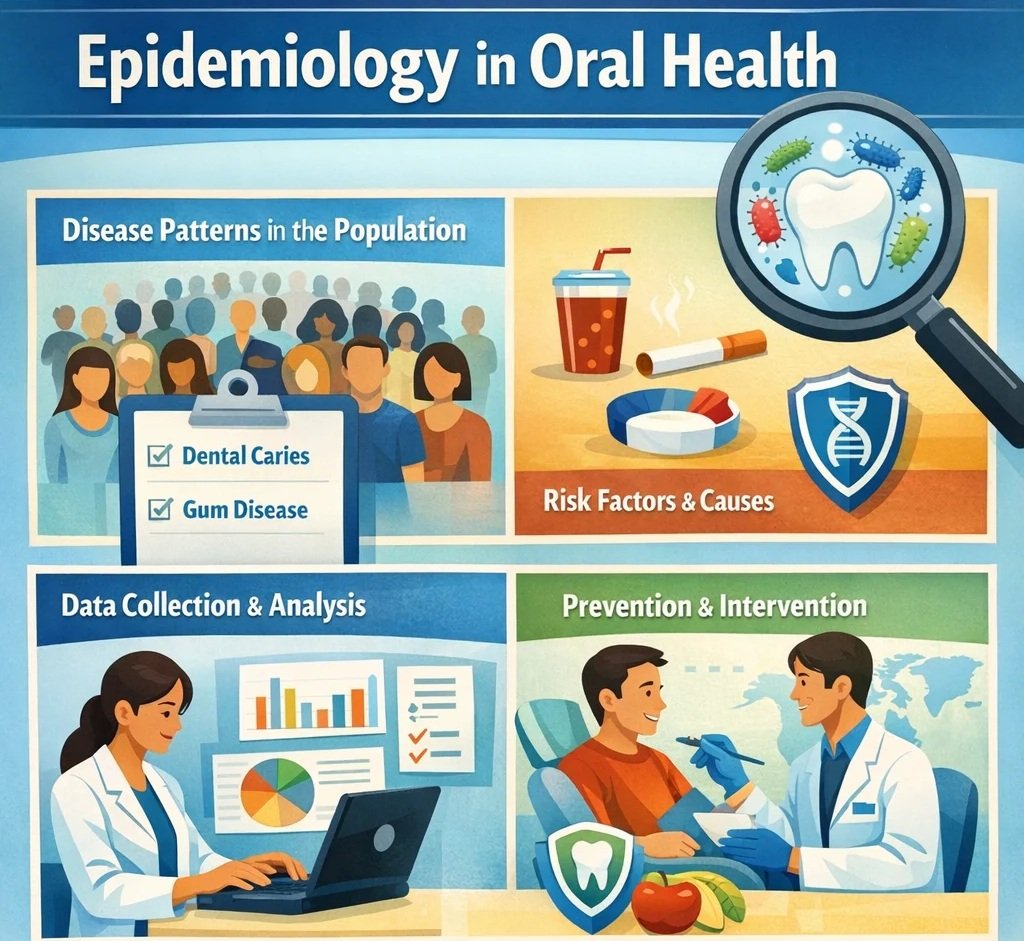
Oral epidemiology is the application of epidemiology principles and techniques to the oral diseases and conditions in populations. Instead of targeting specific patients, it analyses trends, reasons, and impacts of oral health complications across the community, national, and international fronts. Oral epidemiology can offer evidence based on population based data analysis, which can be used to inform public health planning, define preventive measures, and contribute to effective clinical decision making. Exposure to such ideas early in the career of dental students, clinicians, and policymakers enables them to value the identification and response to oral health trends.
Simply, the core questions of epidemiology are: What is happening? Why is it happening? And who is affected? Such questions are associated with dental caries, periodontal diseases, oral cancer, malocclusion, and other oral diseases in oral health. The responses determine interventions which extend past the dental chair and affect community programs, health education, and policy formulation.
In earlier phases of the learning process, learners can be presented with the essential materials delineating the area and concepts related to the field, including this introductory overview of epidemiology in oral health, with the emphasis on how population-wide data can reinforce prevention and control activities. It is based on this that the sections that follow touch upon the fundamental ideas, processes, and practices of epidemiology in oral health within contemporary dentistry.
Epidemiology in the Context of Oral Health
Epidemiology is usually described as the investigation of the distribution and determinants of health-related states or events in given populations, and the usage of the study to manage health issues. In the context of dentistry, epidemiology concentrates on oral diseases and conditions, their prevalence, intensity, and distribution and the factors that impact their prevalence.
Oral epidemiology takes the population approach as opposed to clinical dentistry, in which the focus has been on diagnosis and treatment at a point (a patient). This method assists in revealing the trends that might otherwise not be seen within separate clinical experiences. As an illustration, a dentist can treat a large number of patients who might be affected by dental caries; epidemiology assists in identifying whether prevalence of caries is greater in particular age, geography or even socioeconomic groups.
As oral epidemiology changes the emphasis on individuals and populations, it provides the opportunity to identify the risk factors that include diet, oral care practices, exposure to fluoride, smoking, and dental care access. Such factors should be known to prevent stressful situations that can promote disease burden across communities.
Basic Concepts of Oral Epidemiology
One should have a clear understanding of fundamental epidemiologic concepts to interpret data on oral health appropriately. These are the cornerstones of oral health epidemiology and are common in research and practice of oral health surveillance and epidemiology.
Frequency and Distribution of Diseases
Disease frequency is the frequency of the occurrence of an oral condition within a population. Popular indicators are prevalence and incidence. Prevalence refers to the number of people with an illness at a particular time, whereas incidence refers to the number of cases which occur within a certain time frame.
Distribution is the study of the relationship of oral diseases which are person-specific, place-specific, and time-specific. An example is that dental caries might be more common in children compared to adults, more common in rural regions compared to urban areas or the trend may be decreasing in the trend over decades because of better preventive services including fluoride applications.
Determinants and Risk Factors
Determinants are those factors that affect the occurrence of disease. These are biological, behavioral, environmental, and social factors that are inclusive in oral health. Influence of high sugar intake, poor oral health, smoking, and the inability to access dental services are risk factors that make a significant contribution to caries and periodontal disease.
Oral epidemiology does not simply tell about these factors but also estimates their relative significance and interactions. Such knowledge can be used to intervene in a more focused way to deal with the most influential disease contributors.
Populations and Vulnerable Groups
The other important concept is the identification of vulnerable or high-risk populations. Some population groups, including children, older adults, low-income, and those with special healthcare needs, are usually disproportionately impacted by oral diseases. The epidemiologic studies reveal such disparities and contribute to promoting inequity in oral health care.
Techniques of Oral Epidemiology
Oral epidemiology uses systemic approaches to gather, analyze and measure the information. The techniques make the results dependable, valid, and relevant to practice.
Epidemiologic Study Designs
There are a number of study designs used in oral health research. Cross-sectional research determines the level of oral diseases at one time and are very common in the community surveys. Cohort studies involve tracking down groups of people across a period of time to analyze how diseases develop and what are the risks. Case-control studies are used to compare people who have a certain oral condition and those who do not, to determine the possible causes.
Both designs possess their advantages and drawbacks, and the decision is determined by the research question, resources and ethical aspects.
Oral Health Survey and Data Collection
In oral epidemiology, data are commonly gathered via the use of oral health surveys, clinical examination, questionnaires, and health record existences. There are standardized indices, like the DMFT (Decayed, Missing, Filled Teeth) index of dental caries and the Community Periodontal Index of periodontal conditions to provide uniformity and comparability.
It is important that reliable data collection must be used, because wrong measurements may give false conclusions and maladaptive interventions.
Interpretation and Analysis
After collection of data, statistical analysis is applied to determine patterns, trends, and associations. Interpretation should be done with due sensitivity on confounding factors, bias, and limitations of the study. To ensure that assumptions made regarding disease etiology are not wrong, epidemiologists want to differentiate between correlation and causation.
Application to Common Oral Diseases
The practical merit of epidemiology in oral health can best be demonstrated by the use of epidemiology in the common oral diseases like dental caries and periodontal diseases.
Dental Caries
Dental caries have been one of the most common chronic diseases in the world. Epidemiologic research has demonstrated that the distribution of the caries is unequal with the most prevalence being noted in children, adolescents and the disadvantaged groups. These research studies have also determined the most important risk factors such as regular consumption of sugar, lack of exposure to fluoride, and poor oral hygiene.
Oral epidemiology has indicated that oral health education, school-based sealant programs, and water fluoridation are effective in preventing caries by monitoring the trends over a period of time. This has been a piece of evidence that has been used to influence clinical guidelines and policies regarding health to the masses.
Periodontal Diseases
Periodontal diseases are widespread in adults and infections such as gingivitis and periodontitis are the most common causes of tooth loss. Associations between periodontal disease and smoking, diabetes, stress and socioeconomic status have been identified as epidemiologic research.
Population studies assist in determining the risk of periodontal conditions and the high-risk populations. This data aids in the creation of specific prevention and early intervention approaches that minimize the effects of complications in the long run.
Role in Prevention and Public Health Policy
Prevention and policy making is one of the greatest contributions that oral epidemiology makes. Epidemiology enhances the decisions made at various levels of the health system by availing evidence of disease burden and risk profile.
Preventive Strategies Design
The design of preventive programs to reduce the prevalence of oral diseases is based on the population data that highlights the underlying causes of the condition. To illustrate, epidemiologic evidence favors community water fluoridation as a cheap intervention to curb caries of the teeth. In the same manner, tobacco consumption and periodontal disease data is used in smoking cessation efforts in oral health programs.
Publicity of Public Health Policies.
Based on the results of epidemiologic studies, policymakers can expend resources, priorities, and assess the effectiveness of oral health interventions. Oral disease surveillance systems help to identify challenges early enough and policy issues also keep being evidence based.
Clinical Decision Implications
Despite the fact that oral epidemiology deals with people of populations, its results are directly applicable to clinical practice. Knowing disease trends enables a clinician to determine patient risk, prescribe preventive advice, and make a judicious decision in treatment.
As an example, awareness of the caries prevalence by certain age groups can apprehend recall and preventive interventions. Risk factors of periodontal disease can be used to inform patients and prevent disease at an early stage. By doing so, epidemiology helps to fill the gap between individual patient care and public health.
Conclusion
As a basic science, oral epidemiology supplements knowledge on the causes, distribution, and patterns of diseases in oral health. Through epidemiologic principles to dentistry it gives good insights to the burden of oral diseases and the factors, which influence occurrence of these diseases. This community approach is fundamental to successful prevention, provision of equal health care, and sound clinical practice.
Due to the evolving nature of oral health, epidemiology in oral health will be critical. With oral epidemiology, a good understanding of the concepts will help students, practitioners and policymakers alike to enhance oral health outcomes whether individually or in the population. Oral epidemiology provides support to the long-term purpose of enhancing oral health of all people through evidence-based approaches and making informed decisions.