Introduction
The availability of information in the contemporary world has been one of the most significant sources of education, innovations, and interpersonal communication. However, in contrast to the previous time, when people used physical libraries as primary sources, printed books and face-to-face communication as the main ones, the modern society is highly dependent on digital technologies. The internet, browsers and search engines is at the center of this transformation and it has meant that millions of computers and devices are connected to others around the world which implies that sharing of knowledge is possible instantaneously. The internet has enabled people to interact, educate, carry out business and engage in international discussions without facing any restriction as a result of geographical borders.
The internet is not only a technical infrastructure, but a strong information environment. It is being used by students in research and their assignments, by professionals in collaborating and solving problems, and in its everyday purpose by news, entertainment and social networking. Nevertheless, only access to the internet is not sufficient. To be able to find, analyze and utilize information properly, users have to know how to utilize such tools as web browsers and search engines. This is the place where digital literacy is needed.
This article discusses the role of the internet and the online materials as sources of information access. It describes the functions of the web browsers and search engines and it talks about the feasible methods of effective information search. The idea is to ensure that the readers have the most fundamental digital literacy skills that can help them in the academic research, communication, and informed engagement with the digital society.
Knowing the Internet and Online Resources
The internet is a universal system of interconnected computers and computers that exchange data with each other by use of standardized protocols. It enables the transmission of data in the form of text, images, videos and audio to another device in almost real-time. Put simply, the internet is an enormous communication network that has connected people, institutions, and information sources across the globe.
Online resources are the online materials that may be accessed using the internet. They consist of websites, e-books, online journals, online libraries, online educational platforms, databases, blogs, forums, social media sites, and multimedia materials, including videos and podcasts. The combination of the internet and online resources is the foundation of the current information.
Availability is one of the greatest benefits of online resources. Online resources are also available 24 hours all day long and almost everywhere as opposed to physical libraries which are restricted to time and place. This increases flexibility and inclusiveness of learning and research. As a student in one
country, accessing academic articles published in another country is possible in a matter of seconds, which was virtually impossible before.
Another key benefit is speed. Knowledge which would have previously taken days or even weeks to have been received through the conventional media could now be retrieved within seconds. This has greatly enhanced productivity in education, business, and healthcare and in most other areas. As an example, researchers can scan the existing literature in a short period of time, professionals are able to cooperate in real-time and individuals can be informed about the events taking place throughout the globe.
Nevertheless, there is also the problem of overload of information. The information that is found online is not accurate, reliable or trustworthy all the time. That is the reason, users should also acquire critical thinking abilities, in order to judge sources appropriately. The acquisition of skills on how to use browsers and search engines is the initial step to being a responsible and informed digital citizen.
Web Browsers: The Internet Portal
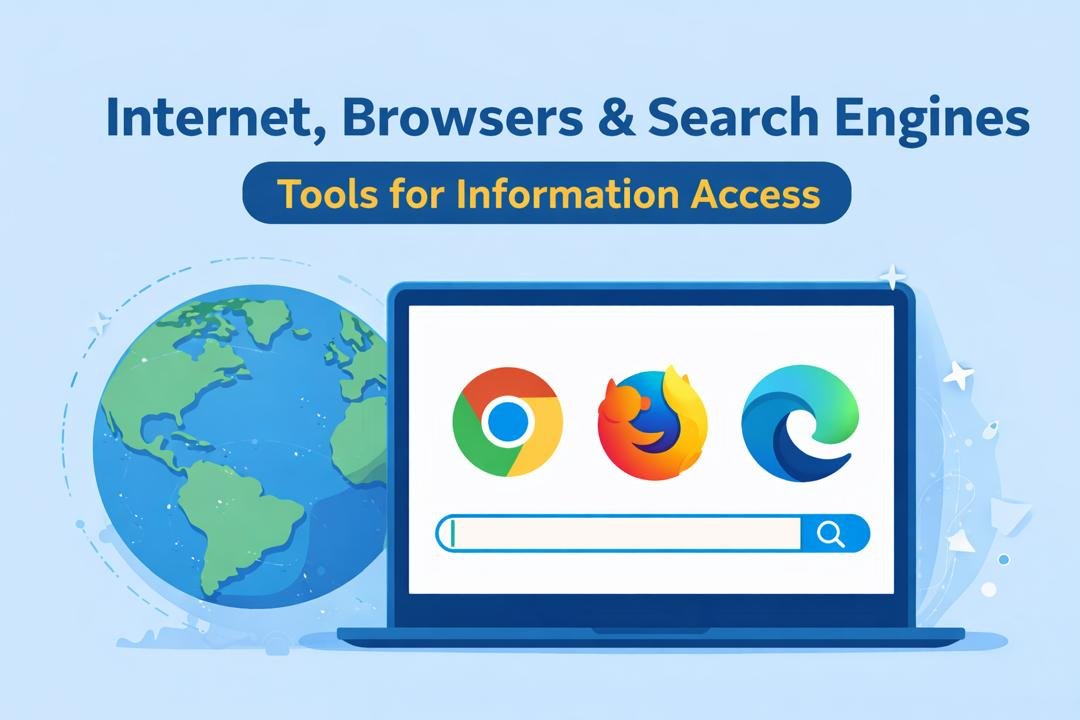
A web browser is a program that enables one to use the internet to view and read information. It serves as a point of contact between user and web allowing people to access websites, read information, view videos, download files, and respond to online services.
Examples of web browsers are Google Chrome, Mozilla Firefox, Microsoft Edge, Safari and Opera. Whereas they might have minor differences in design and functions, all browsers have a set of similar basic tasks. They decipher web addresses (URLs), make requests to web servers and present the content downloaded in a form that is readable.
The web browsers offer a number of features that are significant in increasing access to information. These include:
- Navigation aids – these are the address bar, forward and back buttons and bookmarks which assist the user to navigate conveniently between web pages.
- Search integration – the majority of browsers have an inbuilt search bar that enables one to carry out search on the web.
- Tabs and windows there are tabs and windows that allow users to have more than one page open and hence comparison of information across various sources is easy.
- Security features- the current browsers alert users about unsafe websites, safeguard their personal information, and allow users to use browsing in the privacy mode.
- Extensions and plugins – these are extra tools that can be used to make work more productive which could be ad blockers, translation tools and citation managers.
Most users would not get access to the internet without the use of web browsers. Browsers formulate technical data that is difficult to access and interpret, into simple readable and understandable content. They are important in making sure that the information is accessible as well as useful.
Search Engines: Locating Information in an Electronic World
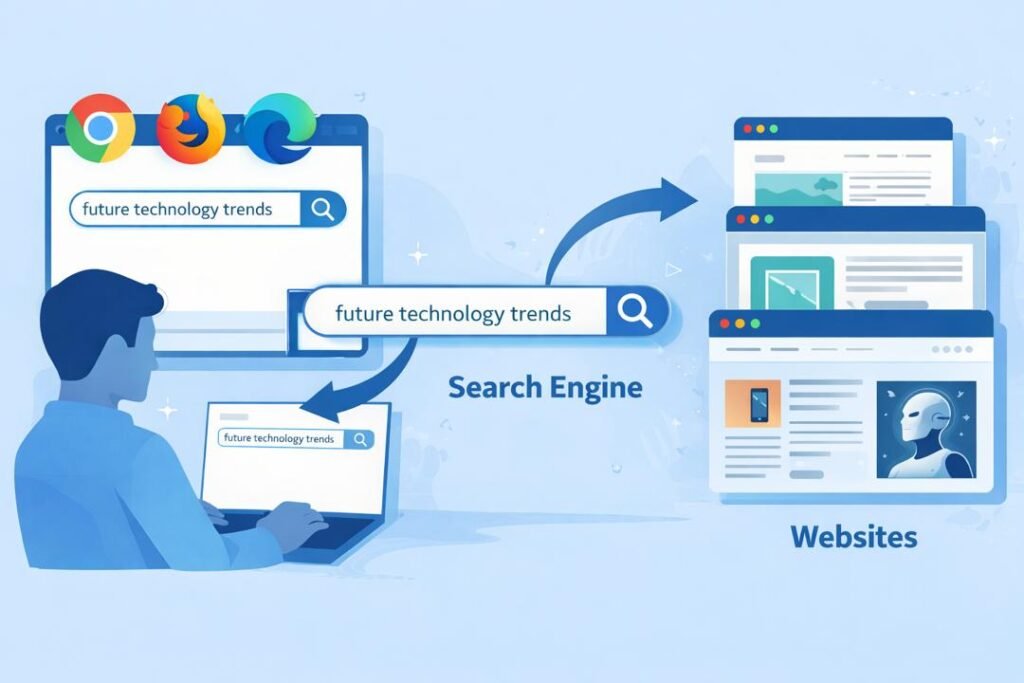
Whereas web browsers allow a person to access the internet, search engines aid users in finding particular information in the broad range of information online. A search engine is a system which searches the internet and offers results to the search query in the form of web pages depending on the keywords typed in by the user.
Google, Bing, Yahoo, DuckDuckGo, and Baidu are the popular search engines. These sites have automated software known as web crawlers or spiders that search and index millions of web sites. The structured data is then stored in massive databases and the search can be made almost immediately.
When a user types in a query, the search engine uses complicated algorithms to find out the pages that are most relevant. The findings are usually presented in an ordered list where the most significant or authoritative sources are presented at the top.
Academic research and general information requirements cannot do without search engines in their daily lives. They allow users to:
- Definitions and explanations of concepts.
- Get scholarly articles and research papers.
- Discover news and latest events.
- Find tutorials and guides, as well as educational materials.
- Compare products and services.
Nevertheless, search engines are not adequate to accuracy. Popularity, keywords, and the structure of the web site are some of the factors which determine the ranking of the results. This implies that a user should be careful and not think that the first result is correct or the best and trustworthy.
Successful Information Retrieval Methods
Users should be able to effectively retrieve information in order to utilize the internet and other online resources best. Information retrieval is a process of seeking, choosing, and applying the necessary information, that is, in a mass of information.
One such method includes the use of the right keywords. The users are not required to type long statements in a search engine but rather to recognize several important words on their subject matter. As an example, it is more effective to search by the following query: causes of climate change rather than writing the following query: what are the reasons why climate change occurs in the world.
The other helpful trick is the use of quotation marks. The quotation marks assist the search engine to find precise phrases. As an example, the search of the phrase digital literacy skills will result in the search including that very phrase and hence will be more specific.
There are also filters and advanced search options that the users can use. Most of the search engines enable the searcher to filter the results according to date, language, file type or region. This particularly comes in handy when doing academic research whereby recent and credible sources are often necessitated.
The most important skill in information retrieval is probably the evaluation of the sources. The following questions should be asked by the users:
- Who is the author or the organization of the information?
- Does it have a credible and authoritative source?
- Is the information up to date?
- Does it have references and evidence to the claims?
- Does it have biased or objective content?
Using such methods, users would be able to filter the misinformation and utilize digital resources better.
The Use of the Internet in Scholarly Research
The internet has revolutionized access to knowledge by the students and researchers in the field of education. Thousands of scholarly articles and books can be accessed in digital libraries, academic databases, and online journals. Google Scholar, JSTOR, ResearchGate, and institutional repositories are the platforms, wherein the students can find reliable academic materials without going to physical libraries.
Internet, browsers and search engines also facilitates group learning. Cloud computing offers students the opportunity to work in online discussion groups, take virtual classes and co-create common documents. This facilitates sharing of knowledge and learning.
Also, the internet has promoted self-education. Using online courses, tutorials and open educational resources, learners are able to gain new skills at their own pace. This is especially useful in developing nations, where the traditional learning materials might be scarce.
Plagiarism and copyright are however to be taken into consideration by academic users. Online information must be referenced correctly, and people must not violate intellectual property.
Sharing of Information and Communication
The internet is also significant in communication beyond research. The email, instant messaging, video conferencing, and social media sites enable individuals to communicate real time even at long distances. This has altered the way people socialize at personal, professional and educational levels.
As an illustration, the internet, browsers and search engines is used in remote working and collaborative work between businesses. Online platforms are used in teaching and interaction with students in education institutions. Social media is the means through which communities communicate news, ideas, and experiences.
Easy exchange of information is also a factor that has led to global awareness. The citizens are able to be enlightened on social issues, culture and political activities of other regions in the world. This facilitates the comprehension and support of international dialogue.
Meanwhile, the simplicity of information sharing may result in the dissemination of fake or illusive information. This indicates that there is a need to be responsible and think critically when using and sharing information on the internet.
Issues with Online Information
Although online information has numerous advantages, its utilization has its problems. Information overload is one of the major problems. The abundance of information on the internet may easily bombard the user and seek to frustrate them by not allowing them to locate information that is relevant and useful.
Misinformation and fake news is another challenge. Not everything on the Internet is correct and credible. There are also websites that intentionally post fake information either because of political, financial, and even social motives. The users who do not have the skills of critical evaluation can be easily deceived.
The risk of privacy and security is also an issue. Users can transmit personal information without being aware or become a victim of cyber criminals like phishing, malware or identity theft. This is the reason why it is essential to access secure websites, passwords, and privacy settings.
Last but not least is the problem of digital divide. There is no equality in access to the internet and online resources. Such factors like economic status, location, and technological infrastructure influence the possibility of people to enjoy the benefits of digital technologies.
Acquisition of Digital Literacy Skills
Digital literacy is the skill to use digital tools efficiently, accountably as well as ethically. It is not only technical but also critical thinking and morality.
The important digital literacy competencies are:
- Knowledge in the use of browsers and search engines.
- The ability to judge the validity of online sources.
- Knowing the internet safety and privacy.
- Effective communication with digital media.
- Ethical use of information and not plagiarism.
The skills are critical to learners, professionals and ordinary users. It is possible that in a digital society, individuals who are not digital literate can be faced with exclusion in education, employment, and social life.
Governments and learning institutions have a role to play in ensuring that people are digitally literate by providing training opportunities, sensitizing and ensuring that their policies are inclusive. In this manner, they will be able to empower people to utilize the internet in a healthy and wise manner.
Conclusion
Internet has emerged as one of the most effective tools of accessing and sharing information in a modern world. Web browsers enable users to navigate a huge digital space and search engines allow one to find specific knowledge in a few seconds. The internet and online resources have a combination that aids in education, communication, research, and global interaction.
Nonetheless, these tools cannot be effective without more than simple technical skills. The users need to know how to search strategically, to be critical of the sources, and use the information ethically. They should also be prepared with issues like misinformation, privacy issues and information overload.
Through effective digital literacy, one can be able to get the maximum out of the internet and reduce the dangers associated with it. By so doing, they make informed members of the digital society who will be able to utilize information prudently in the process of learning, decision-making and effective communication. Finally, knowing how to use the internet, browsers, and search engines is not merely an academic requirement, but a skill that you can only use in life in the digital era.
Get more well researched information about the internet, browsers and search engines here.

Posts like this are why I keep coming back. It’s rare to find content that’s simple, practical, and not full of fluff.
You’re so awesome! I don’t believe I have read a single thing like that before. So great to find someone with some original thoughts on this topic. Really.. thank you for starting this up. This website is something that is needed on the internet, someone with a little originality!