Abstract
The mass media institutions are characterized by complicated internal organizational designs, which decide on the methods of creation, refraction, and distribution of information to the masses. These are the dynamics within the media that make up the ownership, editorial hierarchies, gatekeeping, and the economic pressures that determine the media content. This paper will look at the internal functioning of the mass media organizations and discuss how ownership and control affect editorial decision-making, how they frame issues, and how they represent the social voices. The literature-based qualitative approach, with references to the sociological and political economy approaches, examines the negotiation of professional norms, commercial interests, and power relations by the media institutions. The results show that media content does not neutrally reflect reality, but it is a result of the structured decision-making process that favors some interests over others. The study concludes that understanding internal media dynamics is essential for analysing media credibility, democratic communication, and social responsibility.
Keywords: Mass media; Media ownership; Editorial control; Gatekeeping; Media economics; Communication studies.
1.0 Introduction
The mass media institutions are the key players in contemporary societies, as they determine what the people know, what they can say about politics, and also what they can know about culture. Media content, however, does not just come out of nowhere. It is made in structured institutional contexts, which are controlled by a set of ownership, managerial power, professional practices, and financial limitations. These internal processes play a major role in determining the choice of stories, the framing of their stories, and the voices used.
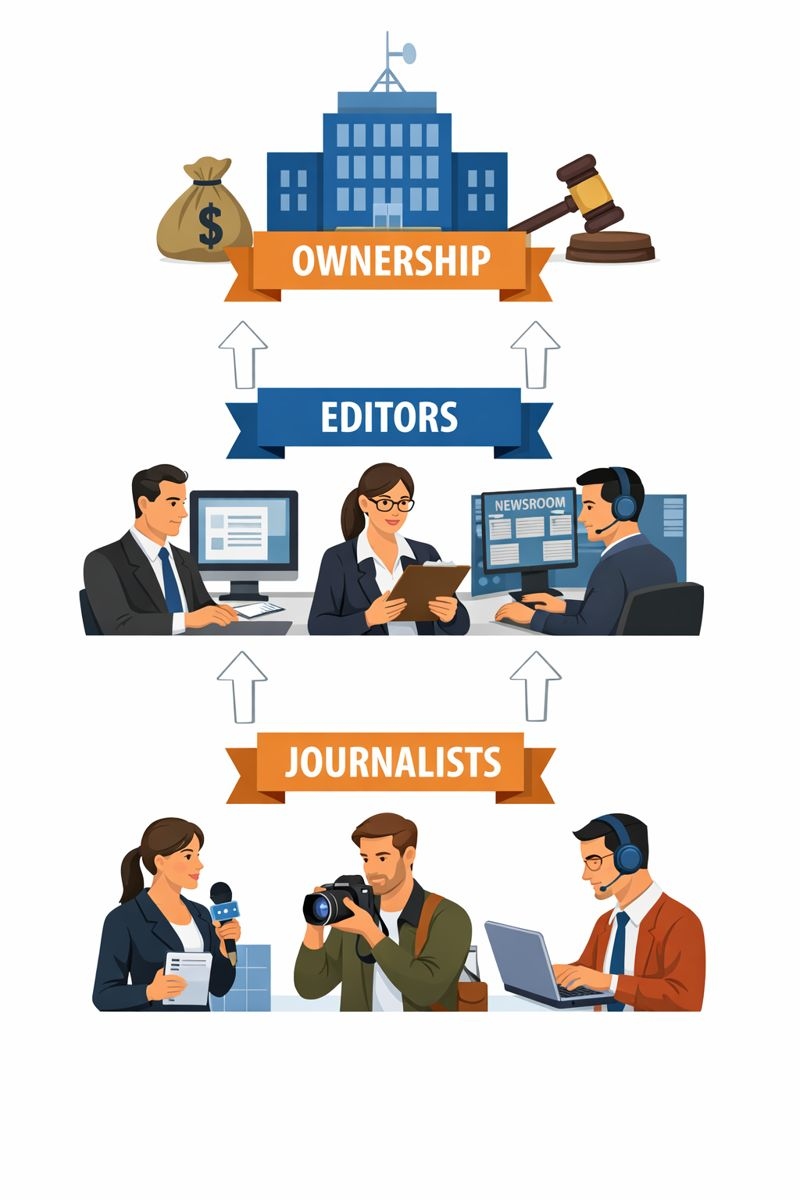
The media organizations are organized institutions just like education, religion, and government. They have official layers of command, rules, and professional conventions that direct the day-to-day running of things. These operations are based on the decision-making processes that deal with editors, journalists, owners, advertisers, and regulators. The following actors are all involved in the construction of media products and public discourse.
The focus in the literature on the internal processes of mass media firms on the significance of the analysis of the concentration of ownership, editorial autonomy, and economic pressure renders the concepts of mass media influence. The paper explores these internal workings of mass media organizations and how they influence the content production, framing, and presentation in the media field. The paper takes a qualitative approach of literature analysis of the institutional dynamics of the mass media without excluding the sociological, political economy, and communication theories. It will contribute to the studies of media by offering a systematic insight into how inner processes of media influence the discussion of people and democratic communication.
2.0 Literature Review
2.1 Organizational Structure of the Media and Institution
Mass media organizations are formal structures which are typified by hierarchical control, professional specialization, and routines (McQuail, 2010). These are their structures that are aimed towards efficiency, consistency, and control in content production. There are defined roles that leave the power and responsibility of making decisions in the hands of editors, reporters, producers, and managers.
Giddens (2013) holds that the institutional structures govern behavior by use of norms and rules, which influence individual agency. These rules in media organizations control news choice, sourcing practices, ethics, and editorial priorities. The informal communication is differentiated by the institutional character of media in relation to professional journalism.
2.2 Media Ownership and Control
One of the strongest factors that defines internal media dynamics is ownership. According to Bagdikian (2004) and McChesney (2015), having a small number of people owning mass media causes content homogenization and suppresses diversity of opinions. Media priorities and commercial and political interests are closely associated with corporate ownership.
As it has been found, the owners also affect strategic decisions, the allocation of resources, editorial preferences, and political orientation (Herman and Chomsky, 1988). Although the direct interference might be nuanced, ownership interests usually influence newswire culture and editorial limits.
2.3 Economic Forces and Commercialization
Media companies exist in market-driven markets that are focused on profitability and readership. The revenue of the advertisements, the ratings of the audience, and competition play a great role in the choice of the content and the manner of presentation. Picard (2011) asserts that economic forces promote sensationalism, entertainment-oriented programs, and simplified stories.
These pressures influence the journalistic autonomy and cause a clash between professional values and business survival. Staffing, investigative reporting, and covering marginalized issues are also affected by economic constraints.
3.0 Theoretical Review
3.1 Political Economy Theory
The theory of political economy focuses on how ownership, economic power, and market forces influence the media content. According to the propaganda model by Herman and Chomsky (1988), the media can be used to serve elite interests by means of concentration of ownership as well as advertising reliance and sourcing behaviors. In this respect, internal media relations are arranged in a way to sustain the predominant power relations and restrict critical discourse. Economic and political aspects affect editorial choices instead of the pure journalistic principles.
3.2 Gatekeeping Theory
The theory of gatekeeping describes the information filtering process involving several decision-making processes before it is shared with the general public. The concept was proposed by White (1950), who demonstrated the role of editors as gatekeepers in terms of receiving and rejecting news.
Further research proves that organizational routine, professional norms, time, and institutional priorities play a role in gatekeeping (Shoemaker and Vos, 2009). It is these internal filters that influence both the knowledge of the people and the visibility.
3.3 Agenda Setting and Framing Theories
Agenda-setting theory assumes that media shape the thoughts of the audiences on issues by highlighting particular issues (McCombs and Shaw, 1972). Framing theory builds on this by offering an explanation of how issues are framed by the media using language, tone, and context (Entman, 1993). Both theories emphasize the strength of internal editorial choices to build social reality and navigate the views of people.
4.0 Methodology
4.1 Research Design
This research takes a qualitative literature-based research design. The method allows a profound analysis of the available theoretical and empirical research on media ownership, control, and decision-making.
4.2 Data Sources
The literature sources included peer-reviewed journal articles, academic books, media policy reports, and reference material in the field of communication and sociology to draw data. The selection of sources was performed on the basis of relevance, academic credibility, and contribution to the media institutional analysis.
4.3 Method of Analysis
Recurring themes in terms of ownership influence, editorial control, gatekeeping processes, and economic pressures were identified through thematic analysis. The comparative analysis enabled the synthesis of the findings between the various media systems and settings.
5.0 Analysis and Findings
5.1 Editorial Direction and Patterns of Ownership
Results reveal that the editorial priorities are highly influenced by the ownership structures. Corporate and privately owned media organizations are more likely to align their content with the interests of the owners, the market preferences, and the demands of the advertisers. The press, which is publicly owned, is more serious regarding the values of public service without being free of being politically influenced.
The ownership influence is usually indirect and is realized through the appointments of managers, budgetary management, and culture.
5.2 Hierarchies of Editorial Control and Decision Making
In the content production, the editorial hierarchies are in the limelight. Editors are intermediaries between institutional policy and journalism. The senior editorial levels have monopolized the ability to make decisions and restrain newsroom independence. Content outcomes are more influenced by routine practices like deadlines, news values, and format constraints.
5.3 Gatekeeping and Representation
It is through gatekeeping processes that voices are either given a voice or put aside. High-profile sources, official channels, and views of the dominant are given more publicity, whereas suppressed and minority views are underrepresented. This tendency supports the status quo and restricts pluralistic discourse.
5.4 Economic Stress and Frame Content
Economic demands promote materials that appeal to huge audiences and advertising. This leads to more focus on entertainment, conflict, and sensationalism. Cost and risk tend to rank investigative journalism and public interest reporting as a low priority.
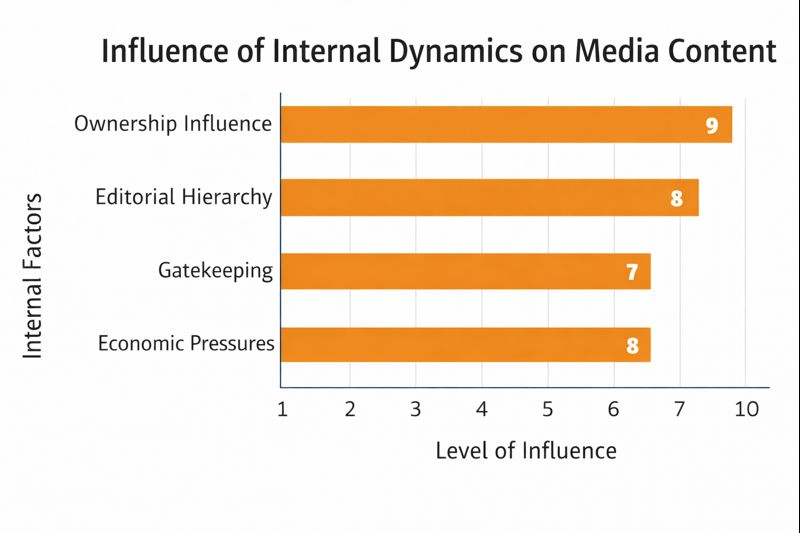
Figure 1: the bar chart provides a conceptual summary of the dominant internal forces shaping media content as identified across the reviewed literature.
6.0 Discussion
The results indicate that media influence can be centralized on internal processes of the mass media organizations. Ownership, control, and pressure in economics are intertwined with professional norms in an effort to influence content production and framing. Politically, through media institutions, dominant interests are favored by the power structure in which they operate.
These dynamics are further institutionalized through the process of gatekeeping and agenda setting, which affects the way people talk and their political involvement. The paper highlights the importance of transparency, ethical regulation, and media literacy to curb the adverse impacts of concentrated ownership and commercial interests.
7.0 Conclusion
Mass media organizations are multifaceted institutions, the dynamics of which greatly impact on communication in society. The patterns of ownership, editorial control, gatekeeping, and economic pressures altogether affect the information that will be presented to the population and the way it will be understood.
The internal processes are to be understood to assess media credibility, foster democratic values, and be socially accountable. With the ongoing changes in the media system in the digital age, the importance of critical analysis of the internal media dynamics is crucial to the continued existence of informed and inclusive societies.
References
Bagdikian, B. H. (2004). The new media monopoly. Beacon Press.
Entman, R. M. (1993). Framing: Toward clarification of a fractured paradigm. Journal of Communication, 43(4), 51–58.
Giddens, A. (2013). Sociology (7th ed.). Polity Press.
Herman, E. S., & Chomsky, N. (1988). Manufacturing consent. Pantheon Books.
McChesney, R. W. (2015). Rich media, poor democracy. The New Press.
McCombs, M. E., & Shaw, D. L. (1972). The agenda-setting function of mass media. Public Opinion Quarterly, 36(2), 176–187.
McQuail, D. (2010). McQuail’s mass communication theory (6th ed.). Sage.
Picard, R. G. (2011). The economics and financing of media companies. Fordham University Press.
Shoemaker, P. J., & Vos, T. P. (2009). Gatekeeping theory. Routledge.
White, D. M. (1950). The gatekeeper: A case study in the selection of news. Journalism Quarterly, 27(4), 383–390.