Introduction
The modern competitive and dynamic business environment is putting more and more pressure on organizations to successfully accomplish projects using limited resources, time constraints, and complex stakeholder demands. It is not just in construction, information technology, education, medical or business development but projects are not merely assemblies of activities but are systems interrelated and need to be managed in structure. This is where Integrated project management plays an important role.
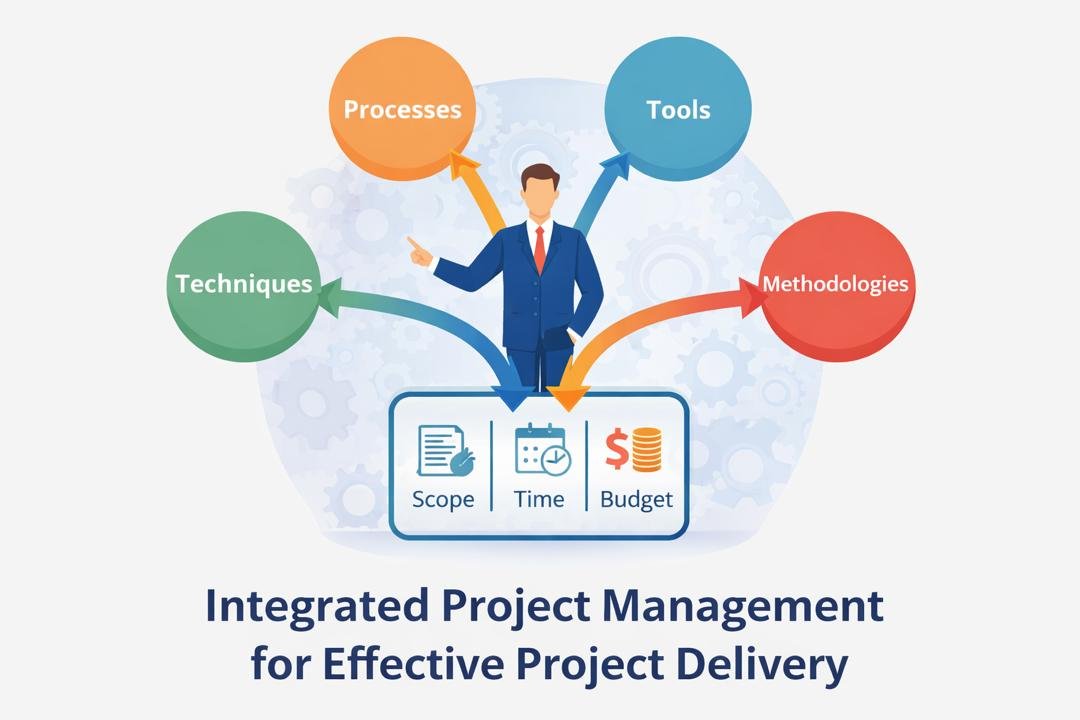
There is no single action that can be fulfilled through a single skill and there is no integration of a single project in this regard, it is a matter of alignment and integration of processes, tools, techniques, and methodologies to deliver the project effectively. Whenever these elements work in harmony, project teams are able to coordinate, uncertainty can be reduced, and risks can be managed and the objectives can always be delivered within scope, time, and budget.
This article delves into the way these elements relate and why taking a holistic approach to the project management helps a project a lot.
Understanding Project Management Integration
Project management integration is defined as the coordination of all the elements of the project to a complete system. It guarantees that the decisions being made in one area (e.g. scheduling) can be made to coincide with other areas (e.g. budgeting or risk management). In the absence of integration, the projects end up with miscommunication, reduced efforts, resulting in conflicting priorities, as well as wastage of resources.
Integration cannot be described as a one-time event but a process that takes place through the project life cycle. It compels the project managers to think as a whole, so that the goals, tasks, tools and people are geared towards achieving the same objectives.
Simply stated, integration answers the question: How do the entire components of the project work together to bring value?
The Role of project management processes
Project management processes give the structure of running of projects. They determine what to do, when to do it, and the way to control it. These processes are normally divided into five large phases:
- Initiation: The purpose, objectives and stake holders of the project.
- Planning: Creation of elaborate scope, time, cost, quality, risks and resource plans.
- Execution: The process of implementing the project plan and the development of deliverables.
- Monitoring and Control: Keeping the track of the progress, handling of the changes and adhering to the goals.
- Closure: Delivering final deliverables, releasing resources and performance appraisal.
These processes guarantee uniformity and a pathway of undertaking activities in an orderly manner. Nevertheless, processes cannot do enough. In order to be effective, they have to be assisted by the necessary tools, techniques, and methodologies.
Project Management Tools: Efficiency Facilitators.
Project management tools are useful tools that facilitate the process of project planning, organization, tracking, and control by teams. They convert the abstract plans into working processes. Examples include:
- Gantt charts: Graphical timetables.
- Project management software: Systems like scheduling or collaboration systems.
- Risk registers: Records that are utilized to determine and monitor project risks.
- Budget tracking tools: To control financial performance.
- Communication tools: Dash boards, collaboration platforms, and Emails.
Tools boost productivity by automatizing most of the repetitive duties, enhancing communication, and rendering real-time information on which to make decisions. When effectively combined with project management procedures, the tools ease the administrative load and enable the managers to concentrate on the strategic problems instead of technicalities.
An example is at the planning stage, scheduling tools are used to convert timelines into visual charts and budgeting tools are used to keep cost estimates in line with the available resources. Collaboration tools keep the stakeholders involved and updated in the process.
Techniques: The Applicability of Knowledge.
Although, tools are the means, techniques are the methods or practices that are utilized in the application of project management knowledge. They include:
- Work Breakdown Structure (WBS).
- Critical Path Method (CPM)
- Risk analysis techniques
- Stakeholder analysis
- Earned Value Management (EVM)
- Expert judgment and brainstorming.
Techniques assist project managers to analyze situations, resolve issues and make sound decisions. As an example, risk analysis methods give managers an opportunity to recognize possible risks and come up with mitigation measures before they arise.
Techniques fill in the gap between theory and practice. They make sure that the tools and processes are not applied mechanically but are applied strategically, depending on the project context and objectives.
Methodologies: Frameworks for Structured Delivery
Project management methodologies are elaborate structures that lay out the manner in which projects should be conducted. They offer principles of guidance, best practices and standard procedures. The usual methodologies are:
- Traditional (Waterfall): Sequential and plan-driven.
- Agile: evolutional and adaptable.
- Scrum: is a subdivision of Agile that is based on sprints.
- PRINCE2: Process approach focusing on governance.
- Hybrid: It is a blend of traditional and agile.
Methodologies affect processes, tools, and techniques choice and implementation. To give an example, agile projects are dependent on collaboration tools and iterative approaches where traditional projects focus on detailed planning tools and documentation.
The selection of the methodology is based on the complexity of project, industry, expectations of the stakeholders, and culture of the organization.
The Strength of Integration Across All Elements
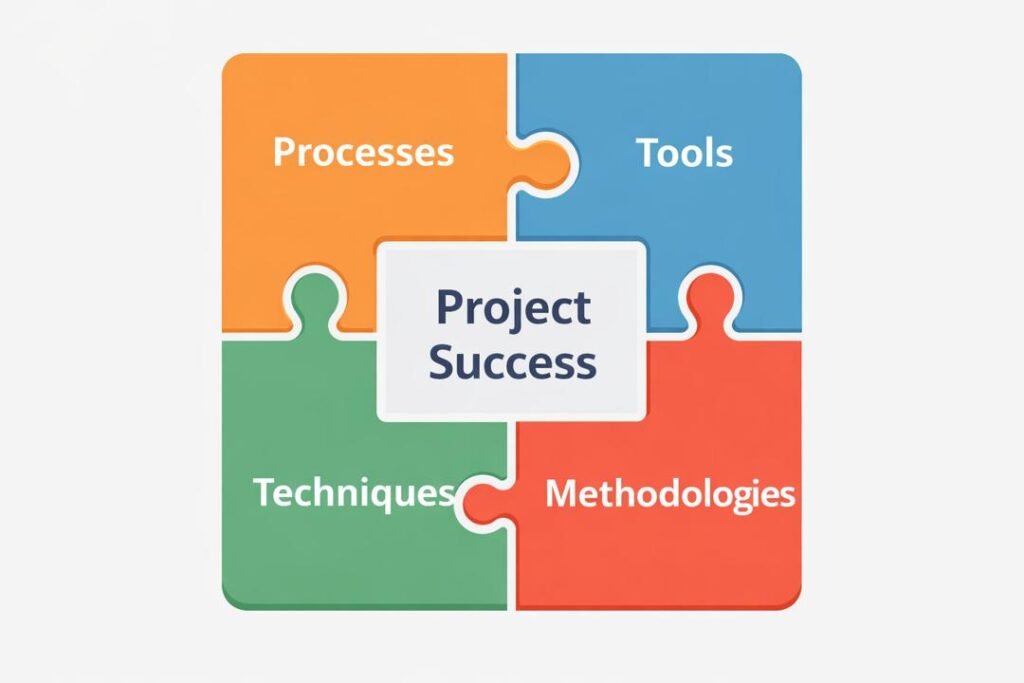
Integration is the real power of the project management. Independent operation of processes, tools, techniques, and methodologies leads to inefficient boards of projects. Integration ensures that:
- Processes are what determine what should be done.
- Tools give the manner in which tasks are performed.
- Techniques are the methods of putting knowledge into use.
- Methodologies stipulate the general approach.
They combine in creating a unified system that improves the performance of projects.
For example:
- The planning phase defines work structure based on the methodology (e.g. Agile).
- Planning activities are defined in terms of processes.
- Backlog boards and others are tools that manage the task.
- Such techniques as prioritization make sure that a proper allocation of resources is made.
The consistency is achieved because this alignment eliminates contradictions, minimizes confusion, and encourages consistency.
Enhancement of Co-ordination through Integration
Increased coordination is one of the huge advantages of integration. Projects entail various stakeholders, departments and resources. In the absence of integration, communication breaches and confusion of roles are very likely.
Integrated project management is one that makes sure:
- Every stakeholder is aware of project objectives.
- There is a smooth flow of information between teams.
- Harsh roles and responsibilities are well outlined.
- It is a decision-making based on mutual data.
As an example, the team members can also be notified in real-time about changes in the tasks by integrating the communication tools with scheduling systems. This will shorten operating time and will improve collaboration.
Risk Reduction through a Holistic Approach
Projects are risky in nature because of the uncertainties based on scope, costs, time and quality. When the management is divided, it exposes it to more risks since issues in one area could take time to be realized before it could get out of hand.
Integration allows proactive risk management by:
- Connecting risk register with planning tools.
- Predicting possible problems with analytical methods.
- Making the risk responses agree with project goals.
The risk management that is integrated into every project process enables the teams to detect the threats early and evaluate the impact of these risks and undertake preventive measures. This minimizes chances of failure of the project.
Improving Decision-Making and Control
On integrated systems, managers receive the right information at the right time and in the most comprehensive way. This enhances the decision making and the control of the project.
One example is the performance tracking tools used in conjunction with other methods like the Earned Value Management which will give an indication of cost and schedule performance. Managers are then able to make informed decisions in order to correct the deviations before they become critical.
In the absence of integration, decisions are usually made using incomplete or old information hence ending in poor results.
Meeting Scope, Time and Budget Objectives
The final project management objective is to create value within a specified limit. Integration contributes significantly towards this aspect, with regard to maintaining balance of scope, time and budget.
- Scope is being processed in systematic ways and analysis of the stakeholders.
- Scheduling tools and critical path techniques are used to manage time.
- Budget is kept track of by use of cost management software and financial monitoring strategies.
Trade-offs can be taken into consideration when these elements are combined. As an illustration, expanding the scope can necessitate extra resources or longer schedules and integrated systems can assist managers to evaluate such effects impartially.
Advantages of Integrated Project Management to an Organization
There are a number of long term advantages associated with using integrated project management practices by organizations:
- Increased success rates: Projects have increased chances of achieving success.
- Higher efficiency: Less duplication of efforts.
- Improved stakeholder satisfaction: Openness and honesty.
- Knowledge retention: Knowledge learned is captured and reutilized.
- Strategic alignment: Projects help in organizational objectives.
Integration also fosters a culture of teamwork and continual improvement in which teams can learn and develop their practices as time progresses.
Problems with Achieving Integration
Integration is not a simple process to be made despite its advantages. Common challenges include:
- Resistance to change
- Lack of standardized tools
- Poor communication
- Inadequate training
- Organizational silos
To counteract these hurdles, organizations have to invest in capacity building, develop a well-defined governance framework and foster leadership devotion.
Effective integration Strategies
To achieve successful integration, the project managers and organizations must:
- Select an appropriate methodology that is in line with the project requirements.
- Use coordinated tools in the departments.
- Educate the train teams about standard methods and practices.
- Promote cooperation and knowledge transfer.
- Nurture on-going process monitoring and improvement.
The strategies also make integration not a mere concept but a reality.
Conclusion
Effective project delivery is impossible without integrating processes, tools, techniques and methodologies. The items have individual functions, but their real value becomes apparent when they are used as a single organism.
One of the benefits of a holistic approach to project management is better coordination, lowering risks, better decision-making, and probability of meeting project objectives within scope, time, and budget. It has ceased to be an option in a business world that is becoming more and more intricate in nature, integration is a strategic requirement that will ensure long term success.
Integrated project management allows organizations to turn projects into an isolated undertaking into a force behind creativity, effectiveness and sustained expansion.
Get more well researched information about integrating process for project delivery here.