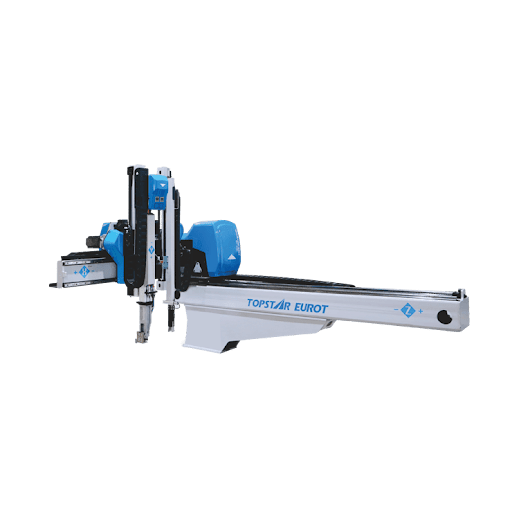
In high-volume injection molding, ejection speed is no longer a secondary factor—it directly determines production cycle time, part quality, and overall equipment efficiency. With shorter production cycles and increased mold cavities, the injection molding robot is no longer merely auxiliary equipment; it has become a key component in improving production efficiency. Selecting the right high-speed ejection injection molding robot requires a deeper understanding of motion dynamics, control response, and system integration.
Injection Molding Robot Speed and Stability: Finding the Right Balance
Speed is the most important metric for most buyers, but speed alone does not guarantee successful high-speed ejection. Injection molding robots must accelerate, decelerate, and stop with extremely high precision without causing vibration or part deformation. Excessive acceleration coupled with insufficient stiffness can lead to part drop, vacuum leaks, or mold interference. Conversely, a conservative motion profile, while protecting parts, limits the potential for reducing cycle count. The key lies in a balanced design. High-speed injection molding robots should combine lightweight motion structures, high-torque servo drives, and optimized motion profiles.
Injection Molding Robot Payload and End Effectors for Rapid Removal
As removal speeds increase, payload becomes increasingly critical. While many molded parts are lightweight, their payloads include fixtures, vacuum generators, sensors, and air hoses, and sometimes multiple parts need to be handled simultaneously.
During high-speed material handling, heavier molds increase inertia, directly limiting achievable acceleration and braking performance. Therefore, an injection robot designed for high-speed material handling typically combines moderate payload capacity with ultra-lightweight end effectors. From an engineering perspective, reducing tooling mass is generally more effective in reducing cycle time than increasing motor power. Therefore, tooling design and robot selection must be evaluated together, not separately.
Motion Path and Mold Clearance Considerations
High-speed material handling is not just about speed—it’s about efficiency. Seemingly insignificant motion paths on paper can accumulate to significant productivity losses after millions of cycles, and these millisecond delays can also result in substantial productivity losses.
The injection robot must enter and exit the mold area cleanly and precisely synchronize with the mold’s opening and ejection times. Insufficient stroke, poor axis alignment, or too many intermediate points will all affect speed and safety. Optimized robot geometry and smooth interpolation technology enable robots to approach molds faster without increasing the risk of collisions. In high-speed environments, “the shortest path is rarely a straight line—it is often the wisest path.”
Control System and Response Time
The control system is the core of high-speed material handling. Even with a robust mechanical structure, an injection molding robot cannot operate efficiently if its controller has a slow response time and cannot be precisely synchronized with the injection molding machine. Modern high-speed robots rely on real-time communication with the injection molding machine to coordinate processes such as mold opening, ejection, and removal. Millisecond-level delays can lead to decreased production efficiency or operational instability.
Advanced servo algorithms, high-resolution encoders, and adaptive motion control technology enable injection molding robots to maintain consistency even under changing cyclic conditions. From the buyer’s perspective, controller performance is just as important as mechanical speed.
Reliability under Continuous High-Speed Operation
High-speed material handling places continuous stress on robot joints, bearings, and transmission components. Over time, poorly matched robots will experience accelerated wear, increased backlash, and decreased repeatability. A well-designed high-speed injection molding robot operates within a safe dynamic range, ensuring smooth movement and extending service life. This helps reduce unplanned downtime and stabilize production costs. As one factory manager observed after upgrading automation equipment, “The fastest robots we’ve ever bought are also the ones with the fewest malfunctions.” Reliability is not a compromise, but a prerequisite for sustainable high-speed production.
Engineering for Sustained Speed
Choosing an injection molding robot for high-speed output is an engineering decision with long-term operational implications. Speed, payload, control performance, and reliability must be comprehensively evaluated to avoid short-term gains leading to long-term problems. The most successful high-speed automation projects focus on balance, not extremes. By understanding the factors that truly drive high-speed output performance, manufacturers can invest in injection molding robots to achieve faster cycle times, more stable operation, and a longer-lasting return on investment.