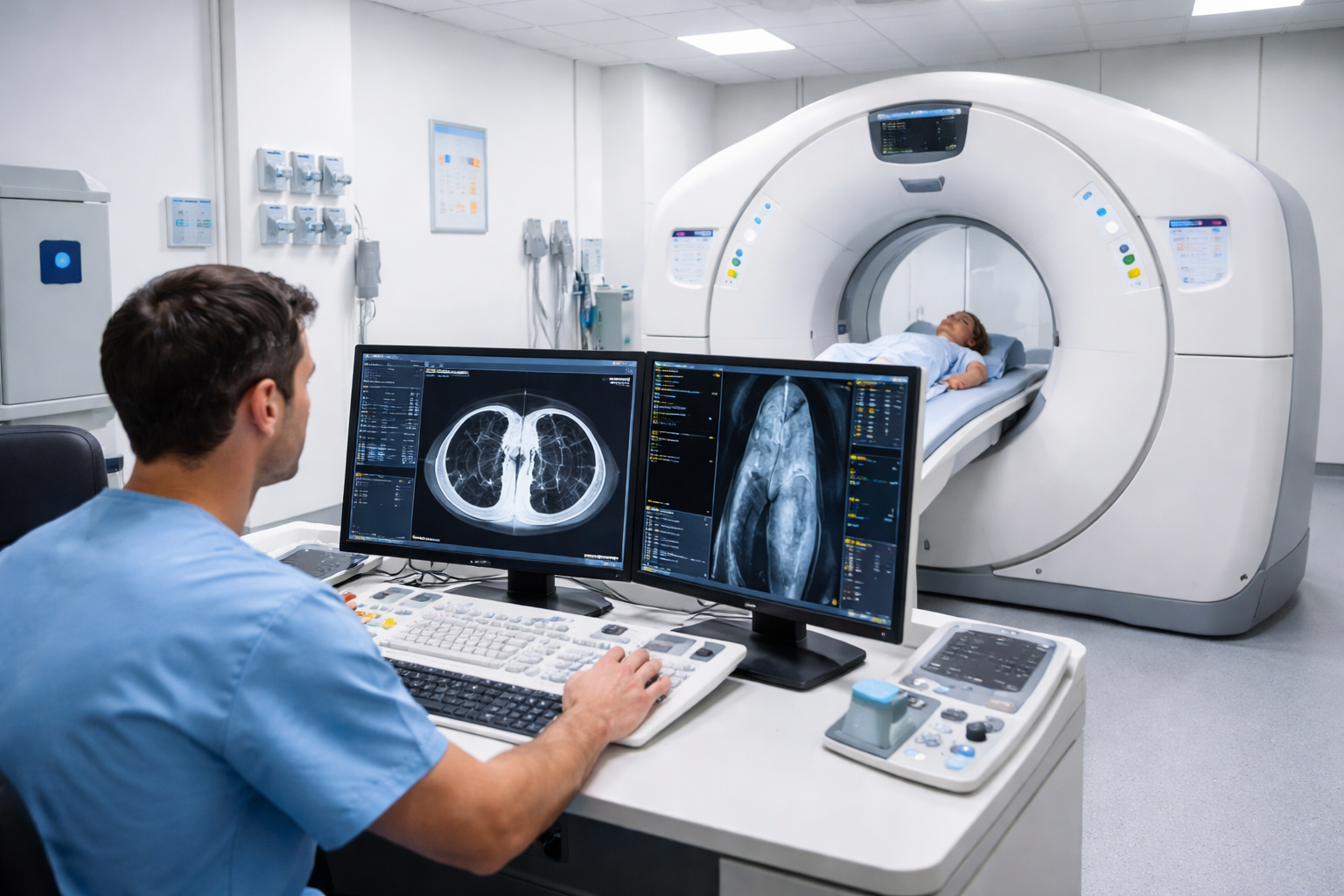
Medical imaging is now at the center of the healthcare system as it enables clinicians to see the internal structures of the body without subjecting the body to invasive operations. Such technologies help provide the correct diagnosis, plan the treatment, and provide a possibility to monitor the development of the disease.
With the further development of imaging technology, there is a great variety of modalities, and they provide different diagnostic benefits. There are however significant safety concerns to consider alongside these advantages such as the effects of radiation and patient safety. The awareness of various imaging modalities and associated risks not only to the healthcare professionals but also to the patients is critical. The right application of safety measures will mean that the diagnostic advantages of imaging will outshine the risks. This paper will discuss the key imaging modalities, the importance of safety measures, reduce risks, and the importance of imaging professionals in the safe and ethical application of imaging modalities.
Learning Imaging Modalities
The medical imaging modalities are commonly categorized into ionizing and non-ionizing, according to the use of ionizing radiation. The ionizing radiation possesses sufficient energy to strip atoms off electrons, and when exposed in excess or repeated dosage, may cause damage to the cells. Non-ionizing modalities, in turn, are not characterized by ionizing radiation and are usually regarded as being safe to use as long as they are used properly.
The imaging modality is determined by the clinical requirements, the patient status, the diagnostic quality and the safety of the imaging modalities.
X-Ray Imaging
Overview
One of the oldest and widespread diagnostic methods is the x-ray imaging. It operates through the transmission of X-rays through body with the various tissues absorbing radiations to different extents. Thick tissue like bones would absorb a higher number of X-rays and appear white on the picture whereas the weaker tissues are dark. The traditional radiography, mammography, and fluoroscopy are common.
Safety Considerations
X-rays use ionizing radiation thus making them dangerous to health. Even though the dose of X-rays on people is normally small, when it is unnecessary or repeated, it may lead to higher lifetime cancer risk. Safety measures include:
- Lead shielding of sensitive organs
- Collimation to narrow down to the region of interest the X-ray beam
- Correction of exposure variables according to age and body size of patients
The tasks of imaging professionals are to make sure that X-ray examination is clinically necessary and conducted at the minimal radiation dose.
Computed Tomography (CT)
Overview
Computed Tomography (CT) is a high-tech method of imaging whereby, various X-rays projections are made at various angles to create cross-sectional images. CT scans are very useful especially in trauma, cancer and vascular imaging, since they give anatomical details that are detailed.
Safety Considerations
CT scans give more exposure to patients of higher levels of ionizing radiation than regular X-rays. Key safety measures include:
- Exposure control systems Automatic exposure control systems
- Low-dose CT protocols
- Different clinical justification of each scan
The CT tests should be done only when the diagnostic benefit is clear and the risks are low compared to the benefits especially in children and young adults who are more sensitive to the radiations.
Magnetic Resonance Imaging (MRI)
Overview
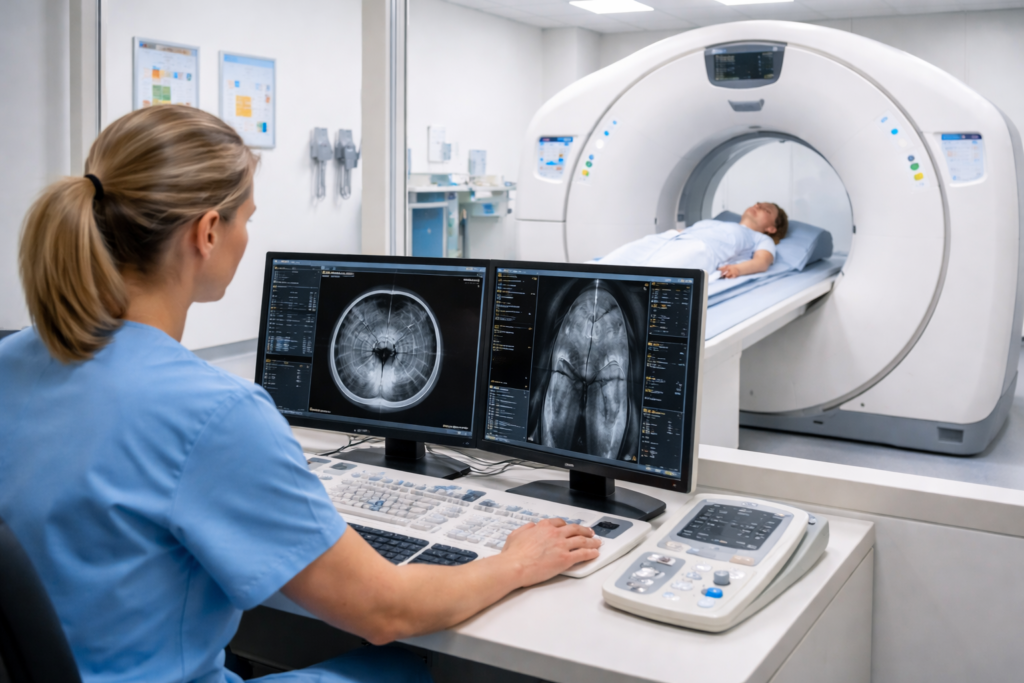
MRI is non-ionizing imaging modality, which involves the use of powerful magnetic fields and radiofrequency pulsation to produce images of soft tissues in details. MRI is very handy in brain imaging, spinal cord, muscle imaging and internal organ imaging.
Safety Considerations
Even though MRI does not observe the effects of ionizing radiation, it has special safety issues. It is possible that strong magnetic fields will cause metallic objects to become dangerous projectiles and some implants will malfunction or get hot during a scan. Safety precautions include:
- A diagnosis of metallic devices and implants in patients
- Ensuring high-security in MRI suites
- Securing that imaging professionals adhere to MRI safety measures
It is important to prepare the patients correctly and educate the staff in order to avoid accidents or discomfort.
Ultrasound Imaging
Overview
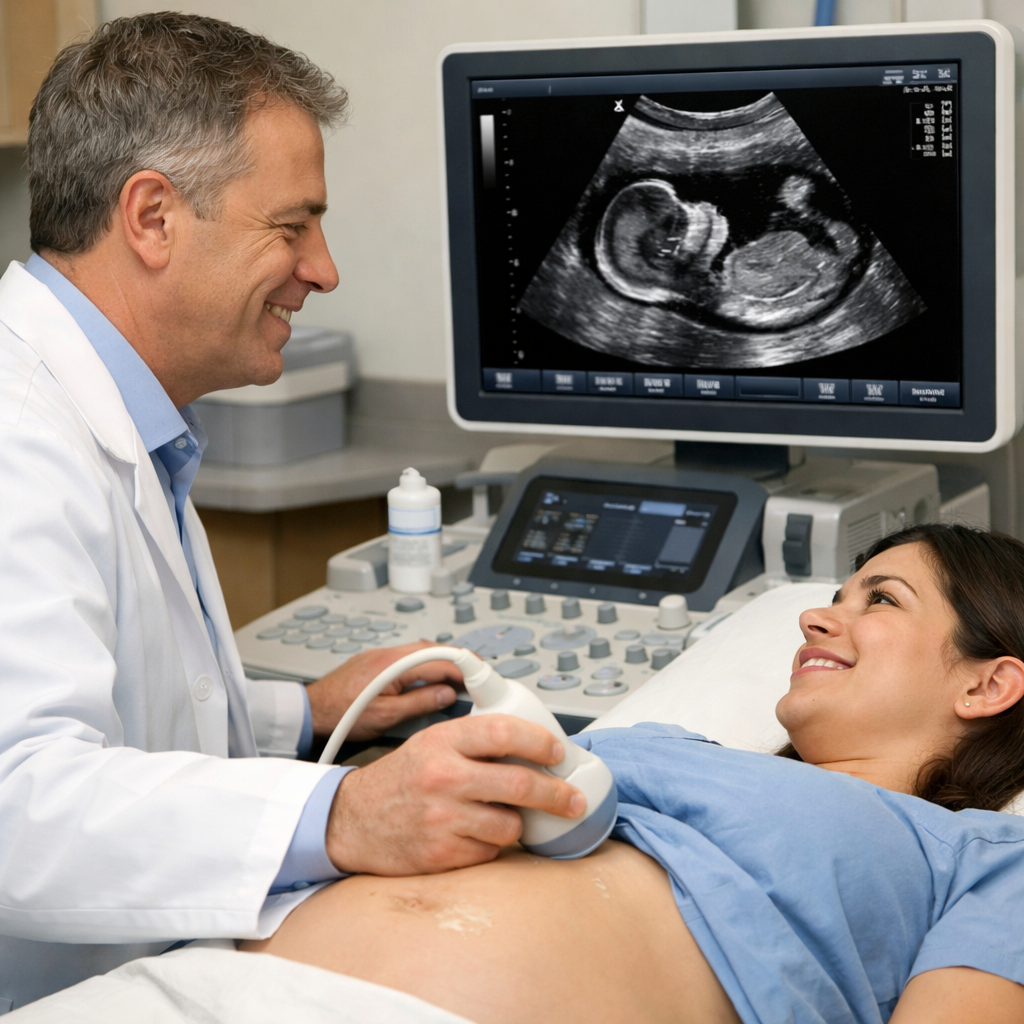
Ultrasound involves the use of high frequency sound waves in generating images of internal organs and tissues. The device is extensively used in obstetrics, cardiology, and emergency medicine because it is portable, has a real-time image, and there is no ionizing radiation.
Safety Considerations
Ultrasound is regarded to be safe, and the biological effects are minimal. However, with long time exposure, or inappropriate use it can lead to tissue heating or cavitation. Minimizing risk involves:
- The use of the principle of ALARA (As Low As Reasonably Achievable)
- Maintaining a minimum exposure time possible
- Having examinations done by trained experts only
Nuclear Medicine
Overview
Nuclear medicine deals with the use of low doses of radioactive materials called radiopharmaceuticals to measure the functioning and metabolism of the organs. The techniques of Positron Emission Tomography (PET) and Single Photon Emission Computed Tomography (SPECT) give functional information that is not available in other imaging modalities.
Safety Considerations
Nuclear medicine is sensitive to the use of ionizing radiations and dose management and handling is essential. Safety measures include:
- Correct dose calculation depending on the size of the patient
- Effective storing and disposing of radioactive materials
- Adherence to the regulatory safety measures
These measures safeguard the patients, healthcare professionals and the environment.
The Significance of Safety Procedures in Medical Imaging
The issue of patient safety is one of the major concerns in medical imaging. The largest risks are associated with ionizing radiations, contrasting agents, and hazards based on modality. The safety measures assure that the imaging procedures are responsible, ethical, and protective both to the patients and the staff.
Radiation Protection Principals
There are three principles of radiation protection:
Justification
All imaging services should be clinically warranted. It is upon imaging professionals to balance expected diagnoses of the diagnostic advantages with radiation risks.
Optimization
The equipment setting and techniques used are to be streamlined so that the images generated are of high quality and that the radiations are minimal.
Dose Limitation
The dose limits safeguard both the medical personnel and the citizens. To the patient, exposure to unnecessary things should always be avoided.
The Role of Imaging Professionals
Radiologists, radiographers, and technologists are very essential in safe imaging practices. They have the following duties:
- Patient history assessment and contraindication
- The choice of the most suitable imaging modality
- Taking the steps to reduce exposure through the optimization of technical parameters
- Patient education on operations and security
- Making periodical maintenance and testing of imaging equipment
The imaging professionals will use their professional knowledge to make procedures safe, effective, and ethically justified.
Reduction of Risk by Means of Technological Progress
The modern imaging systems have equipment that are safer and less risky to the patient:
- SAlteration of dose in CT scanners
- Enhanced efficiency in the detector that needs less radiation
- Image Processing that improves image quality
These innovations minimize the necessity of repeated scans and enhance the level of diagnostics alongside saving patients.
Safety of Patients and Ethics
In imaging, patient centered care is necessary. Some ethical responsibilities are:
- Obtaining informed consent
- Securing confidentiality of patients
- Elimination of redundant or unnecessary imaging, studies
Particular focus should be on the most sensitive groups, such as the children and pregnant women, who are more radiation sensitive.
Trends in Imaging Safety in the Future
Imaging safety is still enhanced by emerging technologies:
- Machine learning to streamline procedures and minimise scanner redundancy
- Cumulative exposure monitoring dose tracking software
- Increase in non-ionizing imaging applications e.g. enhanced ultrasound and MRI
These technologies facilitate safer, more efficient and even personalized imaging.
Conclusion
Medical imaging is an essential part of the contemporary healthcare, it offers essential diagnostic and therapeutic data. Nevertheless, every type of imaging has certain safety concerns. Imaging professionals uphold patient protection by being exceptionally dedicated to safety measures, continued technological advances and professional ethical practices.
Imaging technology could further develop healthcare by striking the right balance between diagnostic advantages and minimization of hazards and promote the highest care and accountability.