Water is among the most basic and yet it is mostly neglected in terms of digestive health. Although much attention is often paid to such nutrients as carbohydrates, proteins, fats, vitamins, minerals, hydration is also an essential factor in a healthy digestive system. Lack of enough water in the digestive system will result in discomfort, poor absorption of nutrients, and chronic gastrointestinal disorders.
The process of digestion is a complicated symbiosis of organs, enzymes, fluids, and movement. Water helps in almost all stages of this process, the breakdown of food in the mouth, and absorption of nutrients in the intestines and removal of resource wastes in the body. This may be interrupted by inadequate hydration after which constipation, bloating, indigestion, and poor absorption of nutrients are experienced.
This article examines the importance of digestion and nutrient absorption. It describes the role of water in enzyme activity, digestion, and nutrient absorption, stool softening, and prevents digestive discomfort. There are also practical hydration tips that can be adopted in order to keep the readers in the best state of gut functionality and overall health.
Learning about the Digestive Process
It is through the digestive system that food is broken down into nutrients which can be absorbed and used by the body to generate energy, grow and develop. In the mouth, the process starts and proceeds to the esophagus, stomach, small intestine, large intestine and the rectum.
Digestion encompasses mechanical and chemical processes. Mechanical digestion involves the breakdown of food into smaller particles by chewing and muscular contraction whereas chemical digestion involves the breakdown of nutrients to smaller molecules using enzymes and digestive juices. Both processes require the use of water, as it helps in the transportation of foods as well as the activation of digestive enzymes.
In the absence of proper hydration, digestion is slowed down and the body is incapable of digesting efficiently. It may cause GIT discomfort, and malabsorption.
The Water and Digestion Role in Absorption of Nutrients
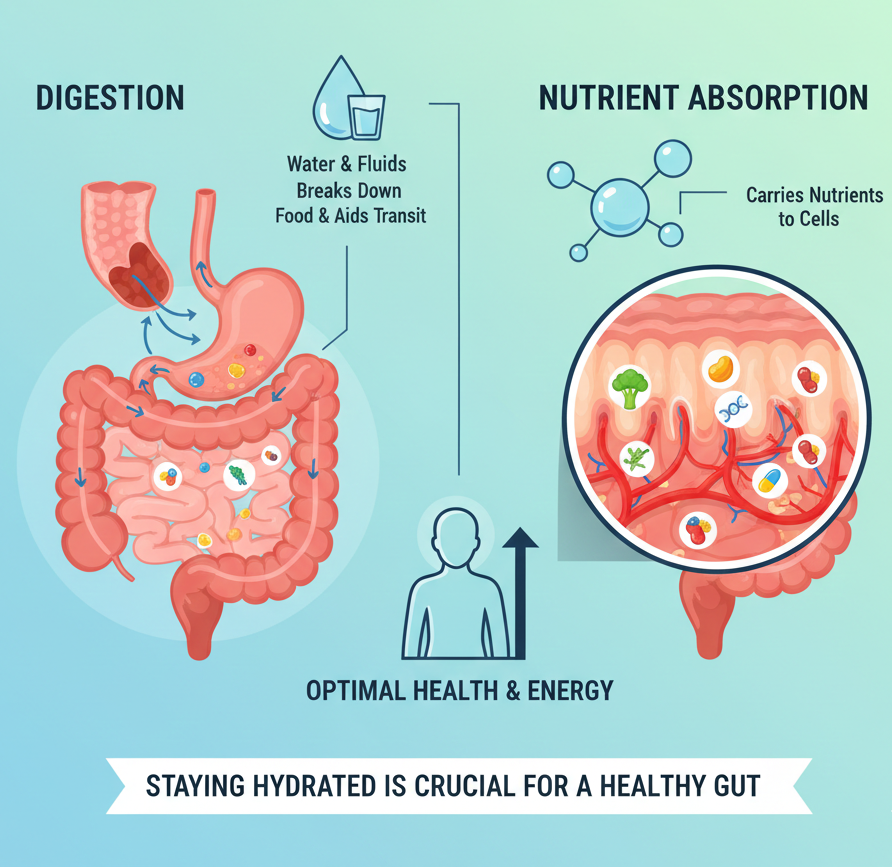
Water has a key role in digestion and absorption of nutrients by aiding the digestion of food and transportation of nutrients to other body parts. Enzymes used during digestion need a liquid atmosphere. These enzymes digest carbohydrates, proteins, and fats into digestible types.
Water aids in a mixture of food and gastric juices in the stomach to create a semi-liquid food, which then flows easily to the small intestine. Water aids in absorption of the nutrients into the bloodstream in the small intestine. Other nutrients like glucose, amino acids and minerals are dissolved in water, hence, enabling them to penetrate intestinal lining with ease.
Lack of water may also retard digestion and lower absorption of nutrients in the body rendering the body to be undernourished despite sufficient food consumption.
Fluidity and Enzyme Action
Digestive enzymes are proteins which are specially designed to accelerate chemical reactions in the digestive system. The enzymes are dependent on water to hold up their structure and perform effectively. In the absence of enough hydration, enzyme functions get slowed down, making food breakdown impossible.
The initial fluid that is involved in digestion is saliva, which is a fluid that contains enzymes used in digestion including amylase. The level of hydration is very important in saliva production. In case of dehydration, the level of salivation decreases, which complicates the process of chewing and swallowing, slows down the whole digestion and further weakens it at the initial stages.
Equally, gastric and small intestinal enzymes work best when the environment is well-hydrated. Enzymes are able to contact food particles effectively thereby facilitating complete digestion provided they are properly hydrated.
Water and Stomach Function
Stomach depends on water to form gastric juices which help in digestion. These juices have hydrochloric acid and enzymes that digest proteins and destroy the diseases causing microorganisms. Water assists in support of the right amount of acidity in the stomach, and therefore, the digestive process goes on smoothly.
Hydration is also sufficient to avoid irritation of the stomach lining. In case the stomach does not have enough fluid, the levels of acid may be too high, which can lead to the development of discomfort and indigestion.
Consumption of water aids in the motility of the stomach and food enters the intestines to be digested further.
Small Intestinal Hydration
Majority of nutrient absorption occurs in the small intestine. Water is essential in the dissolution of nutrients and transportation of nutrients across the intestinal wall to the bloodstream.
The pancreatic and liver digestive secretions are combined with water to dispose fats, carbohydrates and proteins. These secretions are dependent on hydration to keep them effective.
Lack of water reduces nutrient absorption effectiveness which at long run may cause fatigue, weakness, and nutrient deficiencies.
Water and Stool Formation
The fact that water affects the formation of stool is one of the most famous functions of water in digestion. Water aids in softening the stool which becomes easy to push through the colon. In cases of low hydration, the colon will absorb a higher level of water in waste material thus causing hard, dry stools.
This procedure elevates the threat of constipation which may bring in discomfort, bloating, and pains to the abdomen. There is also the possibility of hemorrhoid or bowel obstruction as a consequence of chronic constipation.
Proper water consumption guarantees the passage of waste along the digestive tract without complications, which promotes normal bowel movement and general gut ease.
Hydration in Preventing Constipation
One of the digestive disorders that are usually associated with incomplete fluid consumption is constipation. Although fiber has often been highlighted as a means of preventing constipation, fiber is not effective in the absence of water. Fiber may even increase constipation in the absence of adequate water.
Hydration is acting in conjunction with dietary fiber that gives stool bulk and softness. Water aids in the enlargement and passage of the fibers in the intestines resulting in normal discharge.
The simplest and most efficient method to prevent constipation and keep the digestive regularity is to ensure that a person is properly hydrated.
Flattening and Demystification of Hydration and Bloating
Another frequent digestive complaint which is related to dehydration is bloating. The digestive system becomes deficient in water, and as the water level decreases, the digestion process becomes slower, which gives an opportunity to the gas to accumulate in the intestines.
Consuming adequate water aids in excretion of surplus sodium in the organism, lowering water retention and abdominal bloating. Hydration also helps in efficient digestion which lowers the fermentation of undigested food which may lead to the production of gases.
Drinking plenty of water during the day will help a lot to alleviate bloating and digestive pain.
Hydration and Gut Motility
Gut motility is the act of passage of food and waste into the digestive tract. Water helps in this movement as it lubricates the intestines and helps muscular contractions called peristalsis.
Dehydration reduces gut motility, which means that the food will take a longer period in the digestive system. This may lead to constipation, gas and discomposure.
Adequate hydration means the digestion process is smooth and efficient and therefore, the health of the gut is enhanced.
Symptoms of an Insufficient Water Supply and Digestive System
Among the initial symptoms of dehydration are usually digestive symptoms. They can be dry mouth, problems with swallowing, constipation, bloating and indigestion.
Prolonged dehydration may have an adverse effect on the absorption of nutrients, the strengthening of the intestinal lining, and the balance of gut bacteria. The consequences can be added to chronic digestive problems and poor health.
The relationship between hydration and digestion enables people to treat the symptoms at an early stage by making simple changes to their lifestyles.
Useful Hydration Advice to Improve Bowel Health
To be hydrated does not need complex techniques. Simple routines may aid in the digestive process and well-being.
It is always better to drink water slowly during the day than taking it in huge quantities at the same time. Fruits and vegetables are also water rich and hence hydrating.
Analysis of urine color can give the approximate idea of hydration conditions. The pale-yellow urine usually indicates that a person is well hydrated but urine that is darker may indicate that a person requires more fluids.
Fluid Requirement and Personnel Dissimilarity
The hydration requirements differ depending on the age, activity, climate and health status. Fluid requirements are elevated due to physical activity, elevated temperatures, and illnesses.
It is noteworthy to listen to the thirst cues of the body, but not everyone will necessarily be a good predictor of hydration requirements. Having regular drinking habits is a way of making sure that one is hydrated.
Personal fluid intake helps to aid in the best digestion and intake of nutrients.
LTC Effects of Hydration
Regular hydration is not only good in digestion, but health in general. Proper digestion and absorption of nutrients make an individual produce energy, enhance immune system and repair of tissues.
Hydration enhances the quality of life and prevents the emergence of long-lasting digestive complications by avoiding digestive discomfort and promoting the wellbeing of the gut.
Learning how to be hydrated is an easy but effective measure towards many years of wellness.
Conclusion
Water plays a very crucial role in healthy digestion and absorption of nutrients. Hydration is very important in all the phases of digestion, such as aiding enzyme activity and stomach functions, softening stools and constipation.
Poor hydration may interfere with digestion to cause discomfort, bloating and lack of nutrient absorption. With correct fluid consumption and making the development of easy hydration routines, one can facilitate digestive effectiveness and whole gut condition.
The subject of the hydration significance will enable the readers to make wise decisions to enhance prolonged digestive comfort and health.