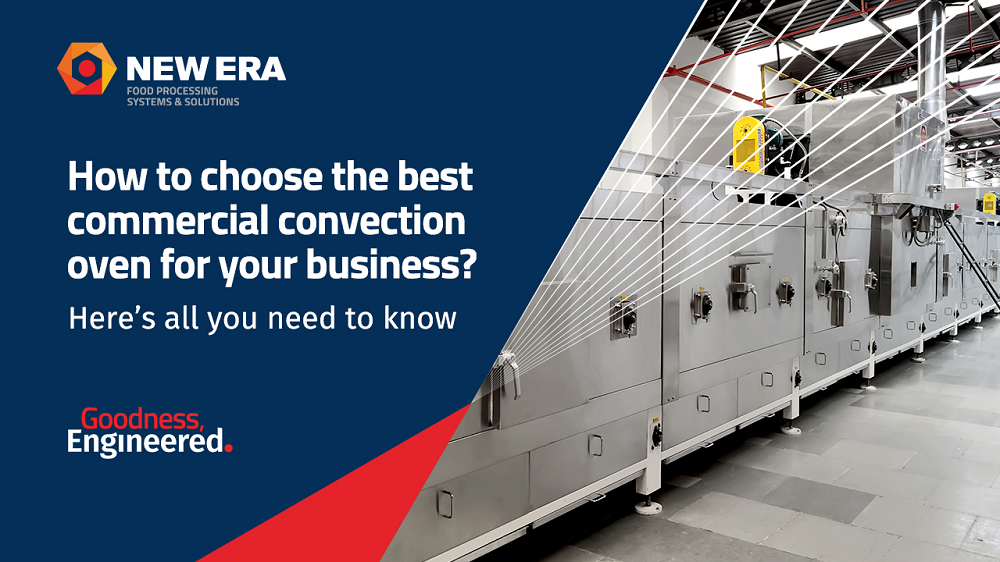
In a bakery or food manufacturing business, investing in the best equipment is what is going to help with quality, efficiency, and profitability. One of the top equipment is the commercial convection oven. Compared to traditional ovens, convection ovens provide faster cooking, excellent color distribution, and consistency in baking because they circulate hot air with fans. These make convection ovens feature something that is indispensable in the high-volume production requirements.
Be it hard dough biscuits, soft dough biscuits, cookies, or any other bakery item, convection ovens have helped companies maintain a balance between speed and quality that modern business entities struggle with.
Here is a breakdown of all you need to know to choose the best commercial convection oven for your business.
Understanding the Role of a Commercial Convection Oven
A convection oven has been structured to distribute heat uniformly, and therefore, it is best in food processing factories where consistency is required. For example, making rotary-cut hard dough biscuits or fragile, wire-cut cookies, a small variation in time and temperature could influence flavor, complexion, and hardness.
By using convection ovens, businesses can be confident that:
- More rapid baking cycles
- Homogeneous color and texture
- Less production wastage
- Long-range energy efficiency
This renders them invaluable, just as small-scale bakes or even the industrial production lines.
Key Factors to Consider When Choosing a Commercial Convection Oven
1. Size and Capacity
The first question is, how much do you require to bake per day?
Countertop convection ovens may be more desirable for small bakeries. Industrial production lines such as New Era Rotary Cutting Line for Hard Dough Biscuits require large and high-capacity ovens.
Tip: Whenever buying an oven, always choose the one that suits both your current needs and your future expansion.
2. Power Source: Gas or Electric
Commercial convection ovens are of two varieties:
- Gas ovens are usually popular due to their low costs of operation in the long run.
- Electric ovens allow the manufacturer to have better control of temperature and are best suited to sensitive products such as soft dough biscuits.
You have the power to make the decision based on utility accessibility, energy prices, as well as product mixes you are producing.
3. Baking Consistency and Technology
The best feature of a good convection oven is its circulation system of air. Seek fan technology during the purchase of the ovens to reduce hot spots. This can be especially important when it comes to making products, such as those produced by using wire-cut cookie or any type of specialty baked item, because uneven heat can affect quality.
With New Era, the cookie manufacturing lines incorporate ovens that are guaranteed to offer accurate and standardized baking to make each batch conform to the best of standards.
4. Simplicity in Operation and Maintenance
Downtimes in environments with high-volume productions might be expensive. Commercial convection ovens must:
- Have user-friendly digital controls.
- They are simple to clean and maintain.
- Provide safety to the operator.
For businesses increasing their output, e.g., moving into other bakery products, choosing ovens that ease the working process is a good investment.
5. Energy Efficiency and Cost Savings
With energy-efficient ovens, there is considerable savings on operating costs. The newer cabinets now have programmable control panels, improved insulation, and energy-efficient design features to ensure the oven can operate in a manner that recycles energy and costs on a long-term basis, and does not compromise quality.
How Convection Ovens Support Different Bakery Products?
Convection ovens are not only versatile, but are the backbone of modern bakery production lines. They are versatile, can produce even heat distribution, speed up baking processes, and are ideal for use in basic biscuits, all the way through to gourmet cookies and high-quality specific products. In fact, 40% of bakeries used convection ovens because their bake times were faster and more consistent, and cooking time was 25% shorter than conventional ovens.
Hard Dough Biscuit: Need uniform, consistent crispness and golden multicolor on the large batches. In the rotary cutting lines of production, convection ovens make sure that all biscuits have the same appearance and crunch.
Soft Dough Biscuits: The texture must be soft, melt-in-the-mouth, and at the same time retain the structure. In the rotary lines of moulding, convection ovens also offer superior control of temperature with fine results.
Cookies: Need an ideal balance in spread, color, and texture. Can be baked perfectly on a wire and deposited cookie lines. All Convection oven models control airflow and heat to produce consistent, superior-quality cookies.
Other Bakery Products: Includes cakes, pastries, and snack products that need adaptable baking profiles. In dedicated bakery lines, convection ovens are adapted to a variety of recipes, and work with more efficiency and high quality.
Conclusion
The best commercial convection oven is the one that suits you in terms of the level of production, product, and expansion orientation. Be it a thick cookie run or the cookie production line, the correct oven is going to enable production of consistent results, use energy, and make the organization profitable.
With care and attention to size, power, technology, and efficiency, businesses can choose an oven that meets their current requirements. You must carefully select the oven that will support your future growth. With New Era, your mission to develop perfeclty baked biscuits can be achieved. We provide the right convection ovens that meet your business needs, and help you outshine the current competitive food industry.
| Looking for the best commercial convection ovens for your business? Contact now! |
FAQs
1. Why is a traditional oven advanced than a convection oven in bakeries?
The fans on a convection oven can aid in the distribution and movement of the hot air, implying that baking with the help of convection ovens is fast and uniform as compared to conventional ovens.
2. Which kind of convection oven should I buy: gas or electric?
Electric ovens could be regulated easily and are the most appropriate for delicate baked biscuits, whereas gas ovens are cheaper and better suited for large ovens.
3. Are convection ovens apt for all types of baked goods?
Yes, they are dynamic and can be used to process biscuits, cookies, cakes, among other foodstuffs, out of the bakery businesses, but the adjustable settings are significant in maintaining product quality.
4. What is the right capacity of the oven?
Measure your production (daily) and growth potential. For small-scale baking, you can use smaller ovens, and for large-scale continuous baking, you will need large, convection ovens.