In programming, the difference between being able to comprehend a problem and how to go about solving the problem in code is vast. It happens to many beginners and even seasoned programmers that they get stuck at the very first stage not because they do not have the technical capacity to code but because they do not know how to tackle the problem they are presented with. This is where pseudocode might come in as a game-changer. Pseudocode also makes simplified logic of a problem easier before the programmer actually types any code, which makes the programmer concentrate on the problem-solving process in lieu of the syntax that he is working in. We will discuss in this paper how pseudocode can make solving problems and developing programs easier, and how students and novices can develop their logical thinking capabilities before we get down to the real programming.
What is Pseudocode?
Pseudocode refers to a technique of explaining algorithms in a simplified form that can be understood by humans. It presents a solution in simple language elaborating the steps in it and is thus easy to understand and communicate. Compared to a real programming language, pseudocode does not have to follow some strict rules of syntax, so that the emphasis is made on the logic of the solution and not on the programming conventions.
Why is Pseudocode Important?
Coding can be a daunting experience to novices due to the large number of syntactical rules they must adhere to. Nonetheless, the major problem is not normally the syntax but the comprehension of how to tackle the problem and deconstruct it into small and manageable components. You can also write the pseudocode first and get straight through to the logic without worry about the complexity of the syntax of a programming language.
Pseudocode lies between a human and a machine. It enables the programmers to describe a methodology using plain language, which can eventually be coded in any programming language. This approach will reduce the fear of coding and will tempt the programmer to think critically before delving into the technicals.
The Pseudocode and the Simplification of Problem Solving
Focusing on the Logic
The most important thing to do when solving a problem is to have a clear understanding of the problem. Pseudocode will enable you to concentrate on the logical flow of the solution. To take an example, when solving a sorting problem, you have to first think about the way you compare the items and rearrange them in order. Pseudocode allows you to describe these steps without getting lost in syntax rules and data structures.
And we will take as an example a sort of a list of numbers in pseudocode:
START
For each number in the list
Compare the present value with the next one.
In case the present value is larger, replace them.
Continue till the list is sorted.
END
This pseudocode is a clear definition of the procedures of sorting a list, and it does not refer to a particular programming syntax. It guides you through the reasoning of sorting without such a line of thought as writing any code.
Decomposing Complex Problems
It is common to solve complicated problems in programming. Attempts to jump to coding without breaking down the problem may result in frustration and confusion. Pseudocode helps you to divide a complex task into smaller and easier steps.
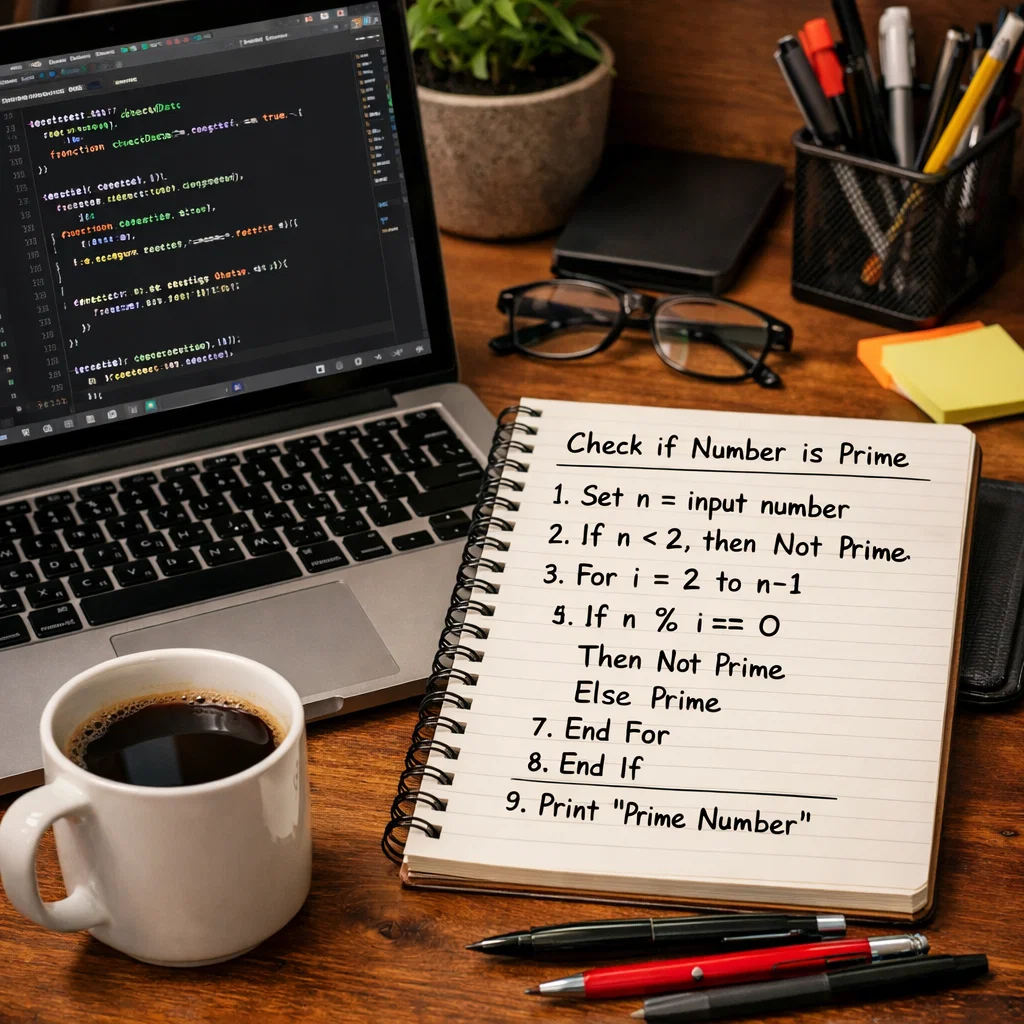
As an example, to write a program to determine whether a number is prime the logic to accomplish it may be a series of steps, checking whether the number is divisible, looping through numbers, etc. To solve this problem, you can write pseudocode:
START
When it has a value less than 2, it is not prime.
On every number between 2 and the square root of the number given.
In case the number provided can be divided by any of these numbers, it is not prime.
In case there is no divisor, then the number is prime.
END
In this pseudocode, the whole primality-checking process is broken down in a relatively simple way, thereby simplifying the conversion into code in future.
Improving Debugging Skills
During the process of programming, different bugs and errors are common. The process of debugging is frustrating and time-consuming. Pseudocode, nevertheless, assists in identifying the errors in logic very early in the programming process. Since pseudocode does not need to follow the rigid guidelines of syntax, it is less difficult to discover the problems in the logical sequence of the program.
Looking at your pseudocode, you can easily know whether some steps of the code are missing, redundant, or wrong. This can lead to fewer mistakes in the later stages of coding and can make you a better debugger.
Enhancing Collaboration
Teamwork is a key aspect of software development. Creating pseudocode gives you an opportunity to share your methodology with other people without making them learn about the details of the programming language in which you are writing. It is a universal language to which every team member, irrespective of their level of knowledge in their area of specialization, can relate.
When you are working in a team you can share your pseudocode and have your peers review the logic of your solution and provide feedback. This simplifies the process of collaboration and allows you to detect possible problems at an early stage of development.
Developing the Trust in Rational Thinking
The Promotion of Critical Thinking
Among the advantages of pseudocode, there is the fact that it promotes critical thinking. You must think about processes to solve an issue instead of attending to the particularities of syntax. This assists you to gain better insight into algorithms and methods of solving problems.
To the novice, writing out the pseudocode first and then coding the program can enhance their logical thinking abilities, which is fundamental in programming. It makes you think in an organized and logical manner and as such enables you to tackle a coding problem without fear.
The Art of Thinking Like a Programmer
Pseudocode is not simply the question of decomposing issues rationally— it is thinking programmer-like. Pseudocoding also makes you think in a mode where you are able to solve problems in a systematic manner and find the most productive way of solving them. This attitude is a vital requirement of programming and can be developed with drilling practice using pseudocodes.
Building a Solid Foundation
Coding may be a daunting task to the beginner due to the large variety of concepts to memorize. Pseudocode provides the solid base due to the emphasis on the main ideas of problem-solving and logic. When you have learned how to write pseudocode, you will understand programming languages much more easily, and be able to compare your reasoning to other code-building systems.
Through the use of pseudocode, beginners are able to enhance their skills and capabilities to structure their minds, simplify issues, and express their ideas in a manner that would help them succeed in the field of programming.
From Pseudocode to Code
You have your pseudocode, and the next thing to do is to translate it into real code. Because pseudocode is in plain language, it is usually a simple exercise to encode it in the syntax of a programming language. This is a sample of the translation of the pseudocode to determine a number as prime to Python code:
def is_prime(number):
if number < 2:
return False
for i in range(2, int(number ** 0.5) + 1):
if number % i == 0:
return False
return True
As you will notice, the logical procedures in the pseudocode map are directly transferred to the Python code making transitioning the pseudocode to the program simple and instinctive.
The Use of Pseudocode to Make Problem Solving a Little Easier: A Complete Tutorial
In case you are keen on learning more about the role of pseudocode in problem solving, you can delve into this detailed tutorial of simplifying problem solving using the pseudocode. The guide contains other information on the ways that pseudocode might improve your programming abilities and speed up your learning curve.
Conclusion
Pseudocode is also a very useful tool in making the course of coding easier. It also makes beginners and students pay attention to the logic of a problem, not to technical aspects of coding. Pseudocode enhances problem-solving, logic, and debugging because complex problems are simplified into small steps. It becomes a base to learn about algorithms and is a prerequisite to writing clean and efficient code. Above all, pseudocode is confidence-building since the beginner is able to practice and refine his or her logical thinking before getting into the real programming. Regardless of your level of skills as a developer, including pseudocode in your work process may help improve your level of expertise in programming and make the process of development easier.