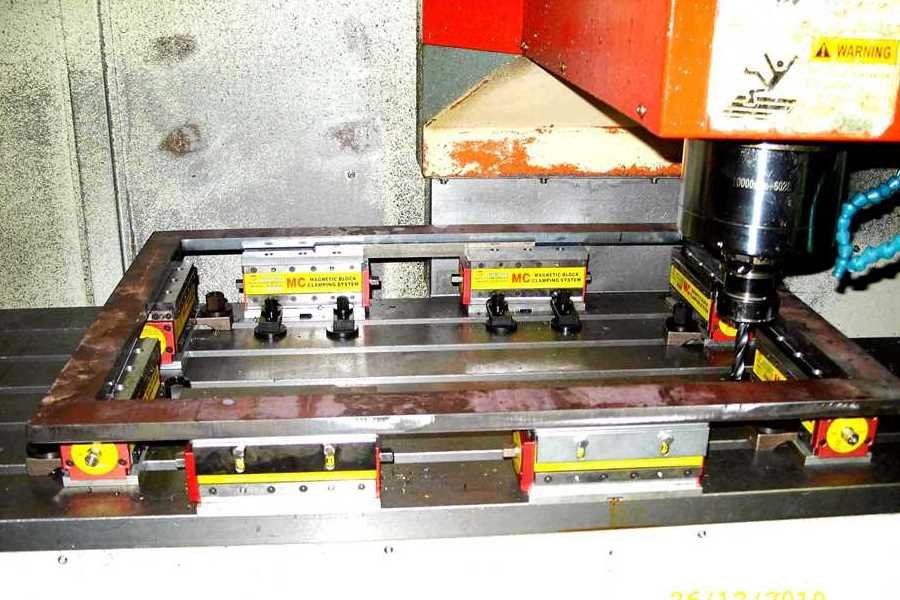
In this type of production, time is quite simply money. Every minute aligning parts, tightening bolts, and resetting fixtures is time wasted from actual production. Machining has advanced in so many ways over the years, faster spindles, smarter software, tool changers that seem to think for themselves but there’s one area that remains incredibly low-tech (even as it causes productivity sinkholes) at many shops, workpiece setup.
This is where magnetic clamping comes in.
Traditional mechanical fixturing is being eschewed in favor of magnetic holding solutions by many manufacturers today. An effective magnetic clamping system offers more than just better machining performance; it also saves time, streamlines your processes and enables you to machine a wider variety of more complex parts.
Let’s get into how magnetic clamping works and why it’s increasingly moving to the forefront of production in virtually every industry.
Why Setup Time Matters More Than Ever
Ask any shop-floor manager and they’ll tell you, cutting time is only part of the equation. In many cases, more hours are lost preparing a job than actually machining it. Positioning fixtures, tightening multiple bolts, checking alignment, and repeating the process for every new part quickly adds up.
Traditional clamping methods also restrict tool access. Large vises and fixtures block cutters, forcing operators to re-clamp parts multiple times just to reach different faces. Every re-clamp introduces errors and eats into productivity.
A modern clamping system needs to do more than just hold parts. It should speed up setups, improve repeatability, and allow machines to work at their full potential.
That’s where magnetic solutions shine.
What Is Magnetic Clamping?
At its core, magnetic clamping uses powerful magnetic fields to hold ferromagnetic workpieces securely against a flat surface. Instead of mechanical pressure from jaws or bolts, magnetic force keeps the part in place.
A typical setup includes:
- A magnetic clamping plate mounted on the machine table
- Internal magnets that can be switched on and off
- Control units to activate or deactivate the magnetic field
Once activated, the plate locks the workpiece firmly in position. When machining is complete, the magnetic field is switched off and the part lifts away easily.
No bolts. No straps. No wrestling with heavy fixtures. Just place, clamp, and start cutting.
How Magnetic Clamping Reduces Setup Time
The biggest advantage of magnetic clamping devices is speed. Operators can position parts directly on the magnetic plate and activate the system in seconds. There’s no need to tighten multiple clamps or align complicated fixtures.
Here’s how it translates into real productivity gains:
Instant Clamping
Parts are secured with the push of a button. This alone can cut setup time by more than half compared to conventional methods.
Single-Setup Machining
With unobstructed access to most surfaces, components often can be machined in one setup instead of several. That eliminates repeated alignment work.
Quick Changeovers
Switching between different jobs becomes faster since there’s no dedicated fixture for each part. The same magnetic plate can handle multiple geometries.
Reduced Manual Effort
Operators spend less time tightening bolts and more time running machines, improving overall throughput.
For high-mix, low-volume production environments, these time savings are massive.
The Role of Magnetic Clamping Plates in Modern Machining
The magnetic clamping plate is the heart of any magnetic setup. Designed with precision-ground surfaces and internal magnet arrays, these plates provide uniform holding force across the entire workpiece.
Unlike traditional vises, magnetic plates offer:
- Full surface support
- Minimal deformation of thin parts
- Excellent repeatability
- Easy integration with CNC machines
Because the workpiece sits flat on the plate, vibration is reduced and surface finish improves. This stability allows machinists to increase feed rates without compromising quality.
And since there are no physical clamps in the way, cutters can access more of the part in a single cycle.
Magnetic Clamps for Machining: Where They Work Best
Magnetic clamps for machining are particularly effective for:
- Flat or irregular metal components
- Thin plates that deform under mechanical pressure
- Large workpieces that are difficult to fixture conventionally
- Parts requiring multi-side machining
Industries using magnetic systems include automotive, aerospace, toolmaking, and general engineering. Anywhere setup time is critical and part variety is high, magnetic clamping becomes a serious advantage.
Even complex geometries benefit, as custom pole extensions or adapters can be used to support uneven surfaces.
Accuracy and Repeatability on the Shop Floor
Speed alone isn’t enough. Setup solutions also need to deliver consistent precision.
Magnetic clamping excels here because:
- The workpiece is pulled evenly against the plate
- There’s no point loading from mechanical jaws
- Thermal expansion is more uniform
This results in better dimensional stability during machining. When combined with CNC automation, magnetic systems provide repeatable positioning that helps maintain tight tolerances across production batches.
Less variation means fewer rejected parts and less rework, another hidden cost saver.
Comparing Magnetic Clamping to Traditional Methods
Let’s put things into perspective.
Conventional fixtures:
- Require manual tightening
- Block tool access
- Demand multiple setups
- Introduce alignment errors
A magnetic clamping system, by contrast:
- Activates instantly
- Leaves surface open for cutting
- Enables single-setup machining
- Delivers consistent positioning
While traditional clamping still has its place, especially for non-magnetic materials, magnetic solutions clearly outperform when speed and flexibility matter.
Integration with Automation and CNC Systems
Modern production lines increasingly rely on automation. Magnetic systems fit naturally into this environment.
Robots can load and unload parts directly onto magnetic plates. CNC machines can control clamping activation through M-codes. Entire processes become hands-free.
This seamless integration allows manufacturers to:
- Run unattended shifts
- Reduce operator involvement
- Improve safety
- Maintain consistent output
In smart factories, magnetic clamping becomes a key enabler of lights-out manufacturing.
Choosing the Right Magnetic Clamping Devices
Not all magnetic systems are created equal. Selecting the right setup depends on:
- Workpiece size and thickness
- Required holding force
- Machine type (milling, grinding, EDM)
- Production volume
- Surface finish expectations
Some applications benefit from permanent magnetic systems, while others require electro-permanent designs that combine safety with strong holding power.
Working with experienced suppliers ensures the magnetic solution matches both current needs and future expansion plans.
Beyond Speed: Hidden Benefits of Magnetic Clamping
While reduced setup time is the headline benefit, magnetic clamping brings several side advantages:
- Improved Tool Life: Stable workholding reduces chatter, extending cutter lifespan.
- Better Surface Finish: Uniform support minimizes vibration marks.
- Lower Fixture Costs: One magnetic plate replaces multiple dedicated fixtures.
- Operator Safety: Fewer manual clamp adjustments mean reduced risk of injury.
Over time, these gains compound into measurable improvements in overall equipment effectiveness (OEE).
The Future of Clamping Technology
As manufacturing pushes toward greater automation and customization, flexible workholding will only grow in importance.
Future developments in magnetic clamping include:
- Smart plates with integrated sensors
- Real-time monitoring of holding force
- Adaptive magnetic fields for complex geometries
- Deeper integration with digital manufacturing platforms
The goal is simple: faster setups, higher accuracy, and smarter production.
Final Thoughts
In today’s competitive manufacturing atmosphere, every minute counts on setup. This method of magnetic clamping is a smarter, faster alternative to traditional fixtures and is helping shops minimize downtime while increasing overall throughput.
With a thoughtfully engineered magnetic clamping system coupled with credible magnetic clamps and an accurate one, the process manufacturing industry would acquire flexibility, precision as well as speed, all at once! Combine that with state-of-the-art, on-the-machine magnetic clamping systems and you’ve got a highly efficient, adaptable clamping system designed for next-generation production.
Among factories and workstation lines, magnetic clamping is no longer just a time saver. It’s turning into a strategic asset for the manufacturers who will keep their wits about them, stay agile and be prepared for anything else the market throws at them.