
You’ve invested in a CRM to simplify your operations and improve customer management but you’re still not seeing meaningful ROI. Instead, your team avoids using the system, your data is messy, and follow-ups keep slipping through the cracks.
If this sounds a lot like your business’ story, then don’t worry, you are not alone! The issue isn’t your team, it’s how your CRM is structured.
A CRM is supposed to be a revenue engine, not a data graveyard. Yet for many businesses, it becomes exactly that: cluttered, confusing, and underused. The root cause? Poor CRM architecture.
Without a clear structure, even the most powerful CRM tools fail to deliver results. This is where CRM consulting comes in. A CRM consultant doesn’t set up your system, but fixes the common CRM issues that plague your teams.
According to MarkeStac, an implementation-first agency, the difference between a failing CRM and a high-performing one always comes down to how it’s built and maintained. Exactly what you need CRM consulting for but before we talk about choosing one, let’s begin with the basics.
What Is “Poor CRM Architecture” and Why It’s So Common?
CRM architecture refers to how your CRM system is structured, including your pipelines and deal stages, contact and company properties, workflows and automation, integrations with other tools, and user roles and permissions etc.
When this structure is poorly designed, everything else falls apart, no matter how capable your team is.
Here are a few common signs of a broken CRM setup, that you should be on the lookout for:
- Duplicate or incomplete contact records.
- Disconnected sales and marketing data.
- No clear pipeline stages or deal ownership.
- Over-complicated or under-used automation.
- Lack of reporting visibility.
This poor CRM architecture isn’t a one-off event, it’s more common than you think. It is often caused by- DIY setups without strategic planning, rushed CRM implementations, lack of alignment between teams, and not considering the long-term scalability while customising the CRM.
The Real Cost of Ignoring Poor CRM Architecture
Ignoring the poor architecture of your CRM system costs you more than what you initially paid for the setup – whether it’s a rushed or poorly planned HubSpot CRM implementation.
At first, the issues seem minor with a few duplicate records, unclear deal stages, or inconsistent data. But over time, they add up to cause serious business problems.
Here’s what the poor structuring of your CRM system can lead to:
- Your leads fall through the cracks, leading to lost revenue.
- Your sales and marketing teams are misaligned.
- Your teams waste their time on manual processes that can be easily handled with automation.
- Low user adoption as your teams can’t trust what they don’t understand.
- Inaccurate sales forecasting and reporting.
Individually, these issues seem manageable but as they compound over time, they create a sinkhole that slows down your team and limits your growth.
This is exactly where CRM consulting services make a huge difference.
Instead of patching the problems on a surface-level, CRM consultants identify the root causes in your system’s structure. They realign your CRM with your actual business processes, eliminate inefficient setups, and rebuild a foundation that supports your scalability.
What Does a CRM Consultant Actually Do?
A common misunderstanding that most B2B businesses have is that CRM consulting services just set up the system. In truth, this role extends to bridge the gap between your business processes and your tech stack.
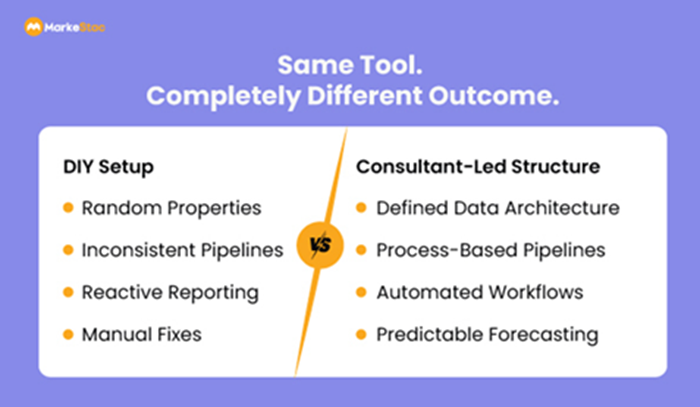
They make sure that your CRM does not just function but is aligned with how your teams operate. Here’s how they do this:
- They audit your current CRM structure and evaluate how clean your data is.
- They map out your sales and marketing processes and match it to your CRM workflows.
- They design scalable pipelines and property frameworks.
- They define how your CRM should be structured and guide HubSpot CRM implementation services to ensure the system is built exactly as planned.
- They train your teams to ensure they adopt the CRM completely.
This approach of CRM consulting ensures that your CRM is built with clarity, usability, and growth in mind.
While a one-time setup can get your system running, it often lacks the long-term alignment that CRM consulting brings. Consulting is essentially an ongoing process that refines your system continuously, improving its efficiency and adapting it as your business grows.
How CRM Consulting Services Fix Architecture Problems (Step by Step)
Here’s a step-by-step overview of how CRM consulting services fix your CRM architecture and align it with your business processes:
- Step 1 – CRM Audit
At this initial stage, a CRM consultant identifies what’s broken in your system and the reason behind it.
- Step 2 – Process Mapping
The next step is to align your CRM structure with your sales and marketing workflows.
- Step 3 – Architecture Redesign
Consultants then outline the strategy to fix your CRM – rebuilding pipelines, properties, lifecycle stages, and automation logic, etc.
- Step 4 – Data Cleanup & Migration
To ensure clean and accurate reporting, the next step is planning for deduplication, normalization, and re-importing of clean CRM records.
- Step 5 – Execution of HubSpot CRM Implementation
Once the architecture is finalized, the system is configured and built by your team or a CRM implementation partner. The consultant plays a critical role here by guiding the execution, validating the setup, and ensuring everything is implemented exactly as designed.
- Step 6 – Enablement & Training
The consultant supports CRM implementation services to enable your team to adopt the system completely through documentation and live training.
- Step 7 – Ongoing Optimization
Implementing CRM isn’t a one-time process but one that requires continuous optimization. A consultant helps you with quarterly reviews, reporting refinement, and building scale-up strategies.
CRM Implementation Done Right: What It Should Look Like
A CRM that’s implemented properly with the guidance of a consultant shouldn’t feel too complicated or overwhelming to use. It should feel natural, something your teams can rely on every day without friction.
The right CRM implementation services therefore align your CRM to support your workflows instead of slowing them down. Here’s how a well-aligned CRM feels like:
- It’s easy for your teams to use it on a daily basis.
- It provides clear visibility into your pipelines and overall performance.
- It automates your team’s repetitive tasks to save their time and reduce errors.
- It delivers accurate, real-time reporting your teams can trust.
- It’s built to scale seamlessly with you as your business grows.
If your current CRM isn’t delivering on these fundamentals, the problem isn’t the platform itself. It’s a sign that your system needs restructuring and not replacement.
Signs It’s Time to Hire a CRM Consultant
Still unsure if you should hire a CRM consultant? Here are some clear signs that your CRM is falling apart and needs attention from an expert:
- Your team avoids using the CRM or updates it inconsistently.
- You still rely on your spreadsheets along with the CRM to manage your data.
- Your reports don’t match your actual sales performance.
- You often notice missed, delayed, or leads not being followed up properly.
- Your CRM still feels too complex to navigate.
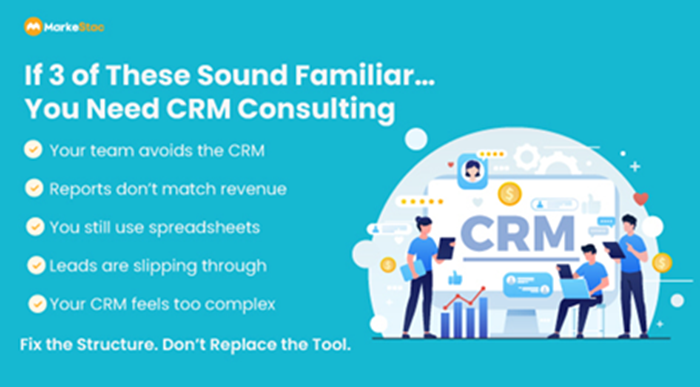
These challenges often point to deeper issues within your CRM architecture rather than the inefficiency of your teams. Bringing in a CRM consultant helps you here to identify what’s not working, fix the underlying structural issues, and build a system your teams can actually trust and use consistently.
How to Choose the Right CRM Consulting Partner
Although there are a lot of CRM consultants out there, not all deliver the same level of expertise and impact. Choosing the right partner is critical because the quality of your setup directly affects how well your business operates and scales.
Here’s what you should look for in the right partner:
- Proven experience of working with HubSpot (check for certifications and real case studies).
- Ensure they follow a process-first approach and not just technical configuration.
- Ask if they perform a site audit and business discovery process before the restructuring begins.
- Check if they offer ongoing support after the setup to ensure continuous improvement.
Besides this, it’s equally important to avoid partners who jump straight into execution without fully understanding your business. A CRM built without proper discovery often leads to the same problems that you’re trying to fix currently.
This is where MarkeStac takes a different approach. Instead of focusing only on setup, their emphasis is on building a strong foundation, aligning your CRM with real business workflows, ensuring data consistency, and creating a system that scales with you.
Conclusion
Poor CRM architecture doesn’t create a loud noise, it will silently limit your growth by creating inefficiencies, reducing visibility, and missed opportunities. But with the right consulting approach, your CRM doesn’t just remain as a tool but becomes a system you rely on and a competitive advantage you grow with.
The right CRM consulting services gives your teams clarity, builds trust in your data, and enables better, faster decision-making.
If your CRM is slowing you down, now’s the time to fix it, book a site audit and take control of your growth.
Author Bio
Sanjay Kumar is the Founder of MarkeStac, India’s first white-label HubSpot service provider. With over a decade of experience in marketing automation, CRM architecture and revenue operations, he helps B2B companies build scalable marketing and sales systems that drive predictable growth.
Having delivered 300+ automation and CRM projects for global clients, Sanjay specializes in HubSpot implementation, complex integrations and full-funnel automation strategies. He founded MarkeStac with a simple belief: businesses don’t need more tools, they need better systems.