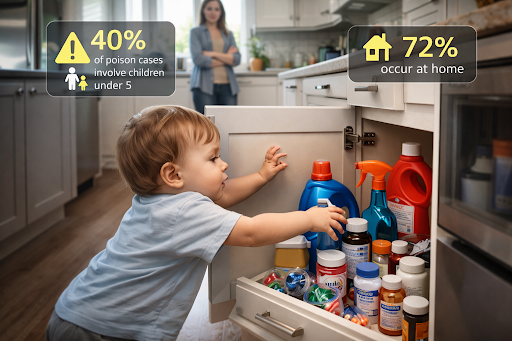
A new data driven report reveals that everyday household products are responsible for the majority of chemical exposures among young children in the United States. The findings, drawn from poison control records, hospital surveillance systems, and academic research, show that children under six face a wide range of chemical risks inside their own homes.
In 2023, U.S. Poison Control centers handled nearly 2.1 million human exposure cases. Forty percent involved children aged five or younger. Most exposures were accidental and occurred during routine household activity.
Household Medications and Cleaners Lead Exposure Sources
The top ten products linked to emergency department visits in 2023 paint a clear picture of the risks inside American homes. Blood pressure medications, dietary supplements, acetaminophen, bleach, antidepressants, and ibuprofen were among the most common sources of poisoning.
Top Household Linked Products in Pediatric Poisonings (2023)
- Blood pressure medications: 5,800 cases
- Dietary supplements: 5,200
- Acetaminophen: 4,900
- Bleach: 3,600
- Antidepressants: 2,800
- Ibuprofen: 2,400
- ADD medications: 1,800
- Illegal drugs: 1,900
Laundry detergent packets also appeared frequently, though national estimates were not available.
These numbers reflect a broader trend. Between 2021 and 2023, emergency department visits for chemical poisoning in children under five rose from 62,600 to 68,600 before settling at 67,000. Across the three years, 72 percent of incidents occurred in the home.
Children Are Exposed to Dozens of Chemicals Before Kindergarten
A UC Davis Health study cited in the report found that children carried measurable levels of dozens of chemicals from plastics, cosmetics, food packaging, dust, and air pollution. Among 201 children tested:
- 96 chemicals were found in at least five children
- 48 chemicals were found in more than half
- 34 chemicals were found in more than 90 percent
The most common chemical groups included phthalates, parabens, bisphenols, benzophenones, pesticides, organophosphate esters, polycyclic aromatic hydrocarbons, and bactericides.
Some chemicals declined over time, but others, including newer pesticides and plasticizers, increased. Firstborn children had lower chemical levels than younger siblings, and two year olds often had higher levels than three or four year olds.
Fatalities Have Increased Sharply Since 2019
Child fatalities from chemical exposure rose from 34 in 2019 to 97 in 2022, before decreasing slightly to 90 in 2023. These numbers represent the highest fatality rates since 1991.
Analgesics were the leading cause of fatal exposures between 2019 and 2024. Fumes, gases, stimulants, batteries, and unidentified drugs also contributed to deaths. Deaths linked to narcotics and psychodysleptics doubled between 2021 and 2023.
Fentanyl Exposure Has Become a Major Household Hazard
One of the most dramatic findings involves illicit fentanyl. Cases of unintentional fentanyl exposure in children under six increased from 10 in 2016 to 539 in 2023. More than 80 percent of these exposures occurred in the home, often due to unsecured pills or powder.
Where Exposure Is Most Common
Between 2020 and 2025, children under six were involved in 436,444 poison control cases. The states with the highest call volumes were:
- Texas: 39,442
- California: 34,037
- Florida: 18,897
The District of Columbia, Vermont, and Rhode Island had the lowest numbers.
How Children Come Into Contact With Chemicals
Ingestion was the dominant route of exposure. Between 2020 and 2025, emergency department cases involved:
- Mouth exposure: 3,485 cases
- Eye exposure: 122
- Skin exposure: 8
- Inhalation: 17
- Multiple routes combined: 228
A Preventable Risk Inside the Home
The study by Anidjar & Levine underscores that 99 percent of chemical exposures in young children are accidental. The data suggest that safer storage, reduced use of high risk products, and greater awareness could significantly reduce injuries.
Parents and caregivers can lower risks by choosing products labeled phthalate free, paraben free, and fragrance free, avoiding plastics labeled 3, 6, and 7, improving ventilation, washing produce thoroughly, and keeping all medications and cleaning products locked away.