Introduction
The development of nationalist journalism in Nigeria was another turning point in the fight against colonialism. Newspapers were the first arenas of an ideological struggle, mass education, and political mobilization long before political parties had a mass following. The educated elites protested against the policies of the colonialists through the printed words, highlighted the wrongs, and raised elevated national awareness among the Nigerians. The focal point in this change was Herbert Macaulay, who was the father of Nigerian nationalism.
Macaulay was more than a political activist and knew how the press could be used strategically. He and other pioneers of nationalism exploited newspapers not only as an informational channel, but also one of resistance, discussion, and enlightenment of the people. Such publications aided in the re-establishment of political consciousness, the cultivation of democratic ideas, and the intellectual preparation for the eventual independence of Nigeria.
This paper will explore the emergence of nationalistic journalism in colonial Nigeria and the role of Herbert Macaulay and other nationalist leaders in changing the newspapers into political activism and mass opposition platforms.
The Early Press Environment in Colonial Nigeria
The Press in the Colonial Rule
Pioneer Nigeria newspapers appeared in a repressive colonial structure. The presses like the Iwe Irohin (1859) were mostly missionary and educational and did not aim at any open political attack. The press coverage was looked up with small concern by British colonial administrators, who were aware of its capacity to call up mass opinion but endeavored to curtail its influence and reach by censorship and licensing legislation.
Nevertheless, these controls did not stop the newspapers that eventually transformed into the means of indigenous expression. Near the end of the nineteenth century and the beginning of the twentieth century, the increasing number of educated African elite produced a readership who were able to follow the political ideas. This process was accompanied by the increasing discontent with the discriminatory colonial policy, expropriation of territories, taxation, and refusal to participate in the process of government.
The Life of Herbert Macaulay, Father of Nationalist Journalism
Intellectual Preparation and Political Perspective
Herbert Macaulay was born in 1864 in a very good family of missionaries and educators of the Lagos community. Learned in Lagos and subsequently in England, Macaulay came back with technical knowledge and also with a conscious understanding of the inequality in colonies. His introduction to the British world enhanced his satire on the hypocrisy of the colonists, more so the difference between democracy and authoritarianism in the European and African context, respectively.
Macaulay was of the opinion that political consciousness could never flourish without information. He considered journalism as a crucial arena where the colonial discourse can be challenged and indigenous voices can be represented.
Creation of The Lagos Daily News
Macaulay established, with John Ayo Adama in 1925, The Lagos Daily News, the first newspaper of nationalism in the history of Nigeria. This was a nationalist newspaper, unlike their predecessors who were very cautious in the way they operated. It was also a critique of colonial rule, a revelation of land-grabbing agendas, and a champion of native Lagosian rights.
The newspaper introduced colonial policies through editorials and reports as unjust and exploitative in a way that supported the reading population to challenge the foreign rule. The news outlet did not simply convey events but interpreted them in a nationalist way. Journalism was a political action.
The Paper as a Political Resistance News Platform
Defying the Colonial Authority
The nationalist newspapers had formed a space in which the colonial rule could be questioned. Investigative journalism, satire, and editorial coverage were used by journalists to demonstrate corruption, racial discrimination, and economic exploitation. These criticisms undermined the colonial authority’s ethics and gave intellectual justifications to the resistance movements.
Macaulay was very confrontational in his writings. He repeatedly challenged land Acts, taxation, and city planning projects that were relocating Africans to the interests of Europeans. Such fearless exploitation of the press made him popular among the common citizens and possibly suspicious among the colonialists.
Mobilizing Public Opinion
The nationalist press was the channel that connected the educated elites with the masses. Even though the literacy conditions were minimal, newspapers affected the discourse of the populace by means of public readings, discussions, and orally. Major concepts were transmitted outside of print, raising the awareness of people.
The political issues were often presented in the moral colorings by the editorial, with an appeal to the common cause of injustice. This strategy made political activism more of social discourse rather than elite one.
Other Nationalistic Journalists and Hotelier Press Movement
Payne Jackson and The Lagos Weekly Record
Newspaper politics had been proven by John Payne Jackson before Macaulay with The Lagos Weekly Record. The editorial style used by Jackson was aggressive, and it openly criticized the colonial officials and defended the rights of the Africans. His work was the foundation that future nationalists developed a more permanent movement on.
Political Press and Ernest Ikoli
Ernest Ikoli, who worked with The Daily Times, developed nationalist journalism through the professionalization of reporting as well as linking journalism and organized politics. He insisted on the freedom of press as a democratic right and extended African involvement in government.
Mass-Oriented Journalism and Nnamdi Azikiwe
In spite of being a bit later in generation, Nnamdi Azikiwe increased the scope of nationalist journalism with his newspaper like The West African Pilot. His populist rhetoric and broad appeal were the concepts originally codified by Macaulay and his fellows. Collectively, these characters transformed newspapers into popular political outfits instead of the elite newspapers.
Journalism, Activism, and Democratic Consciousness
Producibility of Political Literacy
Political education was by way of nationalist newspapers. They broke down constitutional changes, elections, and civil liberties in simple terminology. In doing this, they were able to develop a politically aware citizenry that can engage in democracies.
Macaulay was aware that knowledge was necessary to have freedom. His journalism promoted consciousness as the source of self-determination, the connection between political opposition and popular enlightenment.
Press Freedom as a Democratic Ideal
The idea of press freedom also gained popularity due to resistance journalism. The censorship and the prosecution by the colonialists simply strengthened the idea that free expression was the key to political development. The fight to attain independent Nigerian press was therefore a reflection of the self-governance fight.
Contribution to the Independence Struggle
The nationalist journalism was not an independent phenomenon; however, it conditioned the conditions of the mass political action. Newspapers made complaints one voice, formulated political requirements, and sanctioned stories of resistance. They also forced colonial governments to make constitutional changes by bringing international hypocrisy between imperialism and democracy.
The journalism of Herbert Macaulay was the most notable as it also related activism, nationalism, and media to a unified plan. His work as both a politician and publisher depicted how journalism could directly affect political organization, which later led to the creation of the early nationalist parties.
Legacy of Nationalist Journalism in Nigeria
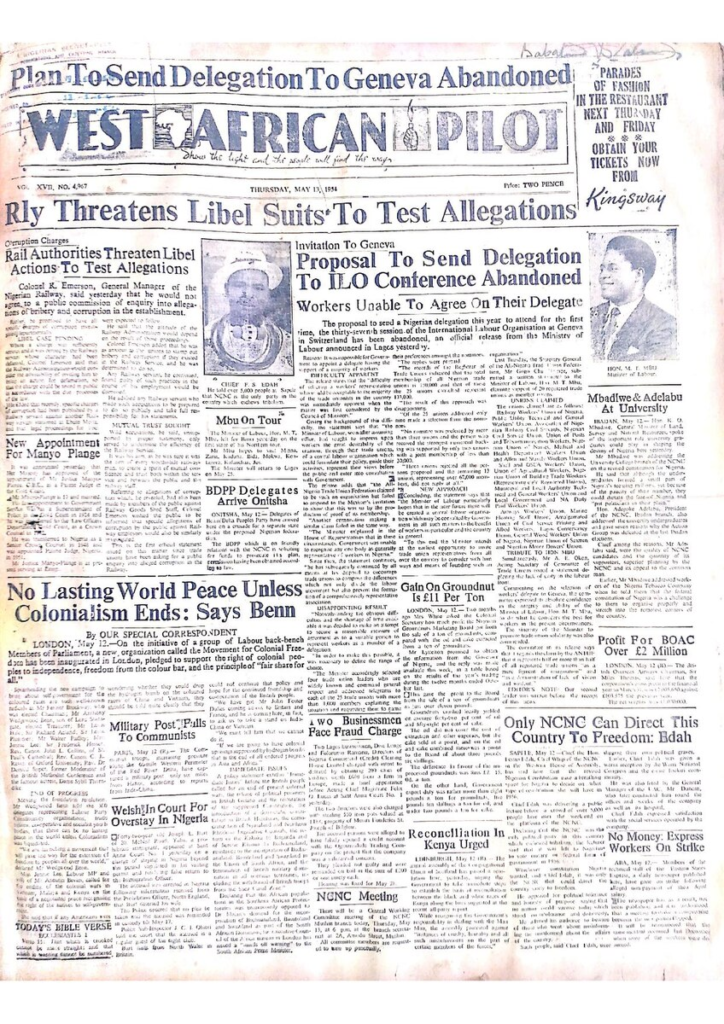
The legacy of the nationalist press in Nigeria can be traced back to the era of British rule in the early 1900s (Adejumobi, 1995).
Nationalist journalism has a post-colonial history. The word pioneer is used to refer to the modern Nigerian media despite its troubles, and such courage is only aroused by the brave steps of journalists who stood up against the empire with the help of ink and paper. Accountability, political participation, and advocacy for the people still exist on the basis of this initial tradition.
The input of Herbert Macaulay is beyond newspaper publishing, but he assisted in redefinition journalism as a civic responsibility. His writing showed that the press could be a mirror and a weapon, a reflection of the reality of the society and an active participant in shaping the politics of the country.
Conclusion
The birth of nationalist journalism in Nigeria was a landmark in the political history of the country. The colonial subjects had a voice through the newspapers, and they expressed resistance and developed a sense of democracy. One of the key figures in this change was Herbert Macaulay, who could issue his own challenges to injustice through journalism and organize the people.
Macaulay together with other nationalist visionaries demonstrated that ideas, when published and diffused, could challenge imperial power and provoke masses to take action. The Nigerian press was not just a tool of communication, it was the battlefield, the political literacy classroom, and the increment of independence. Knowledge of this history helps to see how powerful journalism can be in building nations and protecting the ideals of democracy.
Nationalist journalism is still very relevant to national and international issues in the modern media age. Issues of censorship and political interference, misinformation and economic limitations are the issues that keep the press under scrutiny. The consideration of sacrifices and commitments of the journalists in the early years of nationalism offers an insight into what future and current media professionals should do.
Their doggedness proves that journalism has a social role other than to report events, it is a protector of the common interest of people and democracy. The Nigerian press can keep up the course of civic participation, accountability, and meaningful contribution to the national development by keeping in mind the principles left by nationalist pioneers.