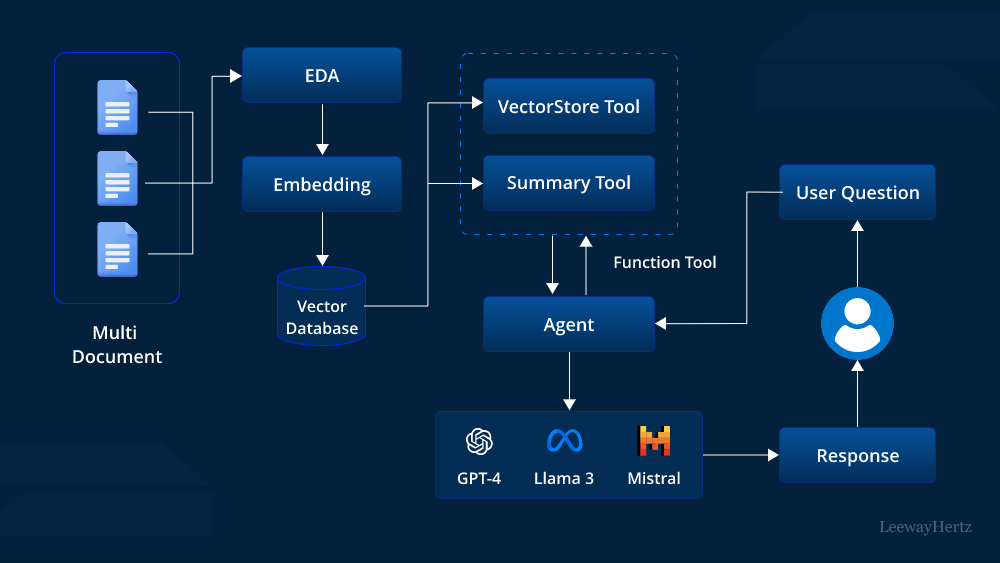
Large Language Models (LLMs) have transformed how we interact with AI, shifting from simple query-response tools to sophisticated assistants capable of understanding and generating human-like text. Traditionally, these models have been reactive, waiting for user prompts and generating answers without broader context or ongoing initiative.
But the next evolution in AI is agentic LLMs, autonomous “teammates” that proactively manage tasks, make decisions, and collaborate with humans and other systems.
Understanding the architecture behind these agentic LLMs is essential for appreciating how they achieve this shift from being mere tools to becoming integral partners in workflows.
This blog dives into the core components, supporting technologies, design principles, and real-world examples that power these intelligent agents.
Core Components of Agentic LLM Architecture
Agentic LLMs are not just bigger or more complex models; they are modular systems designed to operate autonomously and adaptively. Here are the foundational building blocks that enable this:
1. Planning Module
At the heart of agentic LLMs is the planning module, which interprets high-level goals and breaks them down into manageable subtasks. Much like a human project manager, this module designs a workflow or roadmap to accomplish complex objectives. For example, when tasked with writing a research report, the planner decides to gather data, analyze sources, draft sections, and compile results.
This module enables agentic LLMs to move beyond one-off responses, executing multi-step processes that require foresight and structured action.
2. Execution Loop
Agentic LLMs operate in a continuous loop of taking actions, evaluating outcomes, and deciding the next steps. This iterative cycle—action, feedback, adjustment—mirrors human problem-solving and allows the agent to navigate uncertainty, correct mistakes, and optimize its approach.
Unlike traditional LLMs that respond once per prompt, the execution loop lets agents remain engaged with ongoing tasks, adapting dynamically as new information emerges.
3. Memory and Context Management
Effective autonomy requires memory. Agentic LLMs utilize both short-term and long-term memory systems, often backed by external stores such as databases or vector embeddings, to retain context over time.
This memory enables the agent to recall prior interactions, track progress on multi-step tasks, and personalize outputs based on user preferences or past behavior. Without such context persistence, agents would be limited to isolated interactions.
4. Tool Use and API Integration
Agentic LLMs extend their capabilities by leveraging external tools and APIs. Whether it’s performing calculations, querying live databases, accessing web browsers for real-time data, or sending emails, these integrations enable agents to act beyond text generation.
Dynamic tool selection means the agent chooses which tools to invoke based on the current task, weaving external capabilities into its action plan—much like a teammate knowing when to call on specific experts.
5. Communication and Coordination
Many agentic systems are multi-agent environments where several agents collaborate. Effective communication protocols allow these agents to share information, negotiate responsibilities, and resolve conflicts to achieve joint goals.
This coordination capability is essential for complex workflows involving multiple domains, ensuring consistency and avoiding contradictory actions.
Enabling Technologies and Secure Infrastructure Behind Agentic LLMs
Scalable Cloud and Edge Computing
- Cloud Platforms: Services like AWS, Azure, and Google Cloud provide dynamic, scalable compute resources essential for processing large datasets and running complex LLMs without performance bottlenecks.
- Edge Computing: Processes data closer to the source or end-users, reducing latency for time-sensitive tasks such as real-time decision-making and customer interactions.
Robust Data Pipelines
- Integration with Enterprise Data: Connects agentic LLMs to live databases, APIs, and data warehouses, ensuring decisions are based on fresh, accurate information.
- ETL and Streaming: Supports Extract, Transform, Load (ETL) workflows and real-time data streaming to maintain data integrity and timeliness.
Security Frameworks and Compliance
- Authentication & Authorization: Multi-factor authentication and role-based access control (RBAC) protect sensitive systems from unauthorized access.
- Audit Logging: Continuous recording of agent actions and system interactions ensures transparency and traceability for compliance audits.
- Regulatory Adherence: Implements standards such as GDPR, HIPAA, and SOC 2 to maintain privacy, data protection, and governance.
Privacy-Preserving Technologies
- Data Anonymization: Masks personal or sensitive information to safeguard user privacy during processing.
- Secure Enclaves and Federated Learning: Enable secure data use and distributed learning without exposing raw data, enhancing both security and model training capabilities.
Design Principles for Effective Agentic LLMs
1. Modularity and Scalability
Why it matters: A modular architecture allows each functional component—planning, memory, execution, tool integration—to evolve independently. This flexibility is critical as enterprise needs and underlying technologies evolve.
- Benefits:
- Easier debugging and maintenance
- Plug-and-play support for upgrades (e.g., swapping a vector DB or planning module)
- Smooth horizontal scaling for high-volume, parallel workflows
- Easier debugging and maintenance
- Example: If the execution engine fails or needs enhancement, the rest of the system can continue functioning, minimizing downtime and complexity.
2. Transparency and Explainability
Why it matters: Agentic LLMs often operate autonomously. Users, especially in sensitive domains (finance, healthcare, legal), need to understand how and why a decision was made.
- Best practices:
- Track and expose decision pathways (via logs or visual graphs)
- Use chain-of-thought reasoning to make internal logic visible
- Provide summaries or justifications alongside outputs
- Track and expose decision pathways (via logs or visual graphs)
- Example: A healthcare agent recommending treatment options should explain its reasoning based on patient data and clinical guidelines.
3. Robustness and Fault Tolerance
Why it matters: Autonomous agents must operate reliably even in imperfect conditions—unavailable APIs, malformed data, or ambiguous instructions.
- Key elements:
- Retry logic, timeouts, and fallbacks for API calls
- Confidence scoring to trigger human-in-the-loop review
- Circuit-breakers to avoid cascading system failures
- Retry logic, timeouts, and fallbacks for API calls
- Example: If a sales agent fails to fetch lead data due to API downtime, it should either retry with exponential backoff or fall back to cached data.
4. Ethical and Responsible AI Practices
Why it matters: Giving autonomy to LLMs without ethical guardrails opens the door to biased, unsafe, or manipulative behavior—especially in real-world decision-making.
- Design for responsibility:
- Bias detection and mitigation pipelines during training and inference
- Rule-based constraints to limit behavior in sensitive contexts
- Respect for user consent, privacy, and data sovereignty
- Bias detection and mitigation pipelines during training and inference
- Example: A hiring assistant agent should not penalize candidates based on gender, race, or zip code—even if patterns in historical data suggest otherwise.
5. Continuous Monitoring and Feedback Loops
Why it matters: Agentic LLMs operate in dynamic environments. Their performance must be tracked in real time, and they should be capable of improving through structured feedback.
- Implementation ideas:
- Integrate user feedback to refine memory or decision logic
- Monitor task completion success rates and adjust plans dynamically
- Trigger alerts for anomalous behavior or performance dips
- Integrate user feedback to refine memory or decision logic
- Example: A customer service agent that consistently receives low satisfaction ratings for certain responses should adjust tone or escalation logic automatically.
By embedding these design principles early in the development cycle, agentic LLMs can evolve from impressive prototypes to dependable digital teammates in enterprise environments.
Challenges and Future Directions
While agentic LLMs are redefining what AI can do, several technical and operational challenges still need to be addressed for widespread and reliable adoption:
Memory Coherence Over Time
The challenge:
Current memory architectures struggle with maintaining long-term context across complex, multi-session workflows. Agents may forget earlier decisions, lose track of user intent, or duplicate tasks.
What’s needed:
- Persistent, structured memory systems
- Contextual summarization and retrieval mechanisms
- Temporal memory models that evolve with user behavior
Communication Protocols Between Agents
The challenge:
Multi-agent systems often rely on custom protocols to interact, leading to inefficiencies and poor interoperability. Without standard frameworks, coordination across agents remains brittle.
What’s needed:
- Standardized agent communication languages (e.g., Agent Communication Language – ACL)
- Protocols for intention sharing, task delegation, and conflict resolution
- Secure, asynchronous messaging layers for distributed systems
Human-Agent Collaboration
The challenge:
Blending human expertise with autonomous agents is still clunky. Handoffs between human users and agents often break the flow of work or require manual context restoration.
What’s needed:
- Context-aware UI/UX for human-in-the-loop workflows
- Intuitive escalation paths when agents hit edge cases
- Shared dashboards and co-working interfaces for humans and agents
Conclusion
Agentic LLMs are more than just intelligent assistants—they represent a paradigm shift from reactive tools to proactive collaborators. By combining modular planning, memory, execution, and tool use into a cohesive architecture, these agents can tackle dynamic, high-value tasks with autonomy and adaptability.
As enterprises move toward digital transformation, agentic LLMs offer a way to automate not just actions—but reasoning, prioritization, and strategic decision-making. When designed responsibly, they can function like true teammates: understanding context, anticipating needs, and iterating over time.
To fully harness their potential, we must focus not just on capabilities, but also on infrastructure, governance, transparency, and human-centered design. The organizations that succeed will be the ones that treat these agents not as black-box systems—but as evolving partners in problem-solving.



Kadir Görgü sitesi Eskort