Stress is a necessary biological reaction that enables the human body to respond rapidly to danger, challenge or uncertainty. Stress, in its acute manifestation, is preservative as it allows one to be more alert, makes decisions faster and allows one to be more physically prepared. These short-term reactions have helped mankind to survive thousands of years. But, as stress turns out to be long-term and not short-term, the biological processes that had previously facilitated survival binge back on health.
The concept of the modern world poses a special challenge to the system of the stress response. Whereas the threats that early human beings had to deal with were physical and short-term and ended swiftly, the stressors that modern people are exposed to are usually psychological, persistent and inescapable. The stress response may be triggered by financial pressure, work demands, social conflict, and chronic uncertainty many times without providing enough rest. The long-lasting activation of this process over time changes the stress as a useful mechanism of survival to a cause of physiological stress.
This article focuses on how stress turns out to be a short-term adaptation to a long-term harm. It outlines how belonging to stress pathways leads to a lack of balance in the body, contributes to disease and decreases the quality of life. Knowing this transition, the reader may have a better picture of why chronic and acute stresses are entirely different and why it is necessary to manage stress in order to maintain long-term health.
Stress as Survival Adaptive Response
The stress response was a fast defence mechanism meant to help the body in responding to short-term dangers. In a dangerous situation, the brain sets in motion a series of hormonal and nervous system reactions that set the body into action. The heart rate rises, breathing rate increases, muscles contract and the body mobilizes its energy stores. The changes allow the body to react to the threats by fighting, fleeing, or solving the problem at hand.
Such adaptive stress-response are useful when short-term and in proportion to the situation. They enhance the reaction time, physical strength, and attention. As soon as the threat is over, the body goes back to the normal physiological functioning.
This activation recovery cycle is balanced in healthy systems. Stress is not necessarily bad, however, when the stress reaction continues too long or too often, it is a problem.
Acute Stress vs. Chronic Stress
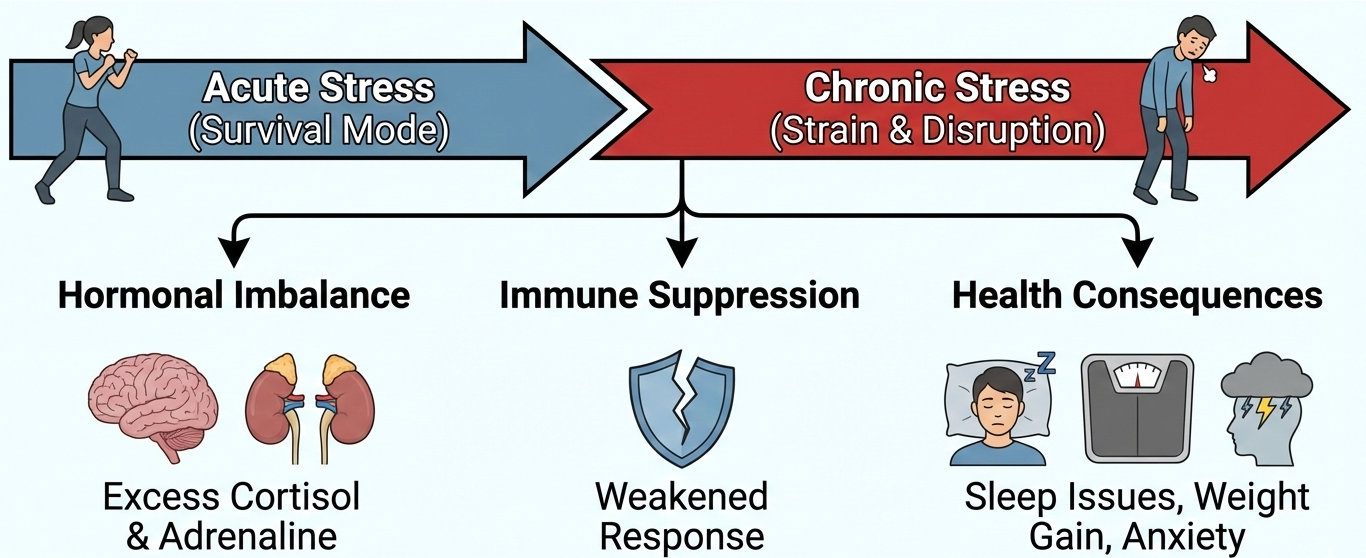
Acute stress is one that is evoked by a particular situation and is relieved once the situation is over. Examples are preventing an accident, studying to an exam or reacting to an emergency. Acute stress temporarily causes the survival systems and then the body recovers.
Chronic stress on the other hand is stress caused by persistent stressors, or stressor recurrence, without sufficient rest. However, the work pressure, the lack of emotional conflict resolution, financial instability, or the need to take care of someone might make the stress response active weeks, months, or even years long.
There is no harm in the intensity of stress but the duration is the key. Stress acutely permits recovery. The body is deprived of this chance by chronic stress, and subtle wear and tear on the physiology occur after some time.
The Disruption of the Balance by Repeated Stress Activation
Human body depends on the balance or homeostasis to work properly. Stress causes a short-term change of this equilibrium in favour of survival. This change is reversible in cases where stress is short-lived. In the case of chronic stress, the body finds it difficult to balance the situation.
The repeated activation of stress causes a continuous pressure on regulatory mechanisms like the cardiovascular, endocrine, immune and nervous systems. The hormones that are supposed to be fluctuating stay high. Resting and repair systems are repressed.
This lack causes dysfunction in the long run. The body responds to stress depending not on restoring to normalcy, but resetting its baseline in a stressful condition.
Hormonal Fatigue and Stress in Chronic Stress
Stress hormones are also central in the process of survival to strain. Cortisol and adrenaline are necessary in case of acute stress, but their lack of regulation is harmful.
Cortisol elevates the level of blood glucose to produce energy, yet the high levels of cortisol in the long term change the metabolism and insulin regulation. This is a cause of weight gain, fatigue, as well as risks of metabolic disease. The immune system is also suppressed by cortisol, and it lowers the immune capability of the body to resist infection and repair tissue.
To sustain fast action, adrenaline raises the blood pressure and heart rate. The continued stress on the cardiovascular system with adrenaline high level leads to the possibility of hypertension and heart disease.
The cumulative effects of this hormonal overload over time are a weaker body because the regulatory systems are worn out.
Brain and Nervous system Effects
Stress hormones are very sensitive to the brain. Stress in the acute stage is beneficial in improving attention and memory formation whereas in the chronic condition it changes the structure of the brain and its operation.
Excessive exposure to cortisol has an impact on memory, emotional, and decision-making areas. The part of the brain known as the hippocampus which aids in learning and memory can shrink as a result of chronic stress. The prefrontal cortex which is in charge of planning and impulse control is also impaired.
Meanwhile, the amygdala, the processing fear and threat organ, becomes hyperexcitable. It leads to stress cycle strengthening due to the anxiety, emotional reactivity and concentration challenges.
Immunosuppression and Inflammatory Processes
Immune dysregulation is one of the major effects of chronic stress. Stress in the short term inhibits immune responses to save the energy. This interference undermines the body in the long-term.
Chronic stress inhibits the immune cells production, slows down wound healing and exposes the body to infections. It ironically also encourages low-grade inflammation which is associated with most chronic diseases.
A combination of a weakened immunity and constant inflammation promotes faster tissue destruction and disease evolution.
Cardiovascular Strain and Stress
Chronic stress has a direct effect on the cardiovascular system. Increased heart rate and blood pressure become permanent and not temporary. Blood vessels do not relax and this raises resistance and workload of the heart.
This strain ruptures blood vessels in the long run causing atherosclerosis. Stress has long-term impacts on the heart that put a person at risk of heart attack, stroke and other cardiovascular diseases.
This condition (the inability of the body to resume the rest state) leads to the constant stress being placed on the heart, which decreases long-term resilience in the cardiovascular system.
Gastrointestinal and Metabolic Effects
Stressing takes the blood out of digestion to feed the muscles and the brain. This is adaptive in cases of acute stress. Digestion is also impaired in the case of chronic stress.
The decreased activity of the digestive system is reflected in such symptoms as bloating and discomfort, as well as the changed appetite. Gut microbiota is also impaired by chronic stress, which interferes with nutrient absorption and immunity.
Metabolic processes are also affected. The hormonal imbalance disrupts the energy processing, which makes contributions to the fatigue and weight changes.
Stress, Sleep and Recovery Failure
Sleep is necessary to recover and repair the physiology. Stresses that occur continuously also interfere with hormonal rhythms affecting sleep patterns.
High cortisol levels affect the capacity of falling asleep and staying asleep. In turn, lack of sleep enhances the production of stress hormones and thus forms a feedback mechanism that does not allow stress to be overcome.
The body also will not be able to restore balance without proper sleep, and it accelerates the process of adaptation to strain further.
Out of Adaptation to Maladaptation
Adaptive stress reactions will only be beneficial in the short run. When stress is chronic, then these responses change to maladaptation instead of adaptation.
The body is also always ready to go and compromises the long-term maintenance in favour of what is perceived to be survival. This trade-off causes exhaustion and emotional burnout over time combined with a risk of disease.
This change is what makes the difference in understanding why chronic stress is so different as compared to everyday stress. It is not merely an increased stress, but another biological condition.
Less Quality of Life when Stressed Chronically
Chronic stress has not only physical impact but also emotional and day to day functioning. Constant tiredness, short-temperedness, low level of motivation and decreased pleasure in life is prevalent.
Emotional regulation can decrease, leading to the social relationships being affected. Productivity is reduced since the ability to concentrate and make a decision is compromised. Chronic stress lowers the quality of life with time.
These impacts emphasize the need to deal with stress at an early stage when the adaptive systems are not overloaded.
Why the stress management is physiologically needed
Stress management is not a psychological choice; it is a biological need. The result of alleviating stress is that regulatory systems regenerate, hormonal balance is reinstated and long-term health is safeguarded.
Recovery days help the body to restore the tissue, stabilize immune system and regulate emotions. Stress systems are not brought back to their normal levels hence wear and tear are hastened.
The biology of stress helps to strengthen the reasons as to why stress should be managed to ensure health throughout the life cycle.
Conclusion
Stress is an effective survival mechanism that will be dangerous when it is not activated in response to temporary adaptation but rather, to permanent activation. Although acute stress enhances performance and protection, chronic stress destroys physiological balance and exerts a long term strain on the body.
Stress pathways repeated rewire regulatory pathways, which cause disease, emotional distress, and low quality of life. Through the knowledge of how a stresses is transformed to the survival and strain, one can become more aware of the significance of recovery and stress management.
It is not up to us to do away with all the challenges that we face to protect the body against chronic stress but to restore the balance with systems that are meant to cushion us to do their work.