Abstract
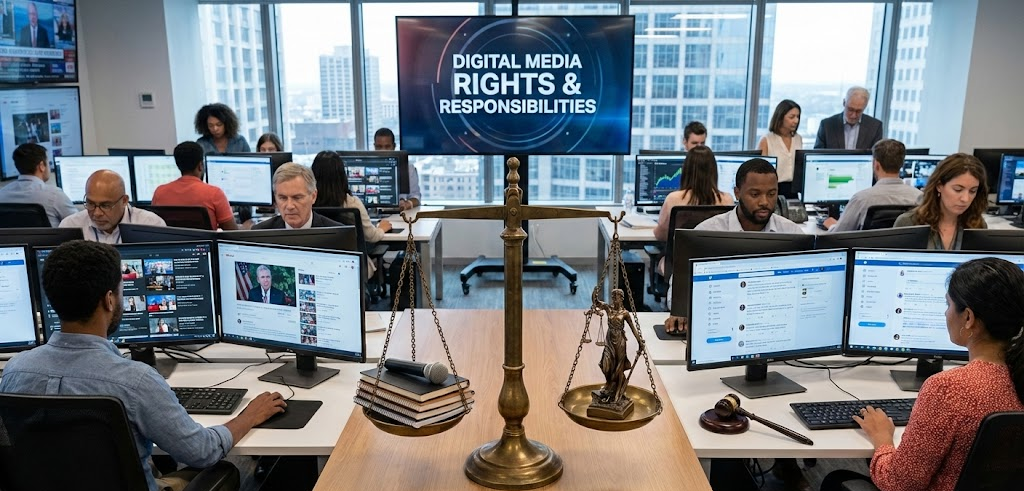
The world of international law provides freedom of expression as one of the pillars of democracies and a fundamental human right. At the same time, the media possesses a strong power to form the opinion of the population, social standards, and prejudice against vulnerable groups, in particular, women and children. This dual position imposes an endless burden on the right to free speech and the right not to be injured, discriminated against or a victim of violations of human rights. It is a critical analysis paper on the relationship of freedom of expression as applied in the protection of human rights, women’s and children’s rights within the contemporary media systems. The study explores the notion of how media houses can exercise the freedoms of expression and be ethically responsible at the same time based on normative theories of media, human rights law, and existing literature. The article presents such issues as haste speech, harmful representation, sensationalism, and amplification of digital media and adopts a qualitative analysis method. The outcomes reveal that speech and protection of rights do not act contrary to one another but require a system of equitable principles, which is anchored on ethical journalism, responsibility of the regulators and media practices that are rights-based.
Keywords: freedom of expression, media ethics, human rights, women’s rights, children’s rights, social responsibility.
Introduction
One of the most disputed postulates in the practice of media, especially in pluralistic and democratic societies, is freedom of expression. It assists the people and the organizations to be in a position to express their opinion, spread information, as well as challenge power without being too deeply interfered with. The international standards state that to be involved in democracy, responsible, and socially progressive, one should enjoy freedom of expression (United Nations, 2023). However, this freedom can be misused to propagate discrimination, reinforce bad stereotypes or offend the dignity and rights of the vulnerable groups of people.
The media also comes to a middle ground on this argument as it has the capability of magnifying speech and stories. Even though the media is meant to hold free expression, it is also meant to hold human dignity, equality and social cohesion. With women and children falling prey to the content in media, this strain is more hyperbolic, as there is a tendency to be overrepresented, exploited, and hurt.
The initial portion of this paper is the examination of the concept of freedom of expression as a part of the media’s responsibility and protection of human rights. The article suggests that the freedom of the media ought to be exercised within an ethical and legal context of respect for the rights of other people. This study seeks to find the middle ways through which media institutions can enable democratic communication without causing much damage through literature analysis and theoretical frameworks.
The Freedom of Speech and Rights of Protection
The Freedom of Expression as a Right to Democracy
Freedom of expression is a right that is provided in the most significant international documents, such as Article 19 of the Universal Declaration of Human Rights and the International Covenant on Civil and Political Rights. These models accept the liberty of requesting, acquire and conveying information in any media beyond borders (United Nations, 2023). Democracy enables this right to give room to discuss, explore, and act as a citizen.
The liberty of expression is not an absolute one. Limits to some extent are provided in international law, in which the expression will threaten the national security, the order, as well as the rights and reputation of other individuals. The question is the extent to which they can go without abusing democracy.
Human, Women, and Children’s Rights Safety
Human rights are to be protected in order to prevent discrimination against dignity, equality and freedom. The protection against exploitation, destructive representation, and abuse is emphasized in the women and children’s rights frameworks, such as the Convention on the Elimination of All Forms of Discrimination Against Women and the Convention on the Rights of the Child (UNICEF, 2022).
The rights are a direct contradiction of the media content that objectifies men, encourages gender-based violence or shows children unsuitable content. It is a social responsibility and not only a legal requirement that the media has a moral duty.
Literature Review
It is the interrelated complex of the freedom of media and social responsibility, which is stressed in academic literature. McQuail argues that media systems ought to create equilibrium between autonomy and accountability, especially in various societies (McQuail, 2010). Studies on media ethics have also emphasized that uncontrollable speech also enhances the power of social inequality and legitimization of risky ideas (Christians et al., 2019).
The research on women’s representation shows that the sensationalist press and stereotypical representation are some of the factors that render gender discrimination normal (Byerly and Ross, 2021). The same situation is also supported by the studies of children and media which show that exposure to unethical reporting and inappropriate content may adversely impact the psychological maturation of children and their privacy (Livingstone and Third, 2017).
Digital media aggravates these challenges. The speed and the volume of websites allow disseminating harmful words with unbelievable speed. They could normally be unedited. The scholars are emphasizing that with the new opportunities of expressiveness that come with digital media, more opportunities for hate speech, falsehood, and abuse of rights are present (Flew, 2021).
Theoretical Framework
Social responsibility theory
The Social Responsibility Theory can be used to examine media responsibilities. The theory, in addition, presupposes that press freedom is more or less accountable to society like accuracy, fairness and respect for human dignity (Siebert, Peterson, and Schramm, 1956). In this line of thought, media freedom should serve the interests of the people but not necessarily in the commercial and ideological interests.
Media Human Rights Approach
A human rights-based approach makes sure that the global standards on rights to media practice are incorporated. On the basis of this framework, the media content is expected to promote equality, non-discrimination, and engagement, yet it must not be detrimental to vulnerable groups (UNESCO, 2021). It assists in demonstrating that the right protection does not serve as a method of undermining rather than strengthening democratic communication.
Methodology
The selected method of analysis of the presented study is qualitative, which is implemented on the premises of the critical analysis of the academic sources, the international policy documents, and the ethical media guidelines. The sources of secondary data include peer-reviewed journal articles, reports of international organizations, and normative media theories. The methodology allows taking a closer look at the conflict between the rights of protection and free expression without having to conduct a field investigation.
Findings and Discussion
Right Violation and Media Harm
The comparison reveals that the harm of the media is normally a product of sensationalism, lack of context and lack of knowledge of the impact of the media on the vulnerable population. Negative discourse may perpetuate stigma, excuse violence and entitlement to privacy when in circumstances where women and children are affected. The outcome of such is the betrayal of trust and media democracy.
There is no Causal Harm in Free Speech
A significant finding is that the need to remain on the freedom of expression has nothing to do with the toleration of harmful and discriminatory content. This is because editorial behavior, fact verification, and representation are part of the ethical practices that allow the media authorities to maintain expressive freedom and the rights. Sustainable development and reputation are created through honest journalism.
Regulation, Self-Regulation and Accountability
The responsibility of the people, professional self-regulation and legal regulation are united in order to create balanced media systems. On the one hand, overregulation creates censorship, and the absence of it will create abuse. Some of the helpful systems include press councils, ethics codes and rights-based training of journalists.
Towards a Balanced Media Approach
The compromise is to adopt a middle ground in which the media houses must consider ethical issues in editorial decision-making. These include prioritizing the overall well-being over perpetuating a negative stereotype and voicing to the marginalized individuals. The audience’s literacy in media also contributes to the development of critical reception.
Conclusion
Among the most urgent problems of the modern-day media is the problem of freedom of expression versus the rights. Such principles, as illustrated in this article, are not necessarily mutually exclusive and can only be balanced upon consideration of ethical, legal and institutional situations. Media houses are required to encourage free speech without favoring the dignity and rights of women, children and all people. The media can assist in giving a free and fair democratic communication through a socially accountable and human rights-based practice.
References
Byerly, C. M., & Ross, K. (2021). Women and media: A critical introduction. Wiley-Blackwell.
Christians, C. G., Glasser, T., McQuail, D., Nordenstreng, K., & White, R. (2019). Normative theories of the media. University of Illinois Press.
Flew, T. (2021). Regulating platforms. Polity Press.
Livingstone, S., & Third, A. (2017). Children and young people’s rights in the digital age. New Media and Society, 19(5), 657–670.
McQuail, D. (2010). McQuail’s mass communication theory. Sage Publications.
UNESCO. (2021). Journalism, freedom of expression and human rights. UNESCO Publishing.
UNICEF. (2022). Child rights and media guidelines. UNICEF.
United Nations. (2023). International covenant on civil and political rights. United Nations.