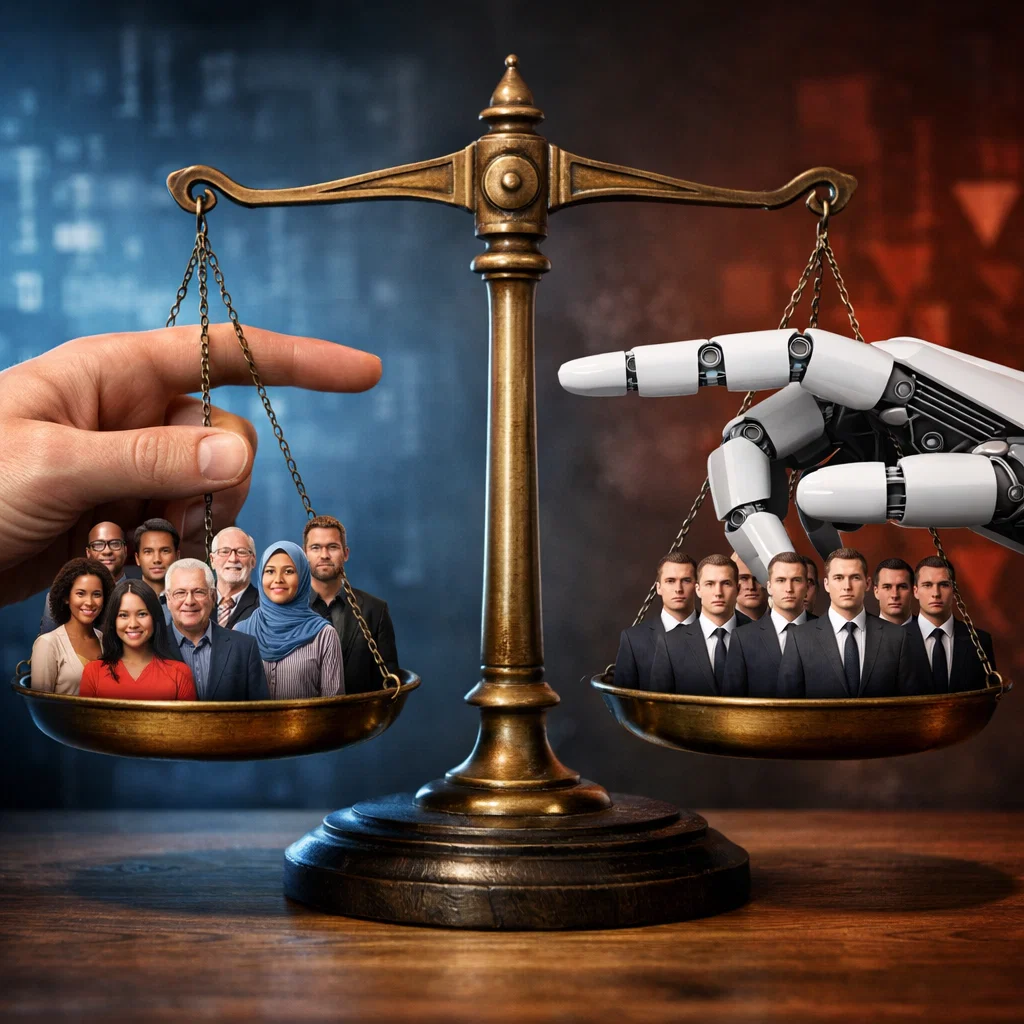
The development of Artificial Intelligence (AI) has brought many changes to many fields of the industry, especially healthcare, finance and transportation, and entertainment. With AI technologies still defining the decision-making processes, there has been an apprehension of the ethical concerns of AI systems. Among other issues, the problem of bias stands out as one of the leading problems with AI development: the unwanted favoritism that may result in the functioning of the algorithm in a biased or discriminative way and explore the impact of discriminatory response. This article needs to go deeper into how bias may be introduced to AI systems via data, design decisions and implementation, the ethical implications of biased systems and provides ways of enhancing fairness, accountability and inclusiveness.
Learning about Bias in AI Systems
The bias in AI is understood as a systematic non-neutral behavior of the outcomes as determined by various factors such as biased training data, bad algorithm design, and even unintentional human mistakes. To learn about bias in the AI systems, it is necessary to consider the primary sources of bias.
Data Bias
It is common to cite the data used to train the machine learning algorithms as the main root of bias in AI systems. The AI systems are trained using previous data, and in case the said data contains the current prejudices, inequalities, or stereotypes, the bias may be sustained, even enhanced by the AI system. Indicatively, when an AI system applied in the recruitment process is trained to use data that is based in an industry that has traditionally hired more men than women, the model will be biased towards hiring male candidates, despite the system design being neutral.
There are various types of data bias:
- Sampling Bias: The biased data results are caused by the lack of representation of the data with the diverse population that it is intended to represent. An example is that facial recognition programs that have been trained on a small size of lighter skinned faces will not designate darker skinned faces with the same success.
- Label Bias: In the dataset, labels are determined by biased human judgment, e.g., in situations where human annotators are biased against certain demographic attributes or behaviour.
- Historical Bias: The data usually represents historical disparities within the society. As an illustration, the criminal records in history can be biased in terms of the minority arrests because of systemic ways of the police force to affect the outcomes resulting in the biased usage of the criminal records to train the AI models in predictive policing.
Design Choices
Besides the biased data, the design decisions in the development of the AI systems can create biasness. The choices that the AI developers make to include or exclude features, model structure, and training hyperparameters are critical in influencing the results of AI models. Even the intentionally designed decisions can be biased.
- Feature Selection: AI developers can inadvertently create biases when choosing features (variables) that are correlated with such sensitive characteristics as race, gender, or socioeconomic status. To give the example, a lending algorithm that uses the ZIP code as one of the features of the applicant may discriminate against some of the racial or economic groups, namely because ZIP codes tend to be associated with some racial and economical disparities.
- Design of the Algorithms: The bias is also affected by the algorithms used to process the data. Some of the algorithms can work or not work well with the underlying dataset. As an illustration, decision trees and deep learning models can be characterized by a certain level of sensitivity to biases in training data, with the consequence being different results among demographic groups.
- Interpretability vs. Accuracy: Not all AI systems place importance on interpretability as opposed to predictive accuracy and this can result into opaque decision making. The treatment of the AI models as black boxes makes it hard to trace and rectify the biased behaviors. This non-openness may contribute to the ethical dilemmas of the AI system since the stakeholders will not have a complete understanding of why some decisions are taken.
Implementation Bias
Discrimination may also get into the system at the stage of implementation. Although the design and data are relatively impartial, new types of bias might be introduced when an AI system is implemented in the real world.
- Operational Bias: AI systems tend to engage in real-world situations, which are generally dynamic, and how the systems are implemented can affect their justness. As an example, facial recognition cameras implemented to provide security in a crowded area can be effective in some light conditions but not others, which is disproportionately true of some groups. In a similar vein, AI-based recruitment solutions can be put into practice in a manner to prioritize one or more qualifications, strengthening the existing biases in hiring behavior.
- Feedback Loops: In certain instances, deployment of AI systems may cause feedback loops, where the actions of the AI system feed into future information that can be used to train the model. As an example, an AI system in predictive policing can focus on certain neighborhoods more than others and will collect more data in those areas and strengthen biased predictions. These feedback loops have the potential to multiply the original bias and thus create a cycle of unfair outcomes.
Biased AI Systems Ethical Consequences
The ethical consequences of biased AI systems are extensive and can be very disastrous to both the individuals and the society. Prejudice in AI can contribute to and amplify the current inequalities in society, which results in discrimination against disadvantaged groups. The most important ethical issues that biased AI systems present are:
Discrimination
The most disturbing ethical concern about biased AI is possibly discriminatory outcomes. In cases where algorithms are used to draw conclusions on bias information or defective design decisions, some individuals or groups of people may be disfavored. The prejudice may be various, such as racial, gender, and socioeconomic. In recruitment, such as in the hiring process, biased AI systems can reproduce gender disparity by prioritizing the male candidates over the female candidates who might equally be capable of performing the relevant duties.
Erosion of Trust
Implementation of discriminatory AIs may result in a considerable mistrust of technology. Once individuals start developing the feeling that AI is rendering unjust or discriminatory decisions, they can no longer trust such mechanisms, which results in the unwillingness to implement AI-driven tools in different industries. Such a loss of trust may reduce innovation and decelerate the process of integrating the AI technologies that otherwise stand to benefit the society.
Unintended Consequences
AI systems are frequently constructed to maximize desired results, which may be efficiency or profitability. Nevertheless, these maximization objectives may occasionally be at the cost of justice and diversity. The goals of the pursuit may have unintended effects, including the perpetuation of damaging stereotypes or the deprivation of underrepresented groups of their chance, because of their narrowly focused goals, including maximizing engagement or increasing sales.
Lack of Accountability
Due to the increasing autonomy of AI systems in their decisions, accountability is becoming a matter of concern. Who should be held accountable in the event that the AI system generates biased or malicious results? Is it either the AI developers, the organizations using the system or the users using the system? Without having a proper sense of accountability, it may be hard to mitigate and correct the ill effects of biased AI systems.
Promoting Fairness, Accountability, and Inclusivity Strategies
Though the problems of bias in AI are serious, there are a range of approaches that can be used to reduce the risks and enhance equity, responsibility, and diversity in AI systems development.
Unlike homogenous and unrepresentative data
The best solution to this issue of biasness in AI is by making the data to be used to train algorithms diversified and reflective of the population. This is possible through gathering data of a diversified demographic population such that no population group is represented more or less in the data sample. Also, the process of collecting data must be transparent and there should be proper documentation of the method used to acquire the data and other possible biases in the data sources.
Bias Detection and Reduction Tools
The tools and techniques can help AI developers recognize and eliminate bias when developing AI. Some of the techniques that can be used to identify the possible sources of bias in training data and model predictions include the use of fairness-aware machine learning algorithms and bias detection software. Moreover, AI systems should be audited on a regular basis to establish and resolve instances of discrimination.
Practical AI and Clarifiable AI
The AI systems ought to be clear and understandable to encourage accountability. In the case of AI systems being utilized in decision-making, the stakeholders must be in a position to know how the system came up with its decision. Explainable AI (XAI) is designed to help make machine learning models more interpretable, allowing developers, users, and the individuals impacted to understand how the decision was made. Such transparency is necessary to make AI systems a responsible and ethical use.
Ethical Rules and Regulation
Industry organizations and governments are to set up clear ethical standards and rules in the development and use of AI. Those guidelines must focus not only on fairness, inclusivity, and transparency, but also on the possible harms of the biased systems. The regulatory frameworks must also enable people to take action against prejudicial decisions by the AI systems and claim redress on the same when they need them.
Inclusive Design Processes
The developers of AI must collaborate with various teams during the development process and the various views put into consideration when designing AI systems. It can be used to determine possible biases at an early stage during the design process and develop more accommodating systems which are more useful to all users. Also, including the underrepresented groups in the creation of AI systems can be approached to guarantee the latter technologies do not continue the current disparities.
Ethical Reflection and Ongoing Improvement
Lastly, AI developers and AI stakeholders must practice constant ethical reflection during the lifecycle of AI development. This means critically assessing the possible effects of the AI systems, willingness to take feedback in various communities, and actively trying to enhance the equitability and inclusivity of AI technologies. Ethical reflection must be deemed a continuous process, and the assessments and updates to the system should be conducted frequently to make sure that AI systems can help the society to stay true to their values and achieve positive results.
Conclusion
One of the most important issues, as AI technologies keep making their way into the future, is the ethical concerns of prejudiced systems. Prejudice may permeate the AI systems by using data, design, and implementation, which results into discriminatory result and undermining the confidence in these technologies. To reduce the risks linked with the bias, AI developers need to consider equity, inclusivity, and accountability as their design principles. We can craft effective and just AI systems by adopting the following strategies; employing a wide range of data, being more transparent, undertaking ethical reflection, and so on.
By emphasizing fairness, transparency, and inclusivity, AI developers and stakeholders can build systems that are ethical, accountable, and truly beneficial to society.