Abstract
Camera operation is an important part of television production because it shapes the audience’s perception and view of the visual narrative. Knowing the fundamentals of using a camera will help a beginner make high-quality, interesting shots. This paper will discuss the key aspects of the use of the camera in television production. It describes the key parts of the camera, the techniques of framing, types of shots and the camera movements to produce television programme effects. This paper will be a qualitative review based on the current academic literature on media production and cinematography. The results indicate that familiarity with camera elements and techniques enhances the telling of stories, better visual representation, and aids in the effective communication of meaning to viewers by producers. The article concludes that learning simple skills using the camera is one of the fundamental skills a beginner in the production of TV must learn, since it helps to add clarity to the story and also display the story in a professional way.
Keywords: production of TV shows, camera work, frame work, shot types, camera movement, visual narrative.
1.0 Introduction
Television production relies on visual communication a lot. Images and stories for audiences are captured by the use of cameras. In the absence of adequate camera skills, one can hardly come up with high-quality and entertaining television programmes. As a novice in media production, it is essential to learn some basic camera principles in order to appreciate the process of television production.
Basic guidelines on camera functioning in television are the knowledge of camera components, framing, shot composition and movement techniques. These aspects are used to ensure that producers record clear images and focus the audience’s attention on an image.
Brown (2020) claims that the art of using a camera would be effective to tell a story since the manner in which a scene is captured affects how the audience perceives characters, emotions, and actions. The visual meaning is thus developed through various types of shots and camera movements by television producers.
This article provides a novice with the fundamental principles of camera operation in television. It talks about the aspects of cameras, framing, types of shots, and movement aspects that are used to make the visual content interesting. This is aimed at describing the aspects in which the camera works better to narrate the story and adds visual value to the television programmes.
2.0 Literature Review
A number of researchers have studied the significance of camera tricks in the production of the media. Studies reveal that visual storytelling depends on camera positioning, shot composition and camera movement significantly.
According to Bowen (2019), one of the technical competencies needed during television production is the operation of the camera. The author states that camera operators need to know how to manage focus, exposure and framing to come up with clear and aesthetic images.
In a similar regard, Millerson and Owens (2021) observe that the television camera is the eyes of an audience. The manner in which a camera captures a subject matter is what the audience pays attention to and how they interpret the scene. The right camera technique also has an impact on viewers.
Recent research also points to the camera movement as an element of visual storytelling. According to Thompson and Bowen (2020), camera movements, including panning, tilting, tracking, and others, can lead the viewers through the scene and help to produce an emotional effect.
Besides, Zettl (2022) underlines that successful television production is not only a matter of technical ability but also creative narration. To convey meaning, camera operators have to strike a balance between visual composition and narrative purpose.
Generally, available literature demonstrates that camera fundamentals are a must for anybody venturing into the television production industry.
3.0 Conceptual Review
3.1 Television Production: Camera Work
Camera operation is a technical and creative process that involves control of a camera to record visual images to be used in television programmes. It also entails the manipulation of camera parameters, the placement of the camera and the choice of shots that promote storytelling (Zettl, 2022).
The camera operators are hired to work closely with the directors and producers in television productions to make sure that all scenes are well taken.
3.2 Basic Camera Components
A television camera is a device that comprises a number of significant components that combine to take pictures.
Lens
The lens regulates the entry of light in the camera, and the focus and zoom of the image. Various lenses can be used to make a wide or narrow perspective of a subject.
Viewfinder
The camera operator can view the camera using the viewfinder and know what the camera is capturing. This can be used to make sure the framing and composition are correct.
Image Sensor
The digital image is the recorded image that is formed by converting light into digital signals using the image sensor. The quality of sensors is an indicator of better images.
Tripod
A tripod gives stability and avoids shaking of the camera. It is normally applied in studio production and interviews.
The knowledge of these elements enables camera operators to regulate the quality of images and fix shots.
3.3 Framing Techniques
The way things are placed within the camera frame is known as framing. Effective framing assists in directing the viewer’s attention as well as producing balanced images.
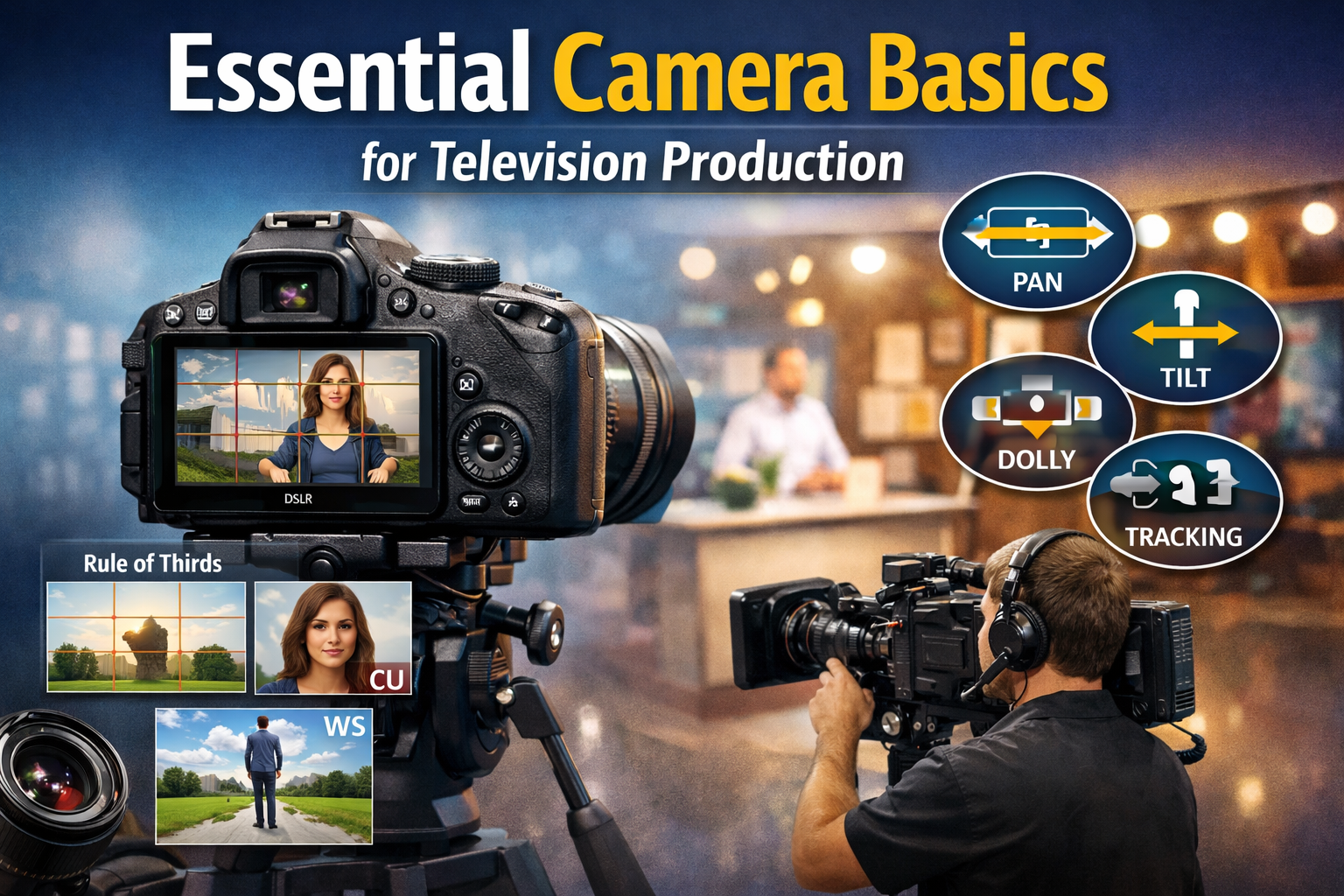
The rule of thirds is one of the most widespread rules of framing, which states that the frame is subdivided into nine equal parts. Portraying subjects in such a way makes the compositions look more natural and beautiful (Brown, 2020).
The other framing considerations are:
- Headroom
- Lead room
- Balance within the frame
These aspects can be used to make the subjects look natural and relaxed in the shot.
4.0 Theoretical Framework
4.1 Visual Communication Theory
Visual communication theory revolves around the visual message and the way it is perceived by the audience.
The theory of visual communication describes how pictures are used to convey meaning to the viewers. Lester (2021) describes visuals, including framing, angle, and movement, as the elements that impact the way viewers comprehend a message.
Statistics Camera operation in television making, enabling the expression of emotions, relationships, and actions without using dialogue only.
4.2 Auteur Theory
According to the auteur theory, filmmakers and directors demonstrate creative vision in the visual style and way of telling the story (Corrigan and White, 2021). There is camera work that is important in this process, as the camera composition and movement assist in shaping the visual identity of a programme.
The theories are used to explain why camera operation is crucial in telling stories effectively on television.
5.0 Methodology
The method used in this article is a qualitative literature review. Academic books, media production textbooks, and up-to-date scholarly research on television production and cinematography were consulted as a source of information.
The selection of sources is based on the fact that the sources published in 2019-24 are the most up-to-date sources of information on the topic of media production. The data were examined based on themes in order to extract major ideas pertaining to camera parts, framing, types of shots, and camera movement.
6.0 Findings
Several important parts of camera work were assessed and determined to affect the quality of production of television.
6.1 Shot Types
The various types of shots are used to convey various meanings in a scene.
Common shot types include:
- Wide Shot (WS) – reveals the scope of the surroundings.
- Medium Shot (MS) – is a view of the subject between the waist and the head.
- Close-Up (CU) – concentration on the facial expressions.
- Extreme Close-Up (ECU) – lays emphasis on minimal details.
The types of shots are used in telling separate stories.
6.2 Camera Movement Techniques
Movement of the camera is used to create dynamic images and to direct the focus of the viewers.
Common movements include:
- Pan – horizontal movement of the camera.
- Tilt – a movement of the camera in a vertical direction.
- Dolly- using the camera to go forward or back.
- Tracking – moving along with a moving subject.
These movements enhance more interesting and attractive scenes.
7.0 Discussion
The results validate the importance of the techniques of the camera in telling well-constructed television stories. The camera elements assist operators in regulating the quality of images, whereas the way people view subjects is determined by the framing techniques.
The types of shots are also important in narration. To illustrate, the setting is set by wide shots, and emotional moments are disclosed by close-ups. The combination of various shots allows the producers to capture the attention of the audience and generate a dramatic effect.
The movement of the camera is also another way of visual storytelling, as it provides movement and dynamism to the scenes. Pans and tracking are just some of the movements which enable viewers to become familiar with the surroundings and track characters.
All these methods enhance the visual aspect of the television programmes and increase the level of interest in content among viewers.
8.0 Conclusion
An essential technique in television production is camera operation. Knowledge of camera elements, framing, types of shots, and movement will enable novice photographers to take clear and interesting shots.
In this article, the camera operation is effective because it facilitates the telling of the story by focusing the attention of the audience and promoting visual communication. Television programmes are made more professional and appealing to the eye when camera operators employ the right methods.
As a novice in the art of media production, these basics on the camera would be a solid ground on which to gain more advanced skills in cinematography later on.
References
Bowen, C. J. (2019). Grammar of the shot. Routledge.
Brown, B. (2020). Cinematography: Theory and practice (4th ed.). Routledge.
Corrigan, T., & White, P. (2021). The film experience. Bedford/St. Martin’s.
Lester, P. M. (2021). Visual communication: Images with messages (8th ed.). Wadsworth.
Millerson, G., & Owens, J. (2021). Television production. Focal Press.
Thompson, R., & Bowen, C. (2020). Basic cinematography. Routledge.
Zettl, H. (2022). Television production handbook (13th ed.). Cengage Learning.

