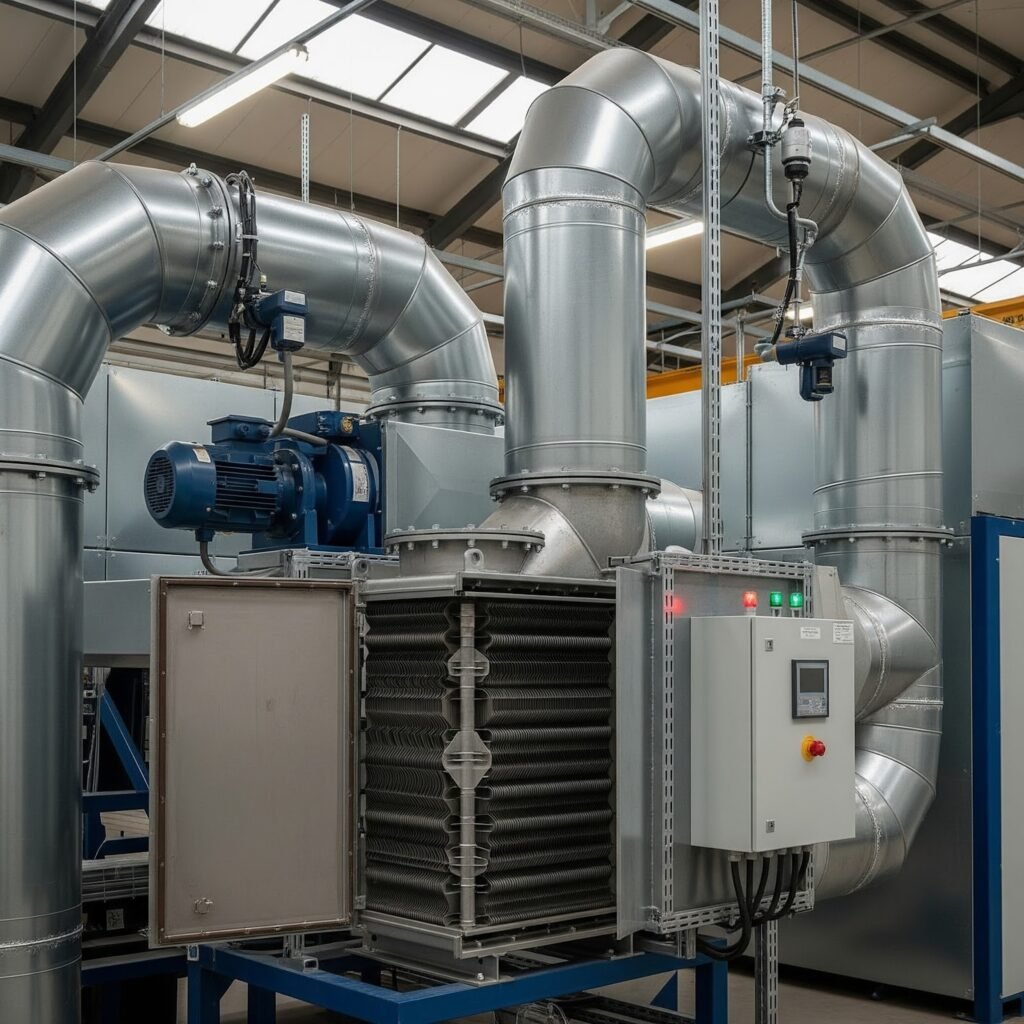
The global shift closer to strength efficiency and decarbonization places the industrial area at a critical juncture. For the US, which historically has struggled with electricity waste, this represents each an enormous mission and a big opportunity. The ability to recover and reuse energy—specifically waste heat—is rapidly becoming the defining metric of a competitive, sustainable American manufacturer.
The Stark Reality of U.S. Industrial Energy Waste
The U.S. Commercial quarter is the state’s biggest electricity consumer, accounting for approximately 35% of total U.S. Cease-use strength intake in 2022, with production taking the most important proportion. However, this excessive intake comes with a dramatic hidden value: significant power waste, basically within the shape of thermal energy released into the atmosphere or water.
While the power efficiency of the U.S. As a whole has advanced, the commercial sector nevertheless discards a tremendous part of the electricity it consumes. Estimates recommend that 13% to 18% of all U.S. Commercial power use is lost as waste warmth.
This colossal amount of wasted energy, which an earlier estimate put at 1.4 quadrillion BTU per year—a figure comparable to the total annual energy consumption of millions of homes—is a drain on national resources and a major contributor to greenhouse gas (GHG) emissions. For companies in energy-intensive industries like iron and steel, chemical processing, cement, and refining, this waste directly translates into higher operational costs and reduced competitiveness.
The Core of Optimization: Major Heat Recovery Technologies
Heat recovery systems operate on the principle of thermal exchange, capturing discarded thermal energy from hot sources and transferring it to a colder medium where the energy is needed.
The most prominent and effective heat recovery technologies for industrial energy optimization include:
1. Heat Exchangers
The fundamental workhorse of thermal exchange, heat exchangers transfer heat between two fluid (liquid or gas) without them mixing.
- Recuperators (High/Medium Grade): Often utilized in furnaces and combustion structures, they seize warmness from hot flue gasoline to preheat the incoming combustion air. This is a direct, closed-loop efficiency improvement.
- Regenerators (High/Medium Grade): Use a porous material (like a ceramic matrix) to store and periodically release heat in cyclical operations, common in glass and steel production.
- Shell-and-Tube/Plate Heat Exchangers (Medium/Low Grade): Versatile and highly efficient devices used for process streams, cooling systems, and extracting heat from hot wastewater to preheat boiler feed water or process streams.
2. Waste Heat to Power (WHP) Systems
These systems convert recovered heat directly into electricity, which is especially valuable for high-grade waste heat that might otherwise be vented.
- Steam Rankine Cycle: The most traditional method, using high-temperature waste heat to produce steam that drives a turbine to generate electricity.
- Organic Rankine Cycle (ORC) (Low/Medium Grade): Ideal for lower-temperature heat sources (even below $100^\circ\text{C}$). ORC systems use an organic fluid with a low boiling point instead of water, allowing them to efficiently convert lower-grade thermal energy into electrical power.
3. Thermal Energy Storage (TES)
TES systems, which include emerging Phase Change Materials (PCM) batteries, are important for fixing the mission of temporal availability. They keep excess warmness generated all through one phase of manufacturing to be used throughout peak call for or a completely different system section, maximizing flexibility and minimizing reliance on fossil fuels throughout important periods.
4. Heat Pumps and Vapour Recompression
These technologies upgrade low-grade waste heat to a higher, more usable temperature.
- Steam-Generating Heat Pumps: Use electricity to boost the temperature of low-grade waste heat, generating medium-grade heat or even boiler-quality steam, effectively cutting down on natural gas usage for boiler systems. This is mainly applicable in industries with low-temperature waste streams, along with meals and beverage processing.
Quantifiable Benefits: Fuel Savings and Financial Returns
The integration of advanced heat restoration systems grants effective, information-backed financial and environmental benefits for U.S. Industry.
Energy Recovery and Fuel Savings
The most immediate benefit is the displacement of primary fuel (natural gas, coal, oil) required to power processes. Heat recovery technologies can achieve an energy recovery rate of 30% to 60% depending on the application and waste stream quality.
- Process Heating: Preheating boiler feedwater or combustion air using recuperators can reduce fuel consumption in heating units by 10% to over 20%. In specialized processes, such as the preheating of raw materials in cement kilns, recovered heat leads to significant savings.
- Electricity Generation: ORC and steam WHP systems capture thermal energy that would otherwise be lost and convert it into onsite, free-of-cost electricity, providing both cost savings and energy resilience.
- Case Study Example: In a typical U.S. manufacturing facility, systematic heat recovery projects are consistently shown to yield annual energy cost savings of 10% to 20%, often with a rapid return on investment (ROI) or payback period of 6 to 18 months.
Emissions Reduction and Environmental Compliance
By reducing the demand for primary fossil fuels, heat recovery directly lowers the facility’s carbon footprint.
- GHG Mitigation: Recovering $1.4$ quadrillion BTU of waste heat in the U.S. industrial sector, as estimated by the DOE, would translate directly into a massive reduction in and other GHG emissions, aligning companies with increasingly stringent state and federal environmental targets, and positioning them to benefit from incentives like those provided by the Inflation Reduction Act of 2022.
- Total Efficiency: Combined Heat and Power (CHP) structures, which are a complicated form of warmth recovery, can obtain usual gadget efficiencies of up to 80%, far surpassing the efficiency of conventional separate warmth and power era techniques.
Operational Resilience and Cost Stability
Heat restoration reduces a facility’s reliance on outside strength sources, that is a prime hedge towards risky power markets. The U.S. Has experienced sizeable fluctuations in industrial natural gasoline and electricity fees; internalizing a portion of power demand through waste heat minimizes publicity to this volatility. Furthermore, by providing stable thermal conditions, recovered heat can extend the lifespan of critical equipment (boilers, furnaces) by reducing thermal stress, leading to lower maintenance costs and less unplanned downtime.
The Path to Industrial Energy Optimization
The industrial oven power performance marketplace in North America is powerful and growing, projected to be the most important marketplace globally, demonstrating that U.S. Industries are increasingly more adopting those answers. The next step for most manufacturers is not a radical overhaul, but a strategic assessment:
- Waste Heat Audit: Identifying the quality (temperature) and quantity (BTU/hr) of all potential waste heat streams.
- Technology Matching: Selecting the optimal thermal exchange technology (e.g., ORC for low-grade heat, recuperators for flue gas) that best matches the source and the demand.
- Integration: Designing a system that seamlessly integrates with existing processes, often by leveraging advanced AI/ML algorithms to dynamically optimize the flow of recovered energy.
By embracing energy-efficient heat recovery systems, American industries can transform a historical liability—waste heat—into a strategic asset, driving down costs, securing energy independence, and leading the way toward a decarbonized future.