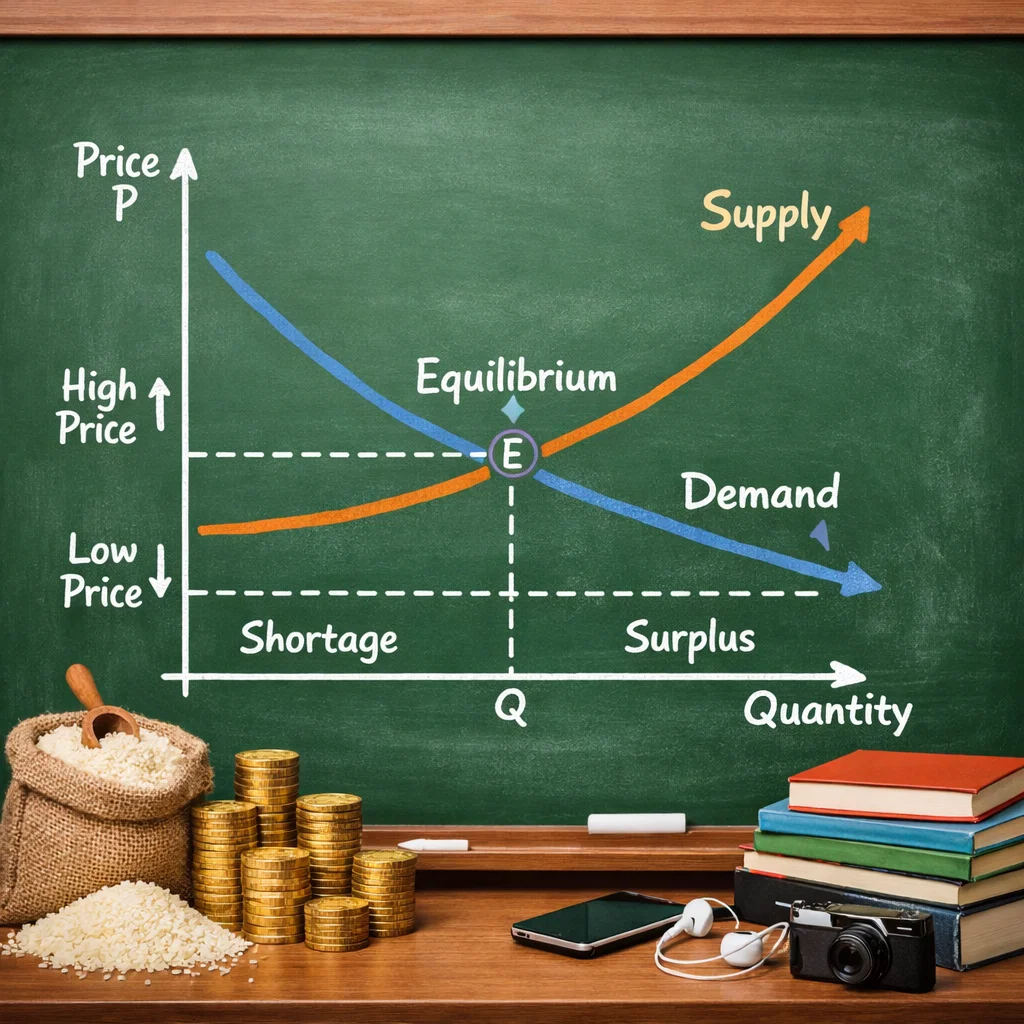
In economics, demand and supply are the pillars that explain how goods and services move in the market. Understanding these concepts helps us know why prices change and how resources are allocated efficiently.
Law of Demand
The Law of Demand states that as the price of a good or service falls, the quantity demanded rises, and as the price rises, the quantity demanded falls, assuming all other factors remain constant. Simply put, people buy more when prices are lower and less when prices are higher.
Law of Supply
On the other hand, the Law of Supply says that as the price of a good or service rises, the quantity supplied increases, and as the price falls, the quantity supplied decreases, assuming other factors are constant. Producers are willing to produce more if they can sell at higher prices.
Determinants of Demand and Supply
Determinants of Demand:
- Income of Consumers – Higher income usually increases demand.
- Prices of Related Goods – Substitutes and complements affect demand.
- Tastes and Preferences – Popularity of a product can increase demand.
- Expectations – Expected future price changes can influence current demand.
- Population – More people usually increase total demand.
Determinants of Supply:
- Production Cost – Lower production costs increase supply.
- Technology – Improved technology boosts supply.
- Government Policy – Taxes and subsidies can affect supply.
- Prices of Other Goods – If another product is more profitable, producers may shift supply.
- Number of Sellers – More sellers in the market increase supply.
Graphs and Equilibrium Price
Graphically, the demand curve slopes downward, while the supply curve slopes upward. The point where these two curves intersect is called the equilibrium price. At this point, the quantity demanded equals the quantity supplied, meaning the market is “balanced.”
Shifts vs Movements Along Curves
It’s important to know the difference:
- Movement along a curve happens when the price changes, affecting quantity demanded or supplied.
- Shift of the curve occurs when a determinant (like income or technology) changes, causing demand or supply to increase or decrease at every price.
For example, if the price of rice falls, there’s a movement along the demand curve (people buy more). But if a new farming technology makes rice cheaper to produce, the supply curve shifts right, increasing supply at all prices.
Understanding demand and supply is crucial for WAEC students because it forms the foundation of microeconomics. It explains everyday market scenarios, from buying snacks at school to understanding national economic policies.