Your cooling tower is an essential machine that keeps your facility running smoothly. However, when its drift control fails, it transforms into an unintended airborne biological delivery system. This is not just a maintenance issue; it represents a legal and public health catastrophe waiting to happen.
The threat of Legionella highlights the severe financial and human costs of cooling tower failures. High-profile outbreaks in locations like Disneyland and Napa Valley, directly linked to cooling tower aerosol spread, have caused multiple deaths, hundreds of illnesses, and millions in legal settlements.
This guide will decode the CTI standard, explain common drift eliminator failures, and outline critical steps to safeguard your facility. Understanding the CTI drift standards is essential for protecting public health and avoiding devastating legal consequences.
Table of Contents
- Introduction
- Deconstructing Drift: Why 0.0005% Is the Standard for Safety
- Defining Drift vs. Plume
- The CTI Mandate
- The Numerical Goal
- The Public Health Link
- The Microbial Projectile
- The Biological Carrier
- Regulatory Pressure (CDC & OSHA)
- The Legal Fallout
- The Critical Role of Inspection and Remediation
- Routine Inspection Checklist
- Physical Integrity Assessment
- Sealing and Gap Evaluation
- Fouling and Obstruction Analysis
- Repair vs. Upgrade Decision Matrix
- Future-Proofing: Upgrading for 0.00025% Compliance
- The Upgrade ROI
- Dual Benefit Analysis
- Conclusion
- FAQs
Deconstructing Drift: Why 0.0005% is the Standard for Safety
What exactly is drift, and why does such a small percentage matter so significantly? Understanding this distinction could not only save lives and protect your organization from catastrophic liability. It also helps you determine when Cooling Tower Repairs are necessary.
Defining Drift vs. Plume
- Plume consists of harmless water vapor that rises from cooling towers as visible steam
- Drift represents liquid water droplets that contain concentrated water treatment chemicals and microbes
- These drift droplets can harbor dangerous pathogens like Legionella bacteria
The CTI Mandate
The Cooling Technology Institute (CTI) serves as the industry’s governing body for thermal and drift performance standards. Their guidelines establish the benchmark that facilities must meet to ensure public safety and regulatory compliance.
The Numerical Goal
Modern standards require drift loss to be 0.0005% or less of the circulating water rate. To put this in perspective:
- For a 10,000 GPM tower, this means losing one gallon every 20 minutes (0.001%) versus one gallon every 2 minutes (0.01%)
- This seemingly small difference represents a twentyfold reduction in potential microbial exposure
- Each percentage point reduction exponentially decreases Legionnaires’ Disease transmission risk
The Public Health Link
Every reduction in drift directly correlates to decreased community health risks. The CTI standard exists because scientists understand that microscopic improvements in drift control create massive improvements in public safety outcomes.
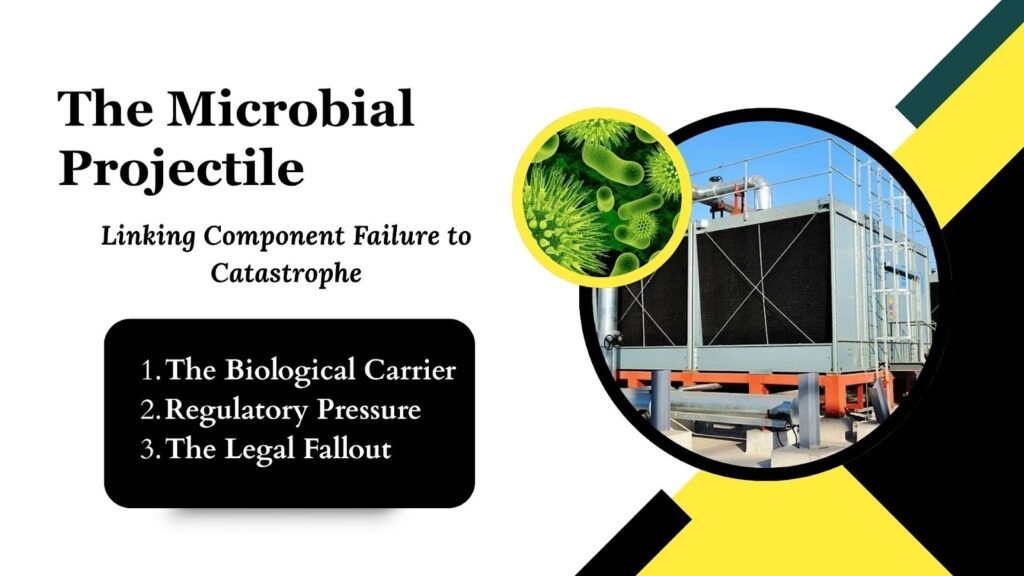
The Microbial Projectile: Linking Component Failure to Catastrophe
How do cooling towers transform from essential equipment into dangerous pathogen dispersal systems? The answer lies in understanding the physics and biology of drift droplets.
The Biological Carrier
Drift droplets smaller than 10 micrometers present the greatest danger because they can remain suspended in the air for extended periods, increasing the likelihood of inhalation. These tiny particles can travel significant distances, potentially affecting individuals far from the source.
- Remain airborne for extended periods
- Travel significant distances (documented cases show spread up to several miles)
- Penetrates deep into the human respiratory system when inhaled
- Concentrate water treatment chemicals and microorganisms into highly potent carriers
Regulatory Pressure (CDC & OSHA)
Both the CDC and OSHA explicitly require facilities to maintain high-efficiency drift eliminators as part of comprehensive Water Management Programs (WMP). Key requirements include:
- Regular inspection and maintenance of drift elimination components
- Documentation of compliance with CTI performance standards
- Immediate remediation when component failures are identified
- Integration of drift control into overall Legionella prevention strategies
Failure to maintain these components constitutes a WMP breakdown and creates significant regulatory exposure.
The Legal Fallout
Organizations face severe legal consequences when documented outbreaks trace back to towers with:
- Known but unrepaired component damage
- Substandard drift elimination systems
- Inadequate maintenance documentation
- Failure to meet established CTI performance criteria
The Critical Role of Inspection and Remediation
What specific signs indicate your drift eliminators require immediate attention? Recognizing these warning indicators can prevent your facility from becoming a public health liability.
Routine Inspection Checklist
Maintenance teams must systematically evaluate several critical factors during each inspection. This proactive approach is essential for preventing the accumulation of pathogens and ensuring optimal system performance.
Physical Integrity Assessment
- UV Damage: Look for discoloration, brittleness, or surface degradation in PVC or FRP materials
- Structural Failure: Document any cracking, warping, or breaking of eliminator blades or support structures
- Chemical Attack: Identify areas where aggressive water treatment chemicals have compromised material integrity
Sealing and Gap Evaluation
- Module Separation: Check for gaps between individual eliminator modules
- Wall Interfaces: Examine sealing between eliminators and tower walls
- Bypass Prevention: Ensure no high-velocity air paths circumvent the drift elimination system
Fouling and Obstruction Analysis
- Scale Buildup: Document excessive mineral deposits that reduce airflow efficiency
- Biological Growth: Identify biofilm accumulation that compromises eliminator performance
- Debris Accumulation: Remove organic matter that obstructs the proper elimination function
Repair vs. Upgrade Decision Matrix
Understanding when to repair versus upgrade depends on several factors: the age and condition of the item, the cost of repairs compared to a replacement, and how well the current version meets your needs. If repairs are frequent or costly, upgrading might save money in the long run while providing improved functionality or efficiency.
Repair Situations
- Limited Damage: A few damaged sections in an otherwise healthy, modern system
- Recent Installation: Systems less than five years old with isolated component failures
- Budget Constraints: Immediate risk mitigation while planning for future upgrades
Upgrade Opportunities
- Obsolete Technology: Replacing old splash-style eliminators with modern curved-blade designs
- Performance Enhancement: Achieving stricter CTI standards through advanced cellular-style modules
- Long-term Investment: Future-proofing against evolving regulatory requirements
Future-Proofing: Upgrading for 0.00025% Compliance
Beyond mere compliance, staying ahead of regulations offers significant long-term benefits. Proactive measures can prevent costly retrofits down the line and solidify a facility’s reputation as environmentally responsible.
The Upgrade ROI
Modern advanced eliminator designs can achieve drift rates as low as 0.00025%, representing:
- Double the performance of current minimum standards
- Future-proofing against anticipated regulatory tightening
- Measurable reduction in legal and insurance liability exposure
- Enhanced community relations through proactive safety measures
Dual Benefit Analysis
Strategic upgrades, such as aligning with CTI Drift Standards, offer both immediate and long-term advantages. They enhance operational efficiency right away while laying the foundation for sustained growth.
- Microbial Risk Reduction: Exponentially decreased pathogen transmission potential
- Water Conservation: Reduced makeup water requirements and chemical loss
- Operational Efficiency: Lower maintenance requirements and extended component life
- Regulatory Confidence: Exceeding standards demonstrates commitment to public safety
Conclusion
Adhering to CTI drift standards is paramount for safeguarding public health and avoiding significant liabilities. As explored, effective drift elimination is your primary defense against Legionella outbreaks and the severe consequences of component failure.
Proactive maintenance, including timely cooling tower repairs and strategic upgrades, offers dual benefits: enhanced operational efficiency and robust protection for both your facility and the wider community.
Neglecting drift control exposes your organization to catastrophic risks, from costly litigation and regulatory penalties to irreparable damage to your reputation. Don’t leave your cooling tower’s integrity to chance.
FAQs
What are the CTI drift standards for cooling towers?
CTI drift standards limit the amount of water droplets (drift) escaping a cooling tower to 0.0005% or less of the circulating water flow, reducing the risk of Legionella spread and improving safety.
Why is controlling drift in cooling towers important?
Drift droplets can carry harmful bacteria like Legionella. Controlling drift prevents airborne contamination and protects public health.
What is the difference between drift and plume?
A plume is harmless water vapor visible as steam, while drift contains liquid droplets with chemicals and microorganisms that can pose health risks.
What agencies regulate cooling tower drift control?
The CDC, OSHA, and CTI provide guidelines and performance requirements to prevent Legionella and protect worker and community health.