The Internet has been labeled as a huge, unseen network of billions of devices all over the globe. Under this seamless connectivity is a set of regulations and norms that enable the data to be reliably transferred between devices. The core of this Internet ecosystem is the basic Internet protocols especially the Transmission Control Protocol (TCP) and the Internet Protocol (IP). These procedures are the foundation of the Internet that allows the devices, servers and applications to communicate effectively and dependably. Knowing how TCP/IP functions does not only de-mystify the Internet functionality but also accentuates why these protocols continue to be the focus of world digital communication.
What are the basic Internet Protocols?
Internet protocols refer to rules that are standard in which gadgets share information on the networks. They determine the format of data, the manner in which data is handled, transmitted, routed and also received. In absence of these protocols, devices would fail to comprehend each other and communication would not take place. Most common protocols are TCP/IP since the protocols offer an efficient, reliable and scalable way of communicating data.
Protocols may be likened to a shared language that is used across all devices so that messages are communicated in a proper manner. Devices just like human beings depend on protocols to transmit information without misinterpretation just as human beings use grammar and syntax to pass information across clearly.
A Brief History of TCP/IP
The history of TCP/IP development is also important to understand this concept. During the 1960s and 1970s scientists were busy developing the technology of linking two or more computers in universities and research centers. This attempt resulted in the invention of the ARPANET which was the predecessor of the Internet. The first communication systems were not compatible and reliable, and this led to the invention of a universal protocol. TCP/IP was developed to overcome these problems giving it a structure that could be cross-platform (between hardware, networks and software systems). In 1983, TCP/IP was made the standard protocol stack in ARPANET, and subsequently the Internet.
TCP / IP: The Foundation of Internet Communication
TCP/IP is not a single protocol but a family of protocols that are intended to be used as a combination to facilitate the Internet communication. TCP/IP stands for:
- Transmission Control Protocol (TCP): Delivery of data is guaranteed.
- Internet Protocol (IP): Addressing and routing is managed as such that data gets to the right destination.
The combination of TCP/IP offers an ordered technique of transmitting information between one device to another device irrespective of the hardware or arrangement of the network.
The TCP/IP Reliable Data Transmission
The ability of sending data relayed by a source to the destination in its original form and in the proper sequence is one of the major challenges of Internet communication. TCP/IP addresses this issue by a stratification:
Breaking Data into Packets

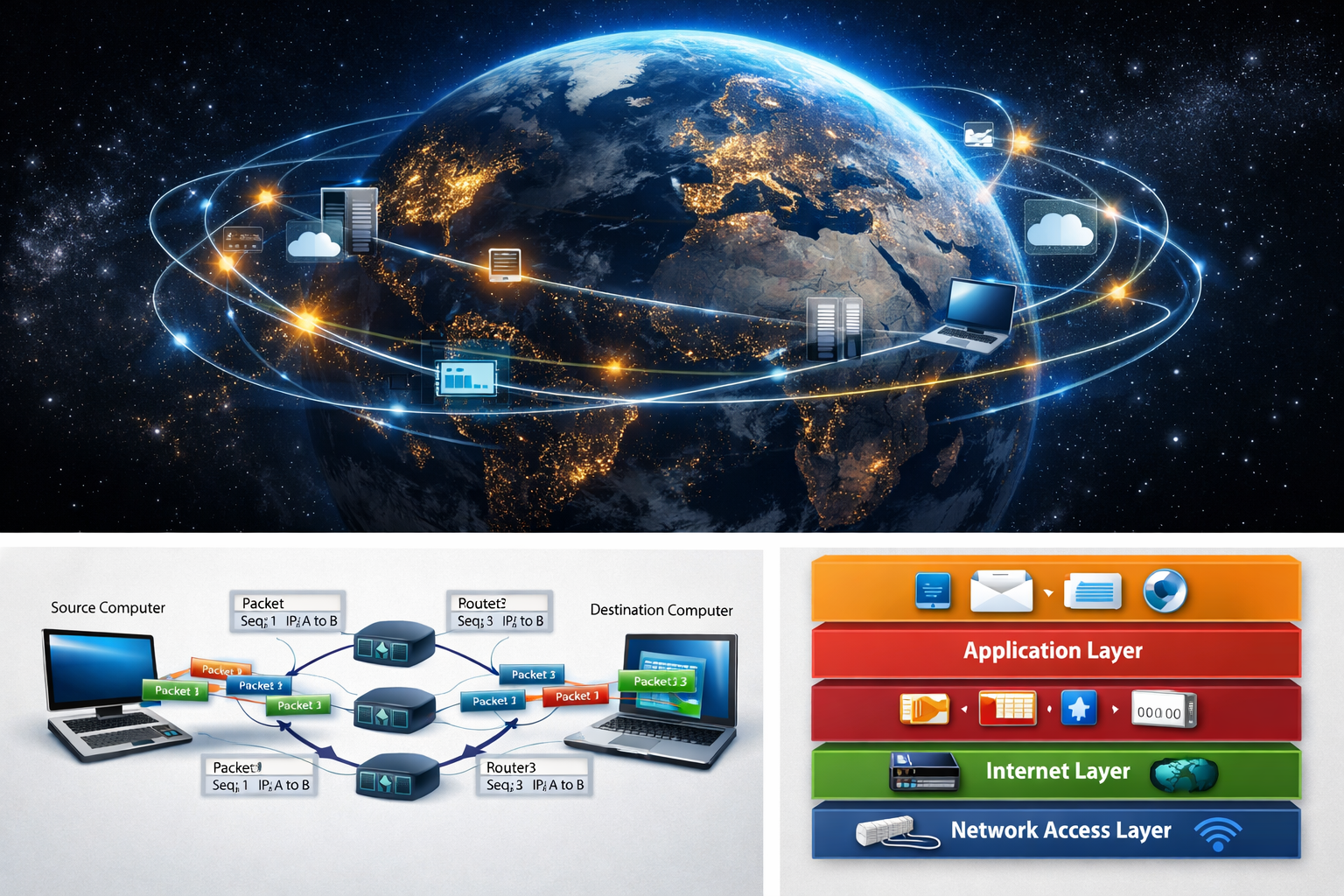
TCP separates data into smaller packets known as packets whenever you send a file, message, or video to the Internet. The packets carry a fragment of the original data and metadata, which are the source address, the destination address, the sequence number, and the error-checking information.
Splitting the data into packets has a number of benefits. It enables networks to map paths to packets on their own and thus utilizes correctly bandwidth resources and mitigates overload effects of network congestion. Also, when a packet becomes lost or corrupt, only the small fragment has to be resend, as opposed to the whole message.
Assigning IP Addresses
Addressing is under the responsibility of IP. Each gadget in the Internet has a distinct IP address, and the IP address functions as a digital postal address. The IP header of each packet includes the IP address of the sender and the receiver, which means that this packet can be properly directed along the networks of several networks.
The IPv6 was a significant development of the IP addressing. As Internet-linked gadgets started to blow up, the IPv4 addresses started to run out. With IPv6 this is addressed by an extremely huge address space that permits devices to virtually connect without any problem of address conflict.
Routing Packet Internetwork
When packets are formed and addressed, they are passed on through a set of routers. Routers are special equipment that calculate the most efficient path that each packet should take depending on the network conditions, network congestion and network topology. Notably, the packets of a message can follow various paths and be received in an out-of-order fashion.
Routing is a dynamic process. Always routers communicate with one another and exchange information concerning the network traffic so that packets can by-pass passages where there are many people. Some protocols such as BGP (Border Gateway Protocol) are needed to control general path of packets transmitted in the Internet making even international data transmission quick and dependable.
Reassembling and Checking of Errors
TCP arranges packets in order using sequence numbers when the packets arrive at the destination. It also does error checking whereby lost or damaged packets are resent. This ensures integrity and reliability in that the recipient gets the data that was precisely sent.
Flow control is also handled by TCP, and a quick sender does not drown out a slow receiver. This eliminates any loss of data and facilitates ease of communication even between networks with different speeds.
Introduction to TCP/IP Model Layers
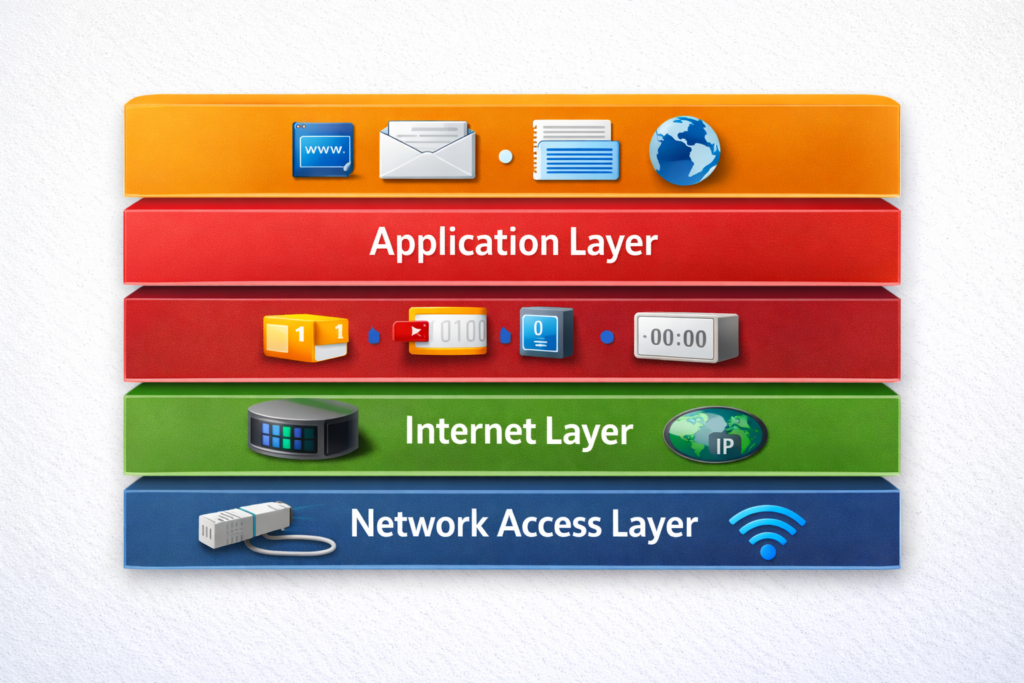
The TCP/IP suite works through a layered architecture which makes communication easy as it breaks communication into parts that are easy to manage. The main layers include:
Application Layer
Network services and applications are deployed here. Examples here are web browsers (HTTP / HTTPS), email clients (SMTP, IMAP, POP3) and file transfer programs (FTP). Application layer is the one that deals with the users directly and is the one that transforms what the users request into the data that can be transferred over the network.
Transport Layer
The layer that TCP works with is end-to-end communication. It handles packetization control, sequence control and error control as well, which offers a dependable data transmission system. Another protocol, the UDP (User Datagram Protocol), is also based on this layer but it is faster, and connectionless and does not provide the guarantee of error check.
Live streaming or online games are common applications that require UDP in order to minimize the latency, although some data packets might be dropped. It shows how the various protocols of the TCP/IP suite are applicable to certain network needs.
Internet Layer
IP operates at this level and does routing and addressing on logical level. It defines the route that packets follow up through networked networks to the destination point.
Network Access Layer
Also referred to as the link layer, it is the layer concerned with the physical transmission via a given piece of hardware, e.g., Ethernet, Wi-Fi, or fiber optic. It makes sure that the packets are allowed to traverse the local networks before they get to the Internet.
Why TCP/IP is at the Center of the Internet
Although other newer protocols and networking technologies have emerged, TCP/IP still prevails on the Internet communication due to a number of reasons:
- Universality: TCP/IP is platform-neutral and is compatible with all hardware and operating systems.
- Reliability: TCP guarantees data integrity by sequencing and retransmission thus ideal in applications which demand reliability.
- Scalability: The hierarchical addressing scheme of IP enables the Internet to have billions of devices.
- Interoperability: TCP/IP has a number of application protocols, which support superfluous communication among different services such as email, video streaming and cloud computing.
Although such sophisticated protocols as QUIC have been developed since then, TCP/IP is the base that is frequently used as the transport layer to provide compatibility and reliability.
Real-Life Case: The TCP/IP in Everyday Life
Take an example of viewing a video on websites such as YouTube. You click play and TCP takes the video in packets but IP manages to get each packet to your device. Packet routing by routers throughout the network is efficient and TCP reassembling them in order of sequence lets you view the video without being aware that there are network complexities. TCP automatically resends the packets that are delayed or lost, and this guarantees a smooth viewing experience.
One more one is the sending of an email. On sending mail, the email client accesses the server with the use of SMTP (application layer protocol). TCP/IP then takes it over the transport and routing, to make sure that your message is received complete even though it may go through a number of networks in between.
TCP/IP is also important to cloud computing and IoT (Internet of Things) devices. The use of TCP/IP is also found in smart home devices, wearable technology, as well as industrial sensors to relay data to cloud servers to be stored, analyzed, and used to make decisions. The popularity of this usage proves the flexibility and stability of this protocol suite.
Challenges and Limitations
Although TCP/IP is a strong one, it is not free of obstacles:
- Latency and Congestion: Congestion may cause a delay in the delivery of packets.
- Security Vulnerability: TCP/IP is not encrypted and therefore extra security measures such as TLS/SSL are required.
- Complexity in Large Networks: IP addresses and routing may become complex with an increase in the size of networks.
- Overhead: TCP overheads increase overhead on the reliability facilities and this can be a limitation in some applications.
These challenges notwithstanding, TCP/IP is very flexible. The recent technologies like IPv6 address space constraints like IP address space depletion, and the protocols like QUIC are meant to minimize latency without compromising reliability.
The Future of TCP/IP
TCP/IP continues to evolve. The Internet applications of the modern world require greater speed, reduced latency, and security. Some of these innovations, such as QUIC (also used by Google as HTTP/3) combine transport and security functions and are not incompatible with existing TCP/IP infrastructure. In the meantime, the use of IPv6 is ever-growing, and all gadgets on our planet will be assigned a distinctive Internet address.
Conclusion
TCP/IP is the unseen force behind the Internet and it allows communication to be reliable worldwide. TCP/IP enables billions of communications among devices through breaking up data into packets, assigning addresses, routing information efficiently and delivering communications free of errors. Its architecture makes it easy to manage the network; and with universal adoption, it is interoperable with a wide variety of systems. With the ever-growing digital world, TCP/IP and the underlying Internet protocols that underlie it will still be at the center of the world connectivity, to ensure that data streams with the correct level of accuracy and efficiency regardless of the complexity of the network.