Abstract
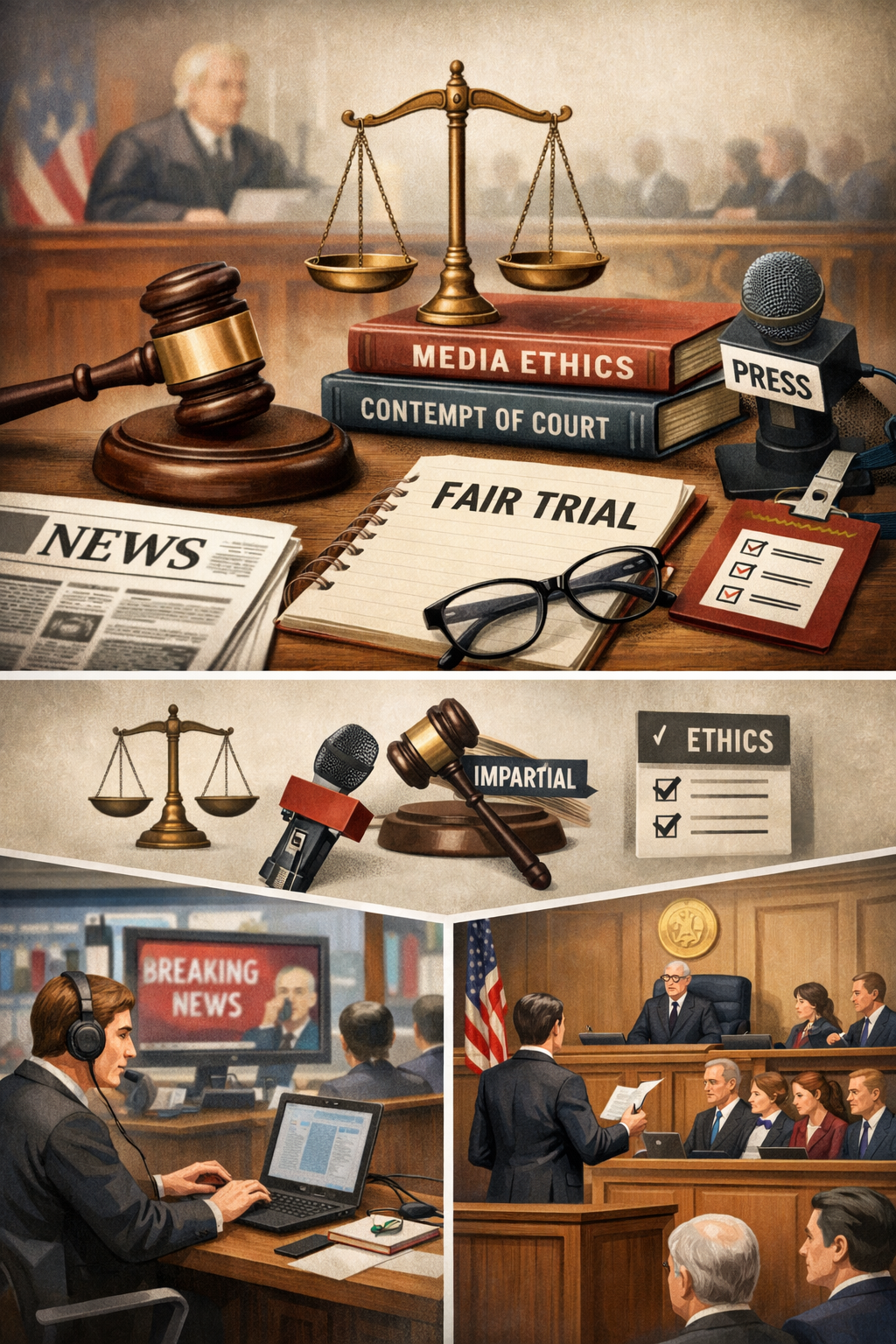
The interaction between the media and the judiciary is influenced by the antagonistic demands of press freedom and the right to trial. Although the media is a crucial aspect of making the population aware of a court case, judicial impartiality and due process may be compromised through irresponsible or sensational media coverage. This paper will discuss contempt of court laws as a legal measure to protect the fairness of judges and the legal duty that governs the actions of the media to report the court proceedings. The paper, based on the legal principles, theories of ethics, and empirical data, examines how the right to know of the populace should be balanced with the right to protect justice by journalists. The article draws the conclusion that the essential factors to responsible judicial reporting in democratic societies include ethical restraint, professional accountability, and legal awareness.
Keywords: contempt of court, media ethics, judicial reporting, press freedom, fair trial, media law.
1.0 Introduction
The media plays a dominant role in the current democratic societies, which is an intermediary between the institutions of the people and the citizens. Reporting on judicial proceedings is among the most sensitive fields in which the company is involved. Not just does court reporting make the people know about the administration of justice, but it also creates images of guilt and innocence, as well as the credibility of the institutions. Nevertheless, unchecked or unscrupulous reporting may fiddle with the process of justice, bias ongoing cases, and undermine people’s trust in the rule of law (Barendt, 2005).
The reason behind the existence of contempt of court legislation is to avoid such intervention by imposing legal restrictions on what kind of information can be released by the media in case of an active legal process. These legislations are meant to maintain the independence of the judiciary, safeguard the rights of litigants and to be able to deliver a verdict on admissible evidence that has been brought before the court. At the same time, the journalists are directed by the professional codes of ethics that focus on accuracy, fairness, and responsibility. It is therefore not possible to separate the issues of freedom of expression and judicial integrity without understanding the ethical and legal responsibilities of the media.
2.0 Literature Review
2.1 Freedom of the Media and Integrity of the Judiciary
There is an overall consensus that press freedom is a fundamental pillar of democratic governance, making it transparent and accountable (McQuail, 2010). This is, however, not complete freedom, especially when a lawsuit is involved. According to Barendt (2005), the unrestricted publicity of trials can undermine the neutrality of the judges because of the pressure of the outside world imposed on the judges, jurors, and witnesses during the trials. Past researchers point out that prejudiced publicity, particularly in a high-profile criminal case, can inform the public discourse before verdicts are delivered (Greer & McLaughlin, 2012). These stories usually construct suspects as being guilty, which dismisses the presupposition of innocence.
2.2 Contempt of Court and Media Practice
According to legal experts, contempt of court is a limitation on freedom of media that is required to safeguard the administration of justice (Borrie and Lowe, 2016). It has been shown that contempt laws are especially applicable within jurisdictions that use jury trials, and in which media bias can have a direct impact on the impartiality of the jury.
Nonetheless, the opponents claim that the indistinctness or unequally applied contempt regulations will foster self-censorship and undermine investigative journalism (Fenwick and Phillipson, 2018). This conflict highlights the value of ethical journalism and legal regulations. Some ethical codes, like the Code of Society of Professional Journalists, stress the reduction of harm, pursuit of truth, and independent action (Ward, 2015).
3.0 Theoretical Framework
The research uses the Social Responsibility Theory, which is based on the premise that freedom of the media should be balanced with responsibility to society (McQuail, 2010). Even as the press has the mandate to inform, it has the responsibility to avoid harm.
This theory promotes restrictions on media behavior in which the freedom of the media can pose challenges to administering justice in the court. Deontological ethics focuses on moral responsibility and obligations that are grounded in the idea of duty and implies that journalists are obligated to honor legal procedures and human rights, irrespective of business considerations (Plaisance, 2014).
In a complementary manner, the utilitarian approaches to the consideration of actions are determined by the outcomes of the actions, trying to maximize the benefit to society by making sure that there is informed public discussion without putting fair trials at risk.
4.0 Methodology
In this research, the qualitative research design is used with the application of doctrinal legal analysis and content review. Main sources of data are the statutory provisions of contempt of court under the UK Contempt of Court Act 1981, the landmark court rulings (such as Attorney-General v.). Times Newspapers Ltd, 1974; Nebraska Press Association v. Professional codes of media ethics issued by organisations such as the Society of Professional Journalists and BBC Editorial Guidelines (Stuart, 1976), and various other professional codes of ethics.
The secondary sources include academic journals, law treatises, and policy papers on media law and ethics. This combined methodology allows the in-depth analysis of legal concepts and the ethics of judicial reporting in various countries.
5.0 Legal and Ethical Analysis
5.1 Contempt of Court: Legal Frameworks
Contempt of court is any act or publication which hinders, biases or disrupts the administration of justice. In the media, it can be the release of information that could prejudice a pending hearing, like the speculative opinions, an attack on the personalities of defendants, or the revealing of inadmissible evidence. The UK Contempt of Court Act 1981 introduced an exception of strict liability such that publication that causes a serious prejudice to ongoing proceedings and the publication that poses a statistically significant risk of such serious prejudice is regarded as contempt without any intention (Miller, 2000). It is a difference to the American constitutional system in which the demonstration of an evident and immediate threat is mandatory to deny coverage, and the First Amendment protection is more robust (Goldfarb, 2018).
Study of precedent cases shows that the courts always aim to uphold the privilege of holding a fair trial more than the freedom of the media to comment without any significant threats of prejudice. In Attorney-General v. In Times Newspapers Ltd (1974), the House of Lords decided that the thorough scrutiny of the harmful consequences of a given drug in an ongoing civil litigation must be taken as a form of contempt, and it was held that contempt is not merely limited to a criminal trial. In cases involving Attorney-General v. MGN Ltd (2011), huge damages were claimed against media houses due to biased reporting about a murder trial, and this will go on to show that in the UK, the enforcement is still strong.
5.2 Media ethics: professional standards
Professional ethics codes content analysis demonstrates that there are five fundamental principles of responsible court reporting, which are accuracy and verification, reducing harm to the vulnerable parties, fairness and impartiality, respect for the legal process, and transparency. The Code of the Society of Professional Journalists provides that a journalist ought to be responsible for the accuracy of his or her work and must ensure he/she checks information prior to releasing it. In the case of court reporting, it entails separating between allegations and the proven facts, the legal proceedings should be reported accurately without any embellishment, and the sources of information should be properly identified (SPJ, 2014).
Ethics codes require that the harm to people engaged in legal processes should be reduced to a minimum, and that there should be compassion to those who are affected by the news coverage. Practical uses are safeguarding the identity of sexual assault victims, underage defendants, not gratuitously providing graphic information, acknowledging the presumption of innocence in coverage presentation, and taking into account the long-term reputational implications. The BBC Editorial Guidelines offer specific requirements for safeguarding vulnerable witnesses, and special attention should be paid to the identification of victims and witnesses under the age of 18 (BBC, 2019). The provisions go beyond the legal provisions; they reflect ethical provisions regardless of the law of contempt.
5.3 Dissociations Between Standards and Practice
Even with evident ethical codes of conduct, empirical data show that there is continuously an anomaly between the formal and the actual practices relating to the media. As it has been shown in the analysis of the Madeleine McCann case by Greer and McLaughlin (2012), the British media managed to conduct a lot of speculations, character judgments and prejudice despite the ethical principles and contempt of the law. The desire to report on high-profile cases and the need to be as fast and sensational as possible often lead to more risks of reputation damage and miscarriage of justice. Several causes are attributed to these gaps: journalists lack legal as well as ethical training, there is a commercial and competitive pressure to adopt sensationalism, enforcing professional standards is not practiced as much as it is supposed to be, and competition is further promoted by the 24-hour news cycles (Christians et al., 2009).
6.0 Findings and Discussion
The media ethics and the contempt law play a supplementary role in the regulation of court reporting. Laws establish the minimum standards that can be used by sanctions to deal with flagrante offenses that cause high-risk prejudice. Ethical codes offer guideline principles which go beyond the minimums in the law, and direct journalists to the best practices even where publication may be legal. This complementary relationship is important since legal prohibitions will not be enough to handle all problematic coverage. The contempt law is required to be centered on active proceedings and pre-judgment risks, which introduce a gap concerning pre-charge coverage, post-verdict analysis, and borderline cases. Ethical self-regulation seals these loopholes, creating responsible journalism where the law would be inappropriate or unproductive.
Nonetheless, voluntary ethical compliance is not an effective method considering the commercial demands and competitiveness. Discussion proposes an ideal regulation, which is a combination of transparent legal norms and scaled enforcement, a sufficient system of professional ethics such as compulsory training, increased media studies with legal training and coordinated institutions between the media and the court. New digital media afford new challenges that need new strategies: policy of content moderation by platforms that protect their own fair trial, use by courts of technologies to limit access to devices by juries, increased community education on how to responsibly discuss legal cases, and possibly new legal standards that will hold platform operators liable to contempt on failure to provide effective removal of prejudicial content within their sites after notice.
7.0 Recommendations
Based on this analysis, some proposals come out on how to tighten the screws on responsible judicial reporting. Lawmakers ought to enact the law of contempt with reasonable standards balancing fair trial rights and press liberty, proportionate sanctions that discourage serious offenses but not legitimate journalism, and statutory defenses of good faith reporting. The application of contempt powers by courts should be proportionate, offer guidance to media in clear directions given in practice directions, and alternative remedies should be considered by the court before publication is restricted, and a court-media liaison should be facilitated to enhance understanding between the agency and the media.
The media organizations must adopt extensive codes of ethics that include certain court reporting standards, offer compulsory legal and ethical training to reporters who cover court events, put in place editorial review of possibly biased coverage, and place a greater emphasis on ethical issues than on competitive issues. The journalism education programs must incorporate media law and media ethics in the programmes, offer special training on court reporting and legal terminology and give special focus on case-study analysis of the ethical dilemmas in court coverage.
8.0 Conclusion
The point of collision between press freedom and judicial integrity is a long-running problem in democratic societies. As much as media inspection of judicial processes fulfil crucial public-interest related roles that include the promotion of transparency, discouragement of misconduct, and the exercise of informed citizenship, the unchecked or reckless reporting of judicial activities may bias trials, impair the presumption of innocence, and infringe a basic fair trial right.
This paper has revealed that the law of contempt of court does offer vital legal guidelines in terms of safeguarding judicial integrity, and practice takes a very different approach in different jurisdictions. In addition to legal regulation, professional media ethics is a contribution of essential normative directions, including accuracy, minimization of harm, fairness, respect towards the legal process and accountability. However, great loopholes between ethics and media operations still exist, and they are explained by commercial needs, rivalry, lack of training, and the absence of effective enforcement.
The best way to provide effective protection to the freedom of the press and the integrity of the judiciary is through the combined efforts of proportionate regulation of the law alongside effective ethical self-regulation. Finally, the responsible court reporting is not about the decision between press freedom and the right to a fair trial, but about the need to acknowledge the interdependence of the two. Legitimate judicial results that are deserving of public faith are brought forth through fair trials, and judicial accountability and transparency are guaranteed through media scrutiny.
References
Barendt, E. (2005). Freedom of speech (2nd ed.). Oxford University Press.
BBC. (2019). Editorial guidelines: Section 7—Fairness, contributors and consent. British Broadcasting Corporation.
Borrie, G., & Lowe, N. V. (2016). The law of contempt (4th ed.). LexisNexis.
Christians, C. G., Fackler, M., Richardson, K. B., Kreshel, P. J., & Woods, R. H. (2009). Media ethics: Cases and moral reasoning (8th ed.). Pearson.
Fenwick, H., & Phillipson, G. (2018). Media freedom under the Human Rights Act. Oxford University Press.
Goldfarb, R. L. (2018). TV or not TV: Television, justice, and the courts. New York University Press.
Greer, C., & McLaughlin, E. (2012). Media justice: Madeleine McCann, intermediatization and ‘trial by media’ in the British press. Theoretical Criminology, 16(4), 395-416.
McQuail, D. (2010). McQuail’s mass communication theory (6th ed.). Sage Publications.
Miller, C. J. (2000). Contempt of court (3rd ed.). Oxford University Press.
Plaisance, P. L. (2014). Media ethics: Key principles for responsible practice (2nd ed.). Sage Publications.
Society of Professional Journalists. (2014). SPJ Code of Ethics. https://www.spj.org/ethicscode.asp
Ward, S. J. A. (2015). The invention of journalism ethics: The path to objectivity and beyond (2nd ed.). McGill-Queen’s University Press.