In the landscape of modern industrial production, CNC machining has emerged as the definitive foundational method for precision engineering. As high-growth sectors push the boundaries of physics and efficiency, the demand for components with extremely tight tolerances and complex geometries has never been higher. From the structural integrity required in aerospace to the thermal management needs of electric vehicles, CNC machining provides the reliability and repeatability that 3D printing and traditional casting often cannot match.
Today’s global manufacturers increasingly source these services from specialized suppliers and factories to access scalable capacity. Procurement teams now operate with a data-driven approach: they frequently request a quote, compare multiple suppliers, and rigorously evaluate machining capability before they order a single unit. A reliable CNC machining partner—equipped with advanced multi-axis machine tools and a stable material supply—allows a company to scale production efficiently while maintaining a lean internal footprint. Furthermore, the role of a Chinese CNC machining factory has become central to many international firms looking for a competitive wholesale manufacturing cost without sacrificing the precision required by 21st-century engineering.
Why High-Growth Industries Depend on CNC Machining
High-performance industries rely on CNC machining primarily for its ability to produce precision parts with consistent dimensional accuracy. Unlike manual fabrication, these computer-controlled systems can manufacture complex metal and engineering plastic components directly from CAD designs with absolute fidelity. This digital-to-physical workflow ensures that every part in a wholesale batch meets the exact specifications of the first prototype.
Modern CNC machining suppliers have evolved to offer more than just cutting services; they provide comprehensive supply chain solutions, including rapid prototyping, small-batch production, and high-volume runs with stable inventory management.
Key reasons companies choose specialized CNC machining manufacturers include:
- Micron-Level Tolerances: The ability to manufacture complex precision parts that meet the most stringent engineering requirements.
- Rapid Turnaround: Fast lead times for both initial prototypes and recurring production orders.
- Material Versatility: Reliable sourcing of specialized materials, from aerospace-grade titanium to medical-grade biocompatible plastics.
- Global Logistics: Integrated support for international shipping, ensuring parts arrive at assembly lines regardless of geography.
- Scalability: Seamless transitions from R&D batches to massive wholesale quantities.
- Cost Control: Achieving a competitive production cost by leveraging the infrastructure of established factories, particularly when sourcing from China.
For procurement managers, this process creates a predictable supply chain. By securing a clear cost estimate before production begins, companies can protect their margins and ensure long-term project viability.
Key Industries Driving Demand for CNC Machining
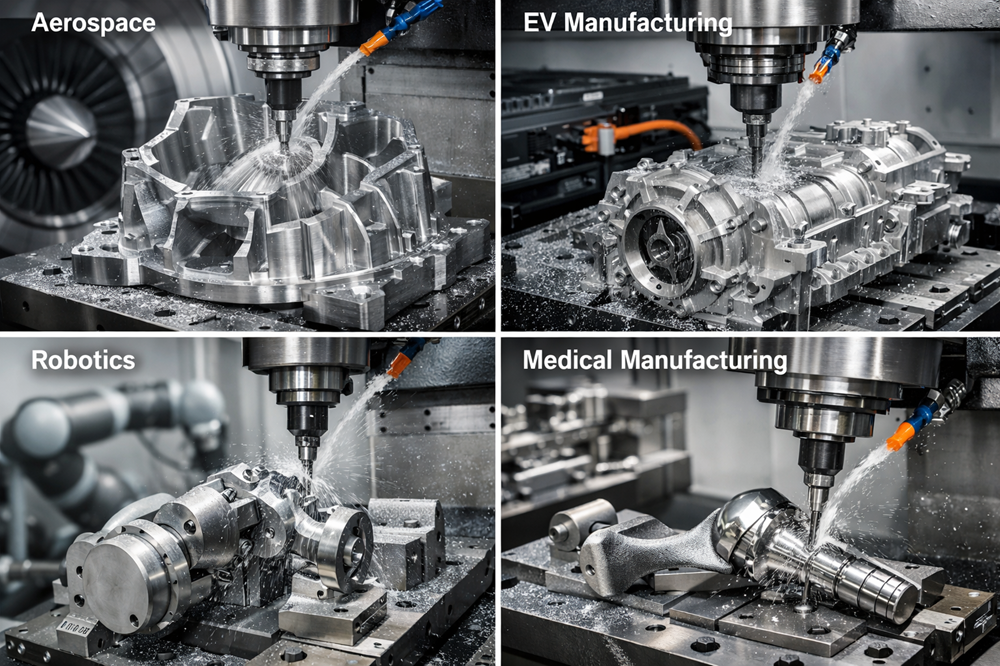
The surge in demand for precision parts is concentrated in sectors where failure is not an option. Each industry brings its own set of material and tolerance challenges that only a high-end manufacturer can address.
Industry Overview
| Industry | Typical CNC Machining Components | Manufacturing Requirements |
| Aerospace | Turbine housings, structural brackets, actuator components | Ultra-tight tolerances, aerospace alloys (Titanium, Inconel) |
| Electric Vehicles (EV) | Motor housings, battery enclosures, cooling plates | Lightweight materials, thermal performance, high-volume |
| Robotics | Gear housings, robotic arm joints, precision shafts | High precision, durability, smooth motion |
| Medical Manufacturing | Surgical instruments, orthopedic implants, diagnostic parts | Biocompatible materials, regulatory compliance (ISO 13485) |
Each of these sectors relies heavily on a precision CNC machining manufacturer to navigate these strict performance requirements. For example, EV manufacturers often require high-volume machining of battery system components to keep up with consumer demand, necessitating a supplier who can manage large inventory levels. Meanwhile, aerospace firms often buy specialized components made from exotic alloys that require specific tooling expertise. In almost every case, buyers compare multiple suppliers to ensure the technical fit is perfect before they order production-grade parts.
CNC Machining Components Commonly Used in Advanced Manufacturing
Precision CNC machining services support a vast array of critical components that serve as the “skeleton” and “nervous system” of modern machinery. These parts often require multi-axis machining operations and advanced surface finishing processes to meet environmental and aesthetic standards.
Commonly sourced CNC machined parts include:
- Precision gear housings and transmission components for robotics.
- Structural aluminum brackets for aerospace airframes.
- Electric vehicle motor shafts and battery system housings.
- Robotic arm joints and high-precision actuator components.
- Medical device casings and specialized surgical tool components.
- Hydraulic system fittings and valve bodies for industrial automation.
Manufacturers frequently source these components from a trusted supplier who can demonstrate a history of stable production capacity. Before placing a purchase order, procurement teams typically review a manufacturer’s surface finishing options and the total cost—including shipping and customs—to determine the best value. Reliable partners also provide the peace of mind that comes with global shipping expertise, moving finished parts from the factory to the warehouse without delay.
Factors Buyers Evaluate When Choosing a CNC Machining Supplier
Selecting the right partner involves more than just finding the lowest price. Industrial buyers must perform a deep-dive evaluation of technical capability and supply chain reliability. A manufacturer might offer a low per-unit cost, but if they cannot guarantee lead times or material quality, the hidden costs of production delays can be devastating.
Factors such as machining accuracy, the age of the machine shop’s equipment, and their logistics capability heavily influence the final decision. Companies sourcing from international suppliers often look at the cost advantages provided by China, but they also prioritize the manufacturer’s ability to support long-term programs with stable inventory levels and reliable shipping timelines.
CNC Machining Supplier Evaluation Criteria
To streamline the vetting process, procurement teams often use a standardized checklist to compare different manufacturers.
Table 2: Procurement Checklist
| Evaluation Factor | Why It Matters for Buyers |
| Machining Capability | Determines the complexity and geometry of parts the supplier can produce. |
| Material Availability | Ensures specialized alloys or plastics are in stock to avoid production delays. |
| Production Capacity | Confirms the factory can scale from a single prototype to wholesale orders. |
| Quality Control Systems | Guarantees precision through CMM reports and ISO certifications. |
| Lead Time & Shipping | Affects the overall supply chain reliability and “just-in-time” delivery. |
| Manufacturing Cost | Defines the total landed cost, including the sale price and international logistics. |
The journey typically starts when a buyer sends technical drawings to a supplier to request a quote. The factory then calculates machining time and material cost to provide a formal price estimate. Once the quote is accepted, it is standard practice to order a prototype to validate accuracy before committing to a full-scale wholesale production run.
Global Supply Chains and CNC Machining Production
As manufacturing becomes increasingly globalized, the role of the international supplier has shifted from a simple vendor to a strategic partner. Many companies now source components from specialized factories that offer a unique blend of advanced machine tools and scalable capacity.
Chinese CNC machining manufacturers have become essential to this network, offering strong industrial infrastructure and cost-efficient production that is difficult to replicate elsewhere. These suppliers often go beyond basic cutting, providing engineering consultation, surface treatment, and sub-assembly services.
By partnering with the right manufacturer, buyers can efficiently source precision parts, secure competitive wholesale pricing, and arrange for global shipping that integrates directly with their local inventory needs. This holistic approach allows companies in the aerospace, EV, robotics, and medical sectors to maintain consistent production schedules while aggressively optimizing their total manufacturing cost.