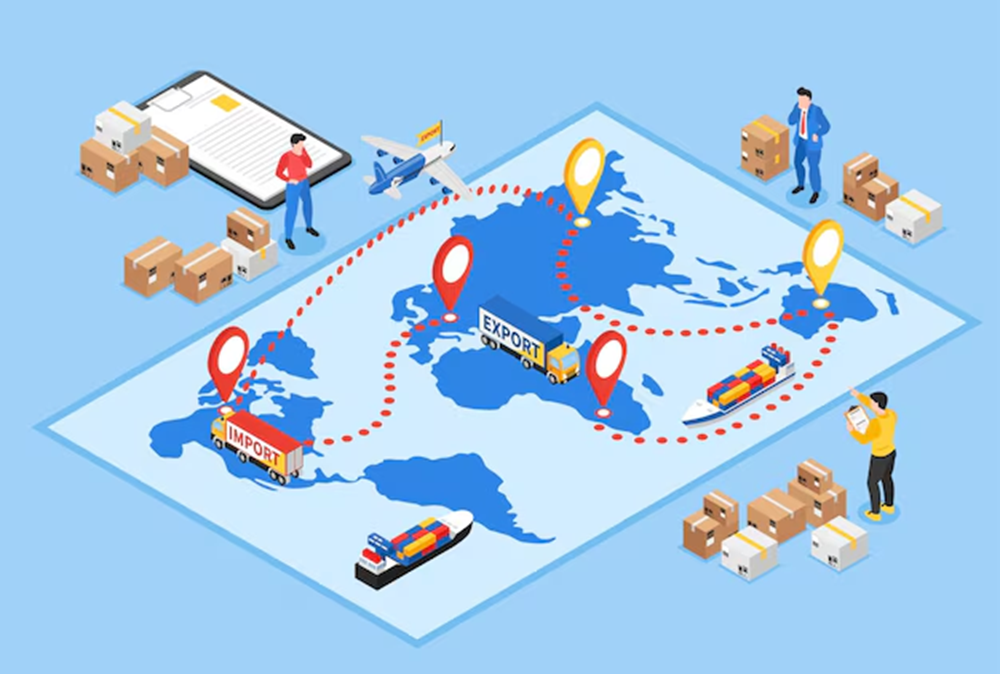
Source: Freepik
A surprising number hides behind the headlines: European shippers logged an average of 20+ disruptive incidents per company in 2024. Not minor hiccups, but genuine breakdowns that forced production slowdowns, emergency sourcing, or outright service suspension. Global supply chain risk is no longer something managers “monitor quarterly,” but it has become a recurring operational headache shaping budgets, logistics flows, and corporate strategy.
What changed? Two forces that rarely cooperate, climate volatility and geopolitical tensions, have begun reinforcing each other. Sudden droughts close canals; regional conflicts reshape shipping lanes; tariffs alter century-old trade patterns overnight. For manufacturing, retail, and logistics leaders, 2026 is less about avoiding disruption and more about outmaneuvering it.
Before diving into specifics, one useful resource that helps frame the financial impact of today’s disruptions is this detailed breakdown of the hidden cost of cascading supply-chain shocks; many teams use it when presenting the business case for resilience improvements: analysis of survival strategies for supply chains under pandemic and geopolitical pressure.
Climate disruption is no longer seasonal noise
Weather-related extremes used to be occasional anomalies. Today, they are scheduling events with the regularity of a payroll cycle. Billion-dollar climate events now strike every three weeks, a tempo that logistics networks simply weren’t designed to absorb.
Recent examples are almost mundane in their repetition: the Panama Canal drought that cut capacity nearly in half, Slovenia’s floods that slowed European automotive output, or wildfire smoke that reduced operational visibility by up to 75%. What these cases show is what practitioners already know: climate risk behaves like a multiplier, not a single variable.
Geopolitical tensions redraw the logistics map
The Red Sea crisis forced carriers to abandon the Suez Canal, rerouting ships around the Cape of Good Hope—a detour that adds 4,000 miles and roughly 30% more sailing time. One response ripple many overlook: overall global container capacity effectively shrank by 9%, simply because vessels were stuck on longer loops.
Where ships go, prices follow. Shanghai outbound rates doubled; Europe-bound rates tripled. Economists expect these shocks alone to add 0.7 percentage points to global core goods inflation. US–China tariff escalation only amplifies the effect, accelerating the shift toward friend-shoring and reshaping supplier portfolios around political alignment rather than pure efficiency.
From visibility to action: what advanced supply chain mapping unlocks
When disruptions behave like a moving target, visibility becomes the foundation for every strategic move. Modern supply chain mapping tools trace raw materials, factory clusters, alternative routes, and regulatory exposure. Some organizations uncover surprising vulnerabilities: one automotive electronics manufacturer learned that four seemingly independent suppliers all relied on a single sub-supplier in a typhoon-exposed zone, a revelation that justified a near-shoring move.
Risk mitigation strategies that actually work in 2026
Most firms talk about resilience; fewer operationalize it. Teams navigating 2026 with confidence combine four practical approaches:
- Quantified diversification beyond simple “China Plus One,”
- twin hedges of multisourcing and multishoring,
- AI-based early warning systems offering 48-hour lead-time advantages,
- supplier relationships treated as strategic assets rather than administrative functions.
These approaches share one theme: mitigation isn’t a checklist; it’s an operating philosophy.
Table: How disruptions propagate across the supply chain
| Disruption Type | Primary Impact | Secondary Impact | Strategic Response |
| Extreme drought (e.g., Panama) | Reduced shipping capacity | Global lead-time spikes | Route diversification, inventory buffers |
| Regional conflict (e.g., Red Sea) | Rerouted vessels | Freight rate inflation | Multishoring, contract renegotiation |
| Tariff escalation | Cost shocks | Supplier relocation pressure | Supply chain mapping, scenario modelling |
| Floods/wildfires | Factory outages | Upstream price volatility | Multisourcing, climate-risk analytics |
What business leaders should take from this
The gap between resilient and fragile supply chains is widening. Companies treating supply continuity as a strategic function supported by technology, supplier partnerships, and scenario planning gain leverage during crises: materials secured earlier, production resuming faster, and competitors scrambling longer. Resilience is not the opposite of efficiency; it is a precondition for competing in a world shaped by climate shocks and geopolitical tensions.