In 2026, a foreign entrepreneur can complete a business setup in Dubai without a local sponsor, without personal income tax, and in some cases without renting a physical office in year one. Five years ago, that combination did not exist.
Business setup in Dubai has shifted from a sponsor-driven model to a regulated but founder-friendly framework built around transparency. Costs are published. Corporate tax is defined. Visa rules are clearer. The Department of Economy and Tourism issues licenses digitally. Free zones process applications in days, not months.
Here is what most founders want to know: What will this actually cost me? Which structure fits my activity? How does corporate tax apply? How long will it take?
This guide answers those questions with exact AED figures, jurisdiction comparisons, and 2026 updates you will not find in generic summaries. By the end, you will understand the real cost of business setup in Dubai, how the mainland differs from the free zone, and the step-by-step path from idea to licensed company.
Let’s start with what changed.
Why Dubai? What Changed for Business Setup in 2026
Business setup in Dubai looks different in 2026 because three structural shifts reshaped the market.
First, 100% foreign ownership now applies to most mainland activities. The old local sponsor requirement no longer blocks international founders from full control of their company formation in Dubai. The Department of Economy and Tourism, commonly known as DED, reflects this change directly on its licensing portal.
Second, the UAE Instant License program allows eligible mainland service businesses to operate in the first year without leasing a physical office. Office rent in mainland Dubai often ranges from AED 30,000 to AED 60,000 per year. Removing that requirement in year one can reduce Dubai company setup cost 2026 by AED 15,000 to AED 50,000 depending on size and location. Big difference.
Third, corporate tax clarity arrived. Dubai corporate tax 2026 applies at 9% on profits above AED 375,000. Profits below that threshold remain taxed at 0%. No personal income tax exists in the UAE. That balance gives founders predictability. The Federal Tax Authority oversees compliance.
The Dubai D33 Agenda targets doubling the economy by 2033. That policy direction affects business setup in Dubai because authorities now prioritize speed, digital approvals, and sector-specific free zones.
Here’s the thing: many founders pick a jurisdiction before confirming their activity approval. DED and each free zone authority approve activities differently. A consultancy license differs from a general trading license. A financial advisory activity may require regulator approval beyond a simple Dubai business license 2026 application.
Wrong activity selection delays banking and visas. Sound familiar?
Structure follows activity. Always.
Dubai Mainland vs Free Zone: Which One Fits Your Business
Every serious conversation about business setup in Dubai eventually lands on one decision: Dubai mainland vs free zone.
Mainland companies receive a Dubai DED license. This structure allows you to trade directly inside the UAE market without restriction. You can rent a retail shop in Dubai Mall, bid on government contracts, or supply local distributors. Mainland setup typically ranges from AED 15,000 to AED 50,000+ for the license and initial approvals. A physical office is normally required unless you qualify for the Instant License scheme.
Free zone business setup Dubai operates under its own authority. Over 30 free zones exist. Costs start as low as AED 5,500 and go up to AED 30,000+ for the first year depending on visa quota and activity. Most free zones include a flexi-desk or shared office solution in their packages. International trade and digital services dominate this structure.
Offshore companies start from AED 9,000. They cannot operate inside the UAE market and do not provide residency visas. Offshore suits holding structures or asset protection. Nothing more.
If your clients are inside the UAE, mainland is the right call. If you’re selling internationally or running a digital business, a free zone almost always makes more financial sense.
So which one is right for you?
Consider the financial structure. Mainland companies face higher renewal costs, typically AED 10,000 to AED 25,000 per year. Free zone license renewal ranges from AED 5,000 to AED 15,000 annually. That difference compounds over time.
Now consider banking. Some free zones enjoy stronger reputations with UAE banks. Others face higher scrutiny. Most guides skip this part.
Common mistake: founders choose the cheapest business setup Dubai option without checking whether local banks accept companies from that jurisdiction easily. Bank rejection stalls operations for weeks because compliance teams request revised documents, additional contracts, and detailed business models.
The structure you pick on day one follows you for years. That matters.
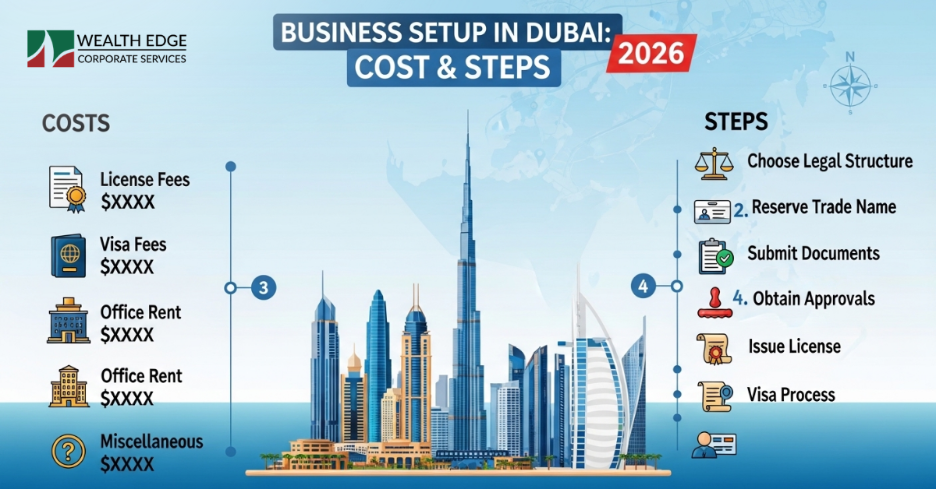
Business Setup in Dubai: Real Cost Breakdown for 2026
Every entrepreneur asks about cost of business setup in Dubai. Few get a full breakdown.
Dubai trade license cost depends on jurisdiction and activity. License fees alone never tell the full story.
Free zone setup: AED 5,500 to AED 30,000+ for the first year.
Mainland setup via DED: AED 15,000 to AED 50,000+.
Offshore: starting from AED 9,000.
Visa cost per person ranges from AED 3,500 to AED 7,000 including medical tests, Emirates ID, and residency stamping through GDRFA.
Office cost changes everything. Mainland physical office rent averages AED 30,000 to AED 60,000 per year. Free zone packages often include flexi-desk solutions in the base price.
Renewals matter more than startups. Free zone trade license renewal ranges from AED 5,000 to AED 15,000 annually. Mainland renewal typically falls between AED 10,000 and AED 25,000 per year.
Late renewal penalty in Dubai stands at AED 200 per day. Miss a month and you lose AED 6,000 for nothing. Worth knowing.
Example one: Solo consultant using IFZA free zone. License package AED 12,000. One visa AED 5,000. Medical insurance AED 2,000. Miscellaneous approvals AED 1,500. Total first year roughly AED 18,000 to AED 25,000 depending on activity. Sounds simple enough.
Example two: Mainland trading company under DED. License and approvals AED 30,000. Office rent AED 45,000. Two visas at AED 6,000 each. Additional establishment card and compliance costs AED 10,000. Total first year easily AED 80,000 to AED 110,000.
Why does that matter?
Because many founders budget only for the license fee. Visa, office, renewal, and compliance costs follow immediately. Cash flow planning fails when these get ignored, which forces directors to inject more capital mid-year.
Business setup in Dubai rewards precise budgeting. Vague planning creates pressure.
Step-by-Step: How to Start a Business in Dubai
Founders researching how to start a business in Dubai often see simplified lists. Reality involves sequence and compliance.
Step one: choose your business activity. Activity codes determine license type. Wrong activity triggers bank rejection because compliance officers compare your transactions to your licensed scope.
Step two: select jurisdiction. Mainland, free zone, or offshore. Activity and client base should guide this choice, not price alone.
Step three: choose legal structure. Mainland companies usually form as LLC. Free zones offer FZE for single shareholder and FZC for multiple shareholders. Branch structures apply for foreign parent companies expanding into the UAE.
Step four: register trade name. DED handles mainland name reservation. Free zones process their own naming rules. Restricted words require additional approval.
Step five: obtain initial approval. Certain activities such as education, finance, or healthcare require external regulator clearance before license issuance.
Step six: secure office solution. Mainland companies lease Ejari-registered offices unless using Instant License eligibility. Free zones allocate flexi-desk or physical space depending on package.
Step seven: apply for trade license, then investor visa, then Emirates ID, then corporate bank account Dubai.
Free zone business setup Dubai often completes within 3 to 5 days if documents align. Mainland formation takes 2 to 4 weeks depending on approvals.
Truth is, many founders apply for banking only after completing business setup in Dubai. Banks perform strict KYC. Advance planning helps. Prepare contracts, supplier agreements, and revenue projections before submission.
Cause and effect remains clear: poor documentation delays banking, which delays invoicing, which affects cash flow.
Plan backward from your first expected transaction.
Best Free Zones for Business Setup in Dubai 2026
Free zone business setup in Dubai works well for international founders, but selection must match activity.
DMCC, Dubai Multi Commodities Centre, suits commodities, gold, and trading businesses. Strong global reputation. License costs generally sit in the mid to higher free zone range.
Dubai Silicon Oasis focuses on technology and IT startups. DSO provides infrastructure support for innovation-driven firms.
DIFC, Dubai International Financial Centre, operates under a separate legal framework aligned with international finance standards. Financial services businesses treat DIFC as non-negotiable due to regulatory credibility.
JAFZA, Jebel Ali Free Zone, remains ideal for logistics and manufacturing linked to port operations.
IFZA appeals to service-based startups seeking fast setup in 3 to 5 days. Packages typically range from AED 10,000 to AED 30,000 depending on visas.
Meydan Free Zone attracts SMEs looking for moderate Dubai free zone license cost and central location prestige.
Common mistake: choosing the lowest Dubai free zone license cost without considering banking perception. Some banks apply enhanced scrutiny to newer or lesser-known zones.
Business setup in Dubai becomes smoother when the free zone aligns with your sector. That matters.
Dubai Corporate Tax, Visas, and Banking in 2026
Dubai corporate tax 2026 introduced clarity. Profits above AED 375,000 face 9% tax. Profits below remain untaxed. No personal income tax applies to salaries or dividends.
Free zone companies may qualify for 0% corporate tax if they meet qualifying income conditions and comply with Economic Substance Regulations. ESR applies to many free zone entities. Failing to meet substance requirements creates penalties and reporting obligations.
But what does that mean in practice?
A consulting firm generating AED 300,000 annual profit pays zero corporate tax. A trading company earning AED 1 million profit pays 9% on AED 625,000. Planning matters.
Dubai investor visa 2026 costs range from AED 3,500 to AED 7,000 per person. Processing through GDRFA takes 2 to 4 weeks including medical test and Emirates ID.
Corporate bank account Dubai approval depends on compliance. Banks request shareholder passports, proof of address, business plans, and source of funds documentation. Some free zones enjoy smoother processing due to historical relationships.
Most founders assume free zone equals zero tax automatically. Not always obvious, but true.
Substance, activity, and income type determine tax outcome. Consult FTA guidance before assuming exemptions.
Frequently Asked Questions
Q1: What is the cheapest way to set up a business in Dubai in 2026?
Cheapest business setup Dubai options usually sit within smaller free zones offering packages from AED 5,500. Realistically, once visa and compliance costs get added, first-year expenses range closer to AED 15,000 to AED 20,000 for a solo founder.
Q2: Can a foreigner own 100% of a Dubai mainland company?
Yes. Most activities now allow full foreign ownership under DED regulations. Certain strategic sectors still require additional approvals, but local sponsor structures no longer dominate standard company formation in Dubai.
Q3: How long does business setup in Dubai take?
Free zone companies often complete within 3 to 5 working days. Mainland companies typically require 2 to 4 weeks depending on activity approvals and documentation readiness.
Q4: What is the difference between mainland and free zone cost?
Mainland setup generally ranges from AED 15,000 to AED 50,000+ excluding office rent. Free zone packages start from AED 5,500. Office rent in mainland adds AED 30,000 to AED 60,000 per year, which increases total Dubai company setup cost 2026 significantly.
Q5: Do I need to live in Dubai to set up a company there?
Physical presence is not required to incorporate in many free zones. Residency becomes necessary when applying for an investor visa and Emirates ID.
Q6: Is Dubai still tax-free for businesses in 2026?
Corporate tax at 9% applies on profits above AED 375,000. Personal income remains untaxed. Qualifying free zone entities may maintain 0% corporate tax subject to compliance with regulations.
Conclusion
Business setup in Dubai rewards founders who treat structure, cost, and compliance as strategic decisions rather than paperwork.
Some entrepreneurs rush to register the cheapest license available. Others pause, analyze client location, banking reputation, tax exposure, and long-term renewal cost before filing any application. The second group scales faster.
So what separates success from frustration?
Clarity before commitment.
Business setup in Dubai works best when activity approval, jurisdiction choice, visa planning, corporate tax exposure, and banking strategy align from day one. Those who plan backward from revenue, instead of forward from price, avoid stalled accounts, surprise penalties, and restructuring costs later.
Dubai offers speed and ownership freedom. Discipline turns those advantages into profit.