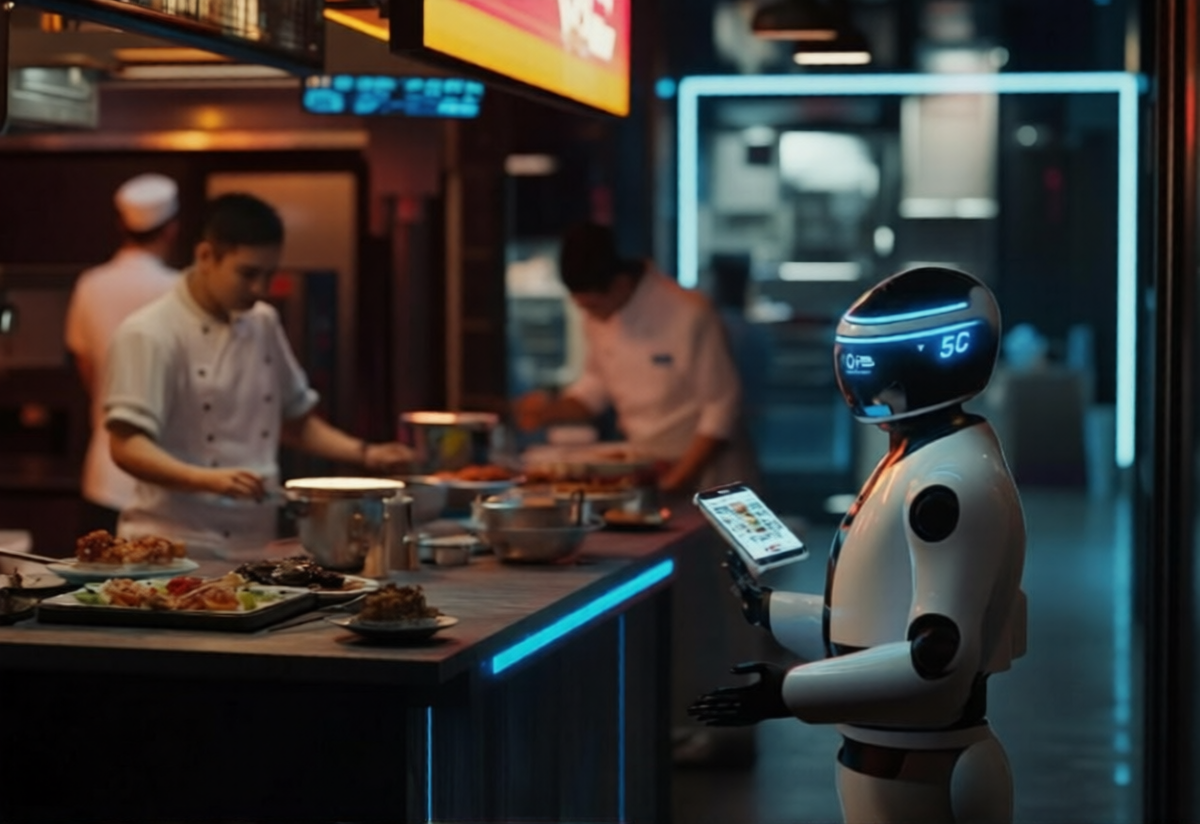
Commercial kitchens represent one of the toughest environments for robotics: unpredictable food shapes, spills, and high-speed demands have long stymied automation efforts. AtomBite AI emerges as a food robotics startup tackling these issues head-on through advanced embodied AI systems. AtomBite.AI is an artificial intelligence application company building the AtomBite Brain, a foundation model for flexible manipulation in commercial robotics.
Industry Problem: Kitchen Automation Challenges
However, restaurants have continued to experience challenges in the automation of routine tasks. The conventional robots have continued to perform well in the factory setting, but they are not helpful in the kitchen, where bags rip, sauces spill, and orders range from tiny to enormous. The operators complain of constant failures with the inflexible robots, causing wasted food and customer dissatisfaction. The problem has also been compounded by the labor shortage, where the turnover rate for the food service industry is above 70 percent every year.
These challenges arise from the chaotic nature of real-world food handling, where a fixed gripper can’t adapt to squished containers or a receipt covered in a slippery substance, or a vision system that was trained on a static image but must contend with a dynamic spill. Experts say only 5 percent of commercial kitchens currently employ robots, largely because of high failure rates in unstructured settings.
Introduction of AtomBite.AI
AtomBite.AI positions itself at the intersection of restaurant automation robotics and commercial kitchen AI transformation. The startup develops embodied AI systems designed specifically for food service environments. Its initial focus lies on automating the “last meter” of takeout fulfillment, a process that consumes significant labor in delivery-heavy restaurants.
Founded in recent years, AtomBite.AI draws expertise from Asia’s demanding food delivery markets. The company avoids bespoke hardware, instead layering its software onto existing robotic arms. This approach lowers costs and accelerates deployment across diverse kitchen layouts.
Founders and Background
AtomBite.AI’s leadership brings proven track records from high-volume operations. Dr. Dong Wang, former CTO of Meituan Delivery, oversaw automation for one of the world’s largest food platforms, handling millions of daily orders. Dr. Tao Li, a former Meituan algorithm expert, specialized in machine learning for dynamic logistics. Steven Li, recognized on the Forbes 30 Under 30 list, contributes business strategy honed in tech-scaling ventures.
Their combined experience addresses a key gap: Meituan’s ecosystem revealed how automation succeeds in warehouses but stumbles in kitchens. Wang’s tenure highlighted the need for adaptive AI beyond rule-based scripts. Li’s insights into market adoption inform the startup’s go-to-market strategy, targeting small chains underserved by expensive custom solutions.
Technology Deep Dive: AtomBite Brain and Embodied AI
Core of Restaurant Automation AI Systems
At the heart of AtomBite.AI’s offering is the AtomBite Brain, a foundation model trained on vast datasets of kitchen interactions. This embodied AI flexible manipulation system processes visual, tactile, and positional data to mimic human dexterity. Unlike narrow AI that follows preprogrammed paths, the brain employs dual neural architectures: one for broad generalization across object types and another for precise engineering reliability.
The model ingests live camera feeds to segment food items, bags, and utensils in milliseconds. It then simulates multi-step actions, predicting outcomes like bag deformation under weight. This enables restaurant automation AI to handle edge cases, such as a leaking soup container requiring mid-process wiping.
Why Traditional Automation Fails and How AtomBite Solves It
Conventional robots rely on suction cups or parallel grippers optimized for uniform parts; in kitchens, these tools drop 20 to 30 percent of irregular items. Vision algorithms falter against occlusions, like stacked boxes hiding labels. AtomBite Brain counters this through reinforcement learning from simulated chaos, including virtual spills and crinkled packaging.
The system achieves adaptive decision-making by continuously updating its world model. For instance, if a bag shifts during packing, the brain re-plans grip points on the fly, reducing errors by factors reported in early pilots. This flexible manipulation robot capability extends to multi-object scenes, prioritizing fragile items first.
Takeout Packing Robot Workflow
The takeout packing robot M1 exemplifies AtomBite Brain in action. Workflow begins with order arrival at a staging area: the robot scans contents via overhead cameras. It sequences packing by stability, placing heavy bases first; sauces go last to avoid leaks.
Next comes manipulation: dexterous fingers unfold bags, insert dividers, and nest items with human-like adjustments. Receipts tuck into designated slots without jamming. The entire process completes in under two minutes per order, matching peak-hour demands.
Real-time object handling shines in food environments. The brain detects anomalies, like a crushed fry carton, and compensates by using gentler grips or alternative placements. This automation spans single orders to bulk family packs, scaling seamlessly.
Robot-as-a-Service Model Explanation
AtomBite.AI offers Robot-as-a-Service (RaaS), which is a subscription-based model that eliminates the capital cost of the hardware. Restaurants pay between $2,200 and $2,900 per unit each month. This is ideal for small and medium-sized restaurants, which make up 80 percent of the market but cannot afford the capital cost of the robot, which is above $100,000.
Scalability benefits chains and franchises: centralized updates push improvements fleet-wide, from better spill detection to new packaging types. Providers handle repairs remotely or on-site, minimizing downtime. Early adopters note return on investment within six months through labor savings and error reductions.
Industry Data Insights
The restaurant automation market underscores the timing for such innovations. Valued at $1.5 billion in 2023, it projects growth to $12.4 billion by 2030, driven by AI advancements and rising wages. Labor shortages compound urgency: the U.S. alone faced 1.6 million unfilled food service jobs last year, pushing operators toward tech solutions.
Robotics adoption in commercial kitchens remains low at under 10 percent, but pilot programs show promise. Chains using similar systems report 25 percent faster packing speeds and halved refund rates from order errors. These metrics align with AtomBite.AI’s focus on high-volume takeout venues.
Founder Quote
“Restaurant environments are among the most complex real-world scenarios for robotics, which is why AtomBite Brain focuses on adaptive manipulation rather than fixed automation,” said Dr. Tao Li.
Future of Restaurant Automation AI
Looking forward, AtomBite.AI is planning to expand to dishwashing and ingredient preparation. With further development in embodied artificial intelligence, AtomBite.AI is planning to integrate voice ordering and inventory systems to enable completely autonomous back-of-house operations. However, AtomBite.AI is currently facing challenges related to food safety regulations and biases in training data.
Yet, with labor costs climbing and delivery demand surging, food robotics startups like AtomBite.AI signals a shift. Success hinges on proving reliability at scale; ongoing pilots will test this in diverse global kitchens. The food robotics startup landscape evolves rapidly, positioning AtomBite Brain as a contender in commercial kitchen AI transformation.