Introduction
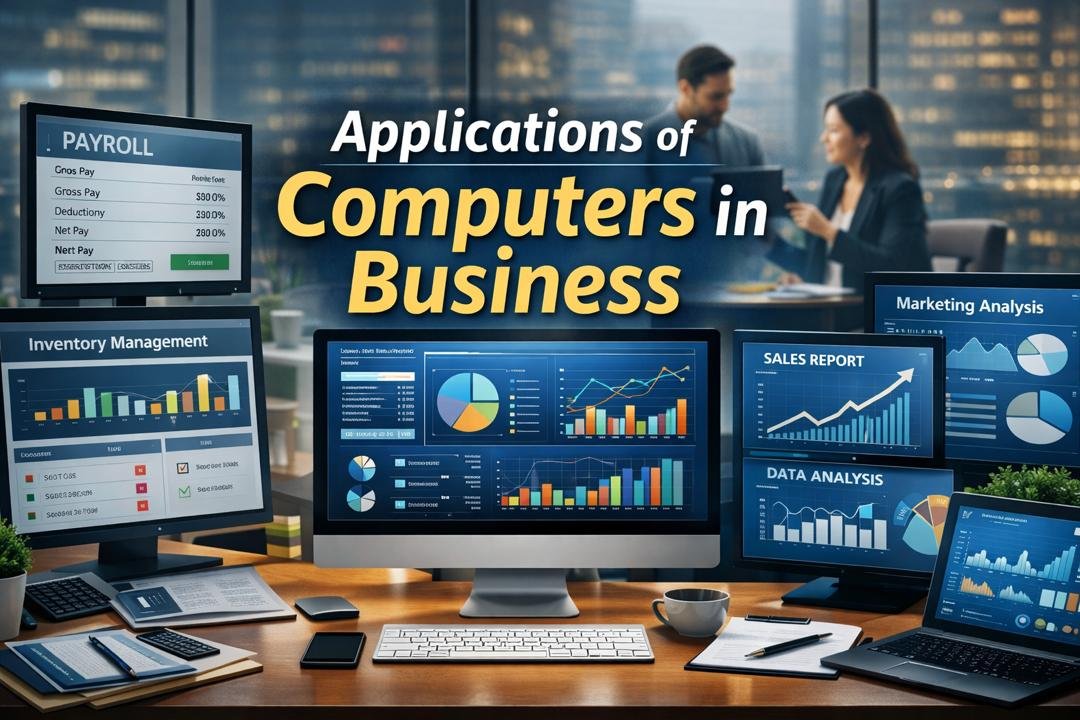
Computers have gained the pivotal role in the modern business in the digital age. Organizations, both small and multinational, highly depend on the applications of computers in business as a tool in managing information, enhancing efficiency, and making sound decisions. This has seen the automated systems being used to replace the traditional manual systems of record-keeping, communication and analysis save time, minimize errors and enhance productivity.
The environment within which businesses are carried out is very competitive, and speed, accuracy, and innovation are the factors that can make or break a business. Computers are important in ensuring that organizations are able to respond swiftly to market changes, customer demands as well as organizational challenges. They are applicable in all departments such as accounting, inventory management, human resource, marketing, customer service, data analysis and strategic planning.
This article discusses the application of computers in businesses in order to boost productivity, better decision making and efficiency in the organizations. It discusses the business processes in which computer technology is indispensable and demonstrates how digital technologies can enhance growth, competitiveness, and sustainability in an organization today.
The Process of Learning the Role of Computers in Business
The computers are electronics gadgets that receive information, manipulate it based on the instructions, store information and give results. Applications of computers in business serve as a means of automation, data storage, communication and analysis. They assist organizations in handling complicated tasks more quickly and precisely as compared to the manual procedures.
Stages in Learning the Role of Computers in Business
- Know the basics of computer concepts: The learners acquire the fundamental functions of the computer, the input, processing, storage and output first.
- Name of Business Applications: Students also get to know how computers are applied in accounting, inventory management, marketing, customer service, human resources and data analysis.
- Practical Software training: The learners are taught on business software like spreadsheets, accounting packages, database packages, and presentation packages.
- Data Handling and Analysis: Students train on how to enter, organize and analyze business data to produce reports and insights.
- It is important to recognize that the problem solving process involves technology and can be utilized to enhance efficiency and effectiveness in the workplace.
- Computers are used unethically: Training will encompass data protection, awareness on cybersecurity, and a responsible use of technology.
- Individual Continuous Learning and Innovation
The computer systems are used in modern businesses to:
- Saving data in huge amounts.
- Processing transactions
- Contact with the customers and staff.
- Performance analysis of business.
- Facilitating the strategic planning.
Computers are now more powerful and flexible with the incorporation of the internet, cloud computing and artificial intelligence. Computer based systems have allowed organizations to operate in various locations, handle remote teams as well as provide services to clients all over the world.
Importance of computer application in organizations
The advantages of computer application in business are quite a number and contribute to both the day to day running of the business and its long run growth. These advantages turn computers into important resources in the contemporary organizations.
Computer use in businesses has a number of advantages:
- Greater productivity: Work which would have taken hours can be done in minutes.
- Better precision: Automated systems eliminate problems of human error.
- Quick decision-making: Managers are able to have real-time information.
- Enhanced communicated: Emails, video calls and collaboration tools enhance teamwork.
- Cost saving: Automation saves on labor and operation costs.
These benefits demonstrate the application of computers in the business world to revolutionize the old ways of doing things to new digitalized systems.
Use of Computers in Accounting
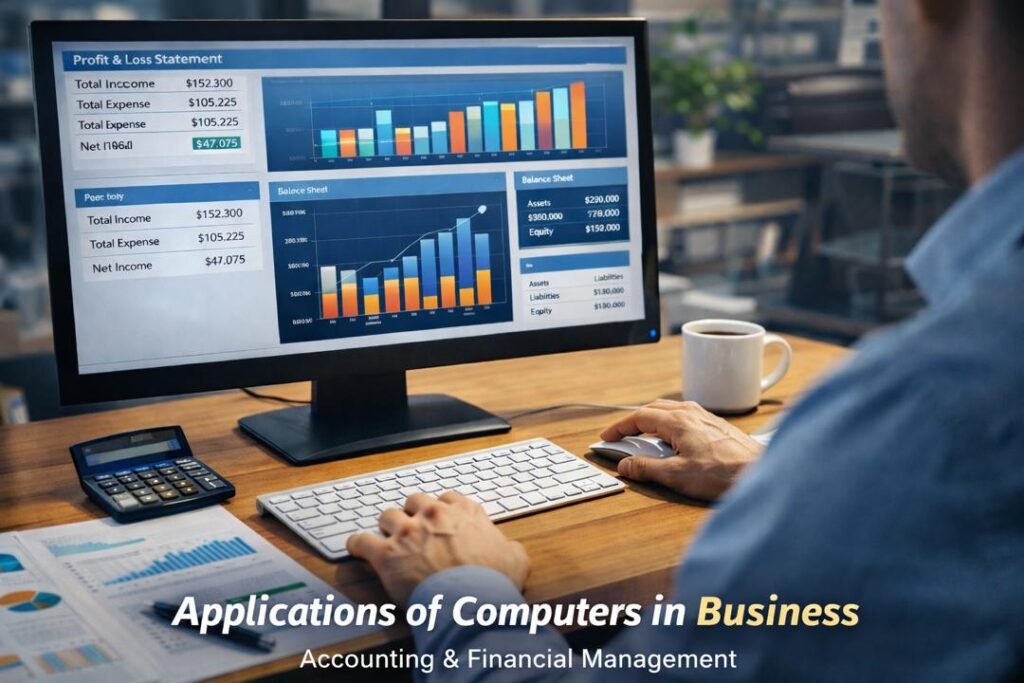
One of the most significant fields in which computers are used in the business world is in accounting. Accountants traditionally handled financial transactions by use of paper records and calculators. Nowadays, all the financial processes are processed by computer based accounting systems.
Computerized Accounting functions.
- Transactions: Sales, purchases and expenses are inputted into accounting software.
- Payroll management: The calculations are made automatically on salaries, taxes and deductions.
- Financial reporting: Profit and loss reports, balance sheets and cash flow reports are listed in real-time.
- Tax management: Software is used to compute tax and prepare tax reports.
Some of the accounting software are QuickBooks, Sage, Tally and SAP. These systems enhance velocity, accuracy, and transparency with regard to financial management.
Use of Computers in Inventory Management
Inventory management entails tracing of goods to the suppliers to the warehouses and ultimately to the customers. In the absence of computers, businesses would be faced with shortage of stock or overstock.
Improvement in Inventory through Computers
- Tracking in real time: Businesses are aware of the number of goods that are available at any given time.
- Automated reordering: Systems issue notifications in case of low stocks.
- Barcode scanning: Barcode scanning is used to track the products.
- Demand forecasting: Software can predict future stock requirement depending on the sales patterns.
The computerized inventory systems minimize wastage, losses, and delivery of the products to customers in time.
Use of Computers in Communication
Business cannot survive without communication. The presence of computers has revolutionized the internal and external communication of organizations.
Computer-Based Communication the types of computer-based communication include:
- Email systems: Rapid and official communication.
- Video conferencing: Virtual meetings based on such platforms as Zoom and Microsoft Teams.
- Instant messaging: Fast and immediate communication using applications such as Slack and Whatsapp Business.
- Customer relationship management (CRM) systems: monitor customer feedback and interaction.
These technologies enhance teamwork, minimize communication expenses and link teams across the world.
Use of Computers in data analysis and making decisions
Data analysis is one of the most potent computer applications in businesses. Organizations receive numerous data every day. This data is then processed by the computers to come up with meaningful information.
Decision-Making With the help of computers
- Data storage: Data bases contain information about customers, finances and operations.
- Data analysis: Programs such as Excel, power BI and tableau analyze trends.
- Forecasting: Predict sales and market needs of the future.
- Risk assessment: Find business risks and opportunities.
Managers use computer-generated reports in making sound strategic decisions.
Use Computers in Human Resource Management
Computers are used by the human resource departments to administer the employee information and organizational policies.
HR Computer Applications
- Manage employee records.
- Recruitment and selection systems.
- Training and performance monitoring.
- Payroll systems and attendance.
Such systems enhance transparency, less paperwork, and management of the workforce.
Use of Computers in Sales and Marketing.
In the modern world, the focus of marketing and sales has moved to computers and it is now the center stage of marketing. Computers are used by the businesses to connect with customers more quickly, advertise their products globally and monitor purchasing habits.
Electronic Marketing Media
- Management tools of social media.
- Email marketing software
- Customer databases
- Internet advertising sites.
Computers are used by sales departments in the invoicing, order processing, and management of customer data.
Computer application in Customer Service
Computers help companies in delivering quality, fast, and quality services to customers. They assist organizations to respond to the needs of customers, address customer complaints, and establish a good relationship.
Customer Service Systems
- Use of Chabot to provide prompt responses.
- Help desk software
- Customer databases
- Feedback analysis tools
Such systems enhance customer’s satisfaction and brand loyalty.
Use of Computers in Strategic Planning
The computer-based tools will help the executives and managers plan the business expansion, performance, and make long-term decisions. These systems assist organizations in analyzing information, predicting future trends as well as effectively managing resources.
Strategic Tools
- Enterprise resource Planning (ERP) systems.
- Business Intelligence (BI) software.
- Project management tools
These systems combine all the business functions in one platform.
Use of computers in Fraud and Data Protection
The computers are also used in securing business information and deterring fraud. The computer-based security systems are used by modern organizations to ensure that the sensitive data is not accessed by unauthorized parties, attacked by hackers, or abused by internal employees.
Computers also aid in safeguarding information of business by:
- Password systems
- Firewalls
- Encryption
- Backup systems
Data security guarantees continuity of business and safeguard customer confidence.
Problems of using computers for Business
Although it has advantages, it has obstacles:
- Cyber security threats
- High setup costs
- Need for skilled staff
- System failures
To surmount these hurdles, organizations have to invest in security and training.
Conclusion
The use of computers has become highly reliant in the modern business activities. Their assistance is in accounting, inventories, communication, data analysis, marketing, customer services, and strategic planning. Organizations are now more organized, the decisions they make are faster and more accurate, and they are competitive in the modern world economy through automation and digital systems.
The paper has also shown the applications of computers in business to enhance productivity, work efficiency and facilitate effective decision-making. Computers have not only changed the manner in which organizations are run but also in the management of financial records, customer relationship, sensitive data and long term strategies.
With technology still improving, those companies that invest in new computer infrastructure, workforce and safe online infrastructure will be very competitive. Computers will not only assist in the business processes but also lead to innovation, growth and sustainability in the world of business in the future.
Get more well researched information about the applications of computers in business operations here.