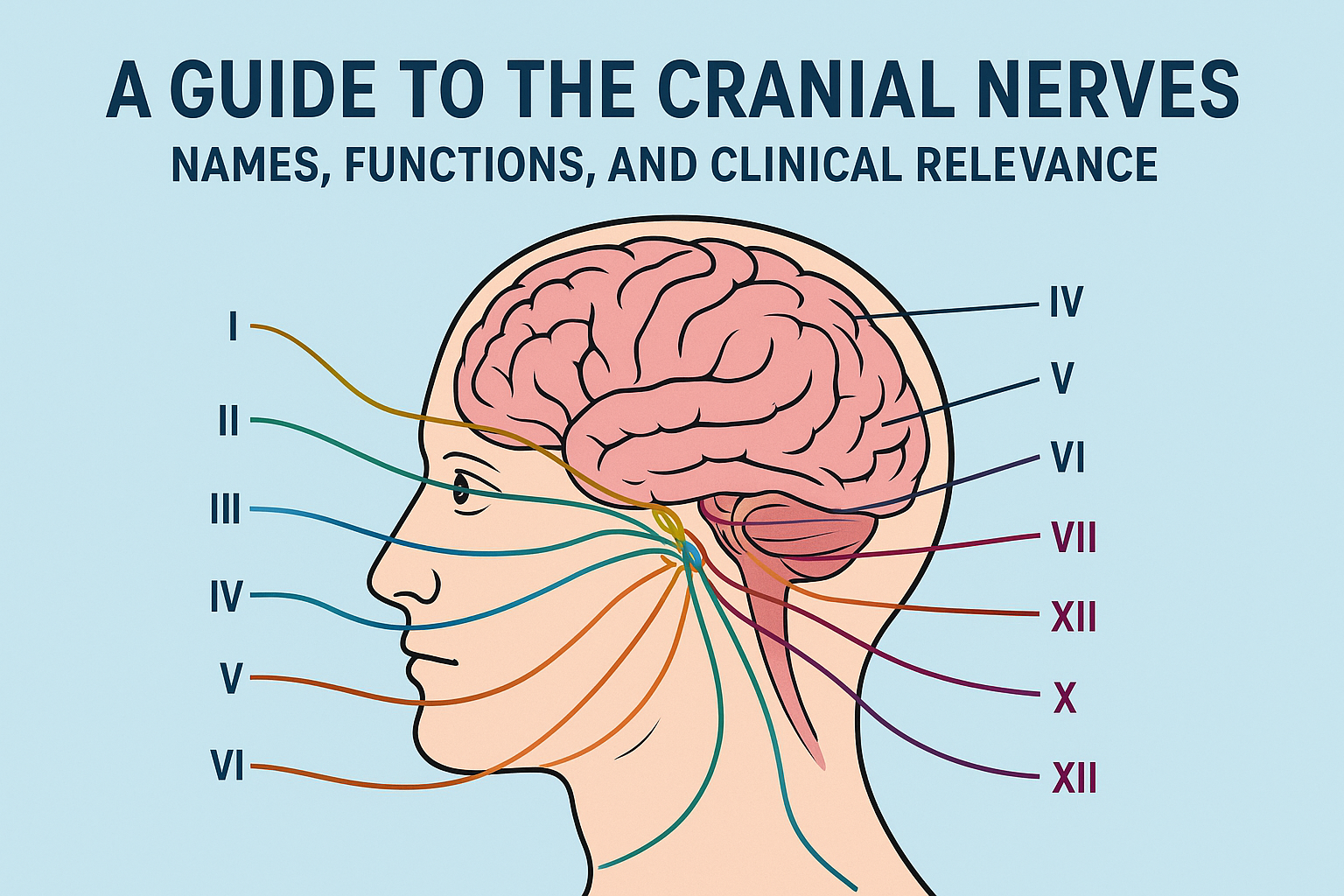
The human nervous system is important to understand by students, health care professionals, and any other person who wants to learn about human anatomy. The most intriguing aspects of the nervous system are the twelve cranial nerves, which leave the brain and the brainstem directly and do important sensory, motor, and mixed functions. These nerves regulate the diverse functions, including facial expressions and movement of the eye, hearing, taste, and smell. This manual offers a well-organized, easy to remember, dissection of all of the cranial nerves and their principal functions as well as clinical significance.
What Are Cranial Nerves?
The cranial nerves are a total of twelve pairs of nerves which have their origins in the brain and traverse several holes (openings) in the skull to reach their respective target organs. The cranial nerves serve the head and neck mostly unlike the spinal nerves which are branches of the spinal cord. The cranial nerves are specialized with a specific role in the body which may be sensory (where they relay information to the brain), motor (where they relay the brain to muscles), or may be mixed (those that have both roles).
The cranial nerves are easy to memorize, but it is possible to use a number of mnemonics to assist in the process. The most common mnemonic that is used to remember the names of all cranial nerves in order is:
Oh, Oh, Oh, To Touch And FeelVery Green Vegetables, AH!
This corresponds to:
- Olfactory
- Optic
- Oculomotor
- Trochlear
- Trigeminal
- Abducens
- Facial
- Vestibulocochlear
- Glossopharyngeal
- Vagus
- Accessory
- Hypoglossal
In the case of sensory, motor, or both functions, the usual mnemonic is:
Some Say Marry Money, Big Brains Matter More, Says My brother.
Dissection of the Twelve Cranial Nerves.
Olfactory Nerve (CN I)
Type: Sensory
Location: The position of the sense of smell is the one in charge.
Clinical Relevance: Traumas to the olfactory nerve may result in anosmia (loss of smell), which may be caused by trauma to the head or tumors or by viral infections. The test is not complicated: it is important to ask the patient to name usual odorants like coffee or peppermint.
Optic Nerve (CN II)
Type: Sensory
Function: Transports the visual data in the retina to the brain.
Clinical Relevance: Lesions may result in either loss of vision, visual field defect (such as hemianopia), or optic neuritis. Pupillary light reflex and visual acuity test could be used in examining the optic nerve.
Oculomotor Nerve (CN III)
Type: Motor
Function: Activates the majority of the eye muscles, eyelid eye-lift, and pupil constriction.
Clinical Relevance: The clinical effect of the damage may include a double-vision (diplopia) and a drooping eyelid (ptosis), as well as additional dilation of the pupil. Its functional capability is measured by examining the eye movement and pupillary light reflexes by clinicians.
Trochlear Nerve (CN IV)
Type: Motor
Function: Supplies the superior oblique muscle that allows the movement of the eye downward and inwards.
Clinical Relevance: Nerve damage of Trochlear nerve may lead to vertical diplopia and inability to read or walk down stairs. Its dysfunction is diagnosed with the help of eye movement tests.
Trigeminal Nerve (CN V)
Type: Mixed (Sensory and Motor)
Function:
- Sensory: Gives the skin awareness of facial sensation of touch, pain, and temperature.
- Motor: Mastication (chewing) muscles.
Clinical relevance: Trigeminal neuralgia is associated with severe pain on the face. The loss of sensation or the inability to chew may also be caused by damage. Sensory testing entails the sense of touch and perception of pain on the face whereas the motor testing entails jaw movements.
Abducens Nerve (CN VI)
Type: Motor
Use: Stimulates the lateral rectus muscle which is the outward eye movement muscle.
Clinical Relevance: The result of the clinical damage is medial deviation of the eye (strabismus) and horizontal diplopia. To test the patient, the clinician asks her to move the eye sideways.
Facial Nerve (CN VII)
Type: Mixed
Function:
- Motor: Ageing control in facial muscles.
- Sensory Taste: Anterior Two-thirds of tongue.
- Parasympathetic fibers: Activation of lacrimal and salivary glands.
Clinical Relevance: The facial nerve palsy (e.g., Bell’s palsy) leads to the asymmetry of the face, inability to close the eye, and the inability to taste. Testing involves smiling, raising eyebrows, and a test of the patient.
The Nerve of the inner ear (CN VIII) is also known as the Vestibulocochlear Nerve
Type: Sensory
Function:
- Vestibular: Space orientation and balance.
- Cochlear: Hearing.
Clinical Relevance: Damage may be vertigo, imbalance and hearing loss. Clinical assessment consists of the Rinne and Weber test, and a test of the vestibular reflex.
The Glossopharyngeal Nerve (CN IX)
can be described as a nerve in the body that supplies lubrication to the mouth, pharynx, and throat.<|human|>Glossopharyngeal Nerve (CN IX) could be explained as a nerve in the body that provides lubrication to the mouth, pharynx, and throat.
Type: Mixed
Function:
- Motor: Helps in swallowing with the help of the muscles of the tongue, which are the pharyngeal.
- Sensory: Pharynx sensation Posterior one-third of tongue (taste) sensation.
- Parasympathetic: Activates parotid glands of the salivary.
Clinical Relevance: Lesions can result in loss of taste, impaired swallowing as well as lack of gag reflex. Examination involves testing of the gag reflex, and assessment of the swallowing capability.
Vagus Nerve (CN X)
Type: Mixed
Function:
- Motor: regulating the muscles of the pharynx and larynx, this affects the speech and swallowing.
- Sensory: Conveys the information of the abdominal and thoracic organs.
- Parasympathetic: Controls the rate of heart beat, digestive activity and breathing.
Clinical Relevance: It can cause damage to the voice to be hoarse, hard to swallow, and lacking in autonomic control. Clinical examinations involve palate vocal and voice alterations.
Accessory Nerve (CN XI)
Type: Motor
Action: INervation: Trapezius, sternocleidomastoid Innervation serves to turn the head and raise the shoulder.
Clinical Relevance: The result of damage is weakness to turn the head or to shrug the shoulders. The testing will include the request of the patient to resist turning his head or lifting his shoulders.
Hypoglossal Nerve (CN XII)
Type: Motor
Function: muscles: Speaking and swallowing.
Clinical Relevance Lesions may lead to tongue deviation to the affected side, atrophy, and dysphagia and dysphonia. Examination involves the request of the patient to extend their tongue and swing it laterally.
Mnemonics and Hints of remembering the cranial nerves
In the case of students, it is easier to memorize the nerves with the help of memorable expressions. The mentioned mnemonics are good to begin with. The other successful strategy is to correlate function with clinical test:
- Sensory: Direction to smell, sight, hearing, balance and taste.
- Motor: Pay attention to the eye movements, the facial expressions, the swallowing, tongue, and the head/shoulder.
- Mixed: Focus on nerves having sensory and motor aspects (V, VII, IX, X).
Memory is also reinforced by visual images, diagrams and repetitions of testing situations in laboratories or clinical practice.
Clinical Significance of Cranial Nerves
Knowledge of the twelve cranial nerves is not merely an academic exercise but it is also vital in clinical practice. Cranial nerve examinations are common procedures of examination by neurologists, ENT specialists, and general practitioners. There are typical instances of cranial nerve clinical situations, which include:
- Head Trauma CN I (olfactory) and CN II (optic) can be subjected to injury. Trauma may be manifested by the loss of smell or sight.
- Stroke: CN VII (facial) has the potential to cause a facial droop which is used to differentiate between central and peripheral lesions.
- Tumors: CN VIII (vestibulocochlear) is affected by acoustic neuromas, which make the individual experience hearing loss and balance problems.
- Infections Viral CN V (trigeminal): CN V may be involved in infections such as herpes zoster, causing pain or paralysis. CN VII (facial): CN VII may also be affected in infections such as herpes zoster and cause pain or paralysis.
- Reflex Testing: Cranial nerves mediate such reflexes as the corneal reflex (V and VII) and the gag reflex ( IX and X ). Assessment of the reflexes is a quick examination of neurological intactness.
Clinical Examination Tips
- Notice: Begin by physically examining the face, eyes, and tongue in order to check their asymmetry.
- Request Movement: Test facial expression, movements of the shoulder and eye movements.
- Test Sensation: Determine the sensation of the face, tongue, and pharynx with light, painful, and taste sensation stimuli.
- Assess Reflexes: Examine the pupillary, corneal, gag, and the vestibular reflexes.
- Integrate Findings: Add deficit to the localized pathology of particular cranial nerves.
Conclusion
The knowledge of the twelve cranial nerves is vital to students about to undergo exams and clinicians involved in carrying out neurological tests. This is because with the knowledge of the functions of each nerve, its sensory or motor classification, and associated clinical tests, one can correctly diagnose and treat neurological disorders. Knowledge of these important elements in the nervous system can be reinforced with the help of mnemonic, repetition, and clinical correlation.