Introduction
The way people invest is vastly different today after online brokerage companies have come into existence. Investors no longer have to call a broker, visit a financial institution or submit paper instructions to open accounts, research investments, place orders, track portfolios or access information about transactions they can now do all these things via a website or a mobile app. The simplest of a “Buy” or “Sell” button is an entire system of technologies and financial institutions that combine to process information and transactions. One of the most vital components is the system that provides price, volume and company information and other information that is real-time or delayed, to the investors. These market-data systems assist brokerage platforms to present the data that investors require prior to deciding. Once you know how they work, it is easier to know what will really happen if an investment is purchased or sold online.
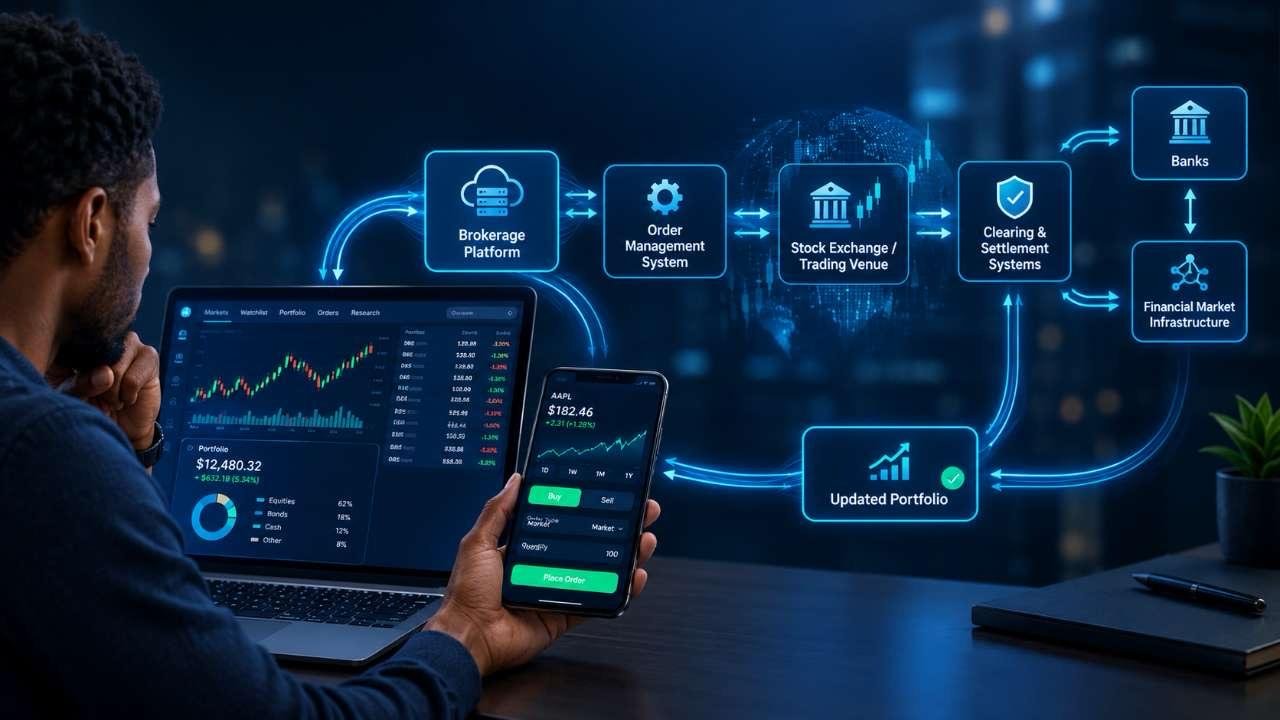
As such, modern online brokerage platforms are a crucial technology for linking individual investors to the broader financial markets. Closed beta means that the investor will only be able to see what’s happening on a mobile phone screen, but the platform will be generating signals to several systems at the same time. These may include order-management systems, exchanges or other trading venues, clearing houses, settlement systems, banks, custodians and regulatory bodies. The brokerage platform accepts the investor’s order, verifies if the order can be executed, directs it to a suitable marketplace, and provides information about the transaction to the investor, and updates the investor’s account. Following execution, other systems are in place to process and settle the position, keep records and move cash and securities. This is a jumbled process, which is why investing online can feel like the process takes just a split second, despite the fact that there are multiple financial and technological transactions that may take place leading up to a transaction.
An Online Brokerage Platform
An online brokerage service is an electronic service used by investors to gain access to the financial markets and manage their investment accounts online. Investors can go to a website or mobile app and buy shares, bonds, exchange-traded funds (ETFs), mutual funds, options, or any other sort of financial product, depending on the provider. The platform offers the interface that customers use to view their accounts, check on market prices, place orders, look at their transactions, and track on what they have in their stocks. The application is not, however, the place where securities usually are exchanged. Instead, it serves as an intermediary and the technology layer between the investor and the financial infrastructure that is used to execute and complete the transactions. This is important because it may be very easy to present a nice looking application from the broker, but there is a lot of meat on the bones behind it. The platform essentially converts an investor’s instructions to electronic messages that can be dealt with by the money related frameworks.
Financial and regulatory obligations also come along with the brokerage relationship. Typically, an investor must open an account with the brokerage firm, verify identity, gather necessary information and decide on which services the investor is authorized to utilize before they can trade. Specific conditions are different depending on country, type of account, financial product and applicable regulations. Investors can enter personal data, identification documents, tax data, employment data and data about their investment account during registration. These procedures assist the financial institutions in complying with customer-identification, anti-money laundering, suitability and other regulatory requirements as applicable. After its approval and funding, the platform links the investor’s account with the firm’s system. At this location, electronic management of deposits, withdrawals, orders, positions, transaction histories, and statements are possible.
Investors Open and Fund Accounts.
Typically, the first step to opening an online brokerage account is to complete an online application. The investor provides personal information in a site or app, uploads needed paperwork (if applicable), and agrees to the terms and disclosures of the brokerage firm. The information is securely passed to the firm’s account-opening systems to be checked automatically and, at times, manually. Much of this exercise can be done remotely with the aid of technology, thus minimizing the use of hard copy and branch visits. After the account is accepted, the investor has to move cash or qualified assets prior to investing. The funding option will vary based on the platform; it could be a bank transfer, electronic payment mechanism or another method accepted by the platform. The brokerage’s books and records contain the cash that is available and associate it with the customer’s investment account, thus establishing the necessary financial base for future transactions.
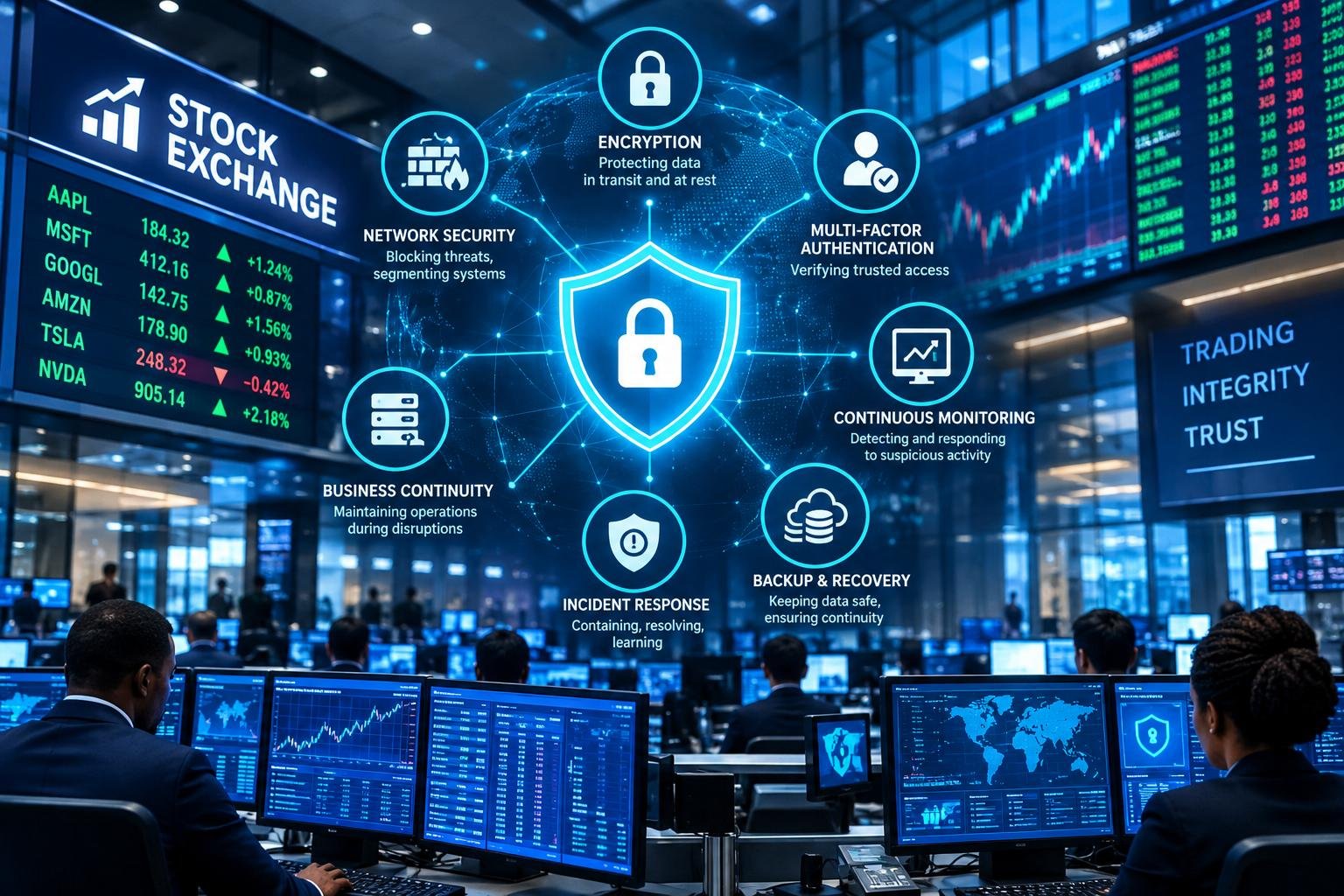
Security is a crucial element of a Digital Account since a brokerage account can be a source of money and valuable Investments. The platforms typically implement authentication methods like passwords, multi-factor authentication, encryption, device verification, session controls, or transaction monitoring. How secure the features are can differ from provider to provider, but their goal is to block unauthorized access and identify any suspicious activity. Investors also have responsibilities when it comes to protecting their accounts. Using the same password, sharing ID and password details, ignoring warnings or logging into accounts on unsafe devices may put your accounts at a higher risk for being compromised. Once an investor registers for an account, digital security doesn’t stop. Digital security does not stop when an account is opened, but extends throughout an investor’s tenure with the brokerage. Part of a secure platform is institutional controls and responsible user behavior.
How Market Data get to Investors
Investors typically view, before placing an order, information like the current or recent price of a security, the trading volume, the bid and ask prices, the historical performance, and various other market information. This information is communicated via interrelated market-data systems. There is a tremendous amount of information generated in financial markets when orders are placed, changed, cancelled and executed. Exchanges generate data feeds which can be disseminated to financial institutions and technology vendors. Then, brokerage platforms handle and display relevant information via their apps. The information shown to an investor can be current, delayed or based on the special data package that the brokerage provides. Therefore, the reported price in an order should not be interpreted as a price that a subsequent order will certainly have.
Information about the markets is also not the same as investment guidance. A brokerage platform can present the price of a company’s shares, financial data, charts, news, analyst data, or other research, but do not make an investor’s decision for them. Mostly, the technology is intended to offer entry to info and trading capabilities. Investors should be familiar with the significance of the various data elements before using them. For instance, the price quoted could vary significantly in an active market, as could the amount of inventory available at any given price. The information shown is thus a moving target in an electronically charged environment and not a set menu of prices. The price an investor will view before entering an order might not be the price he or she will receive when the order is executed, so it is important to understand this dynamic nature.
What Happens when an Investor Makes an Order?
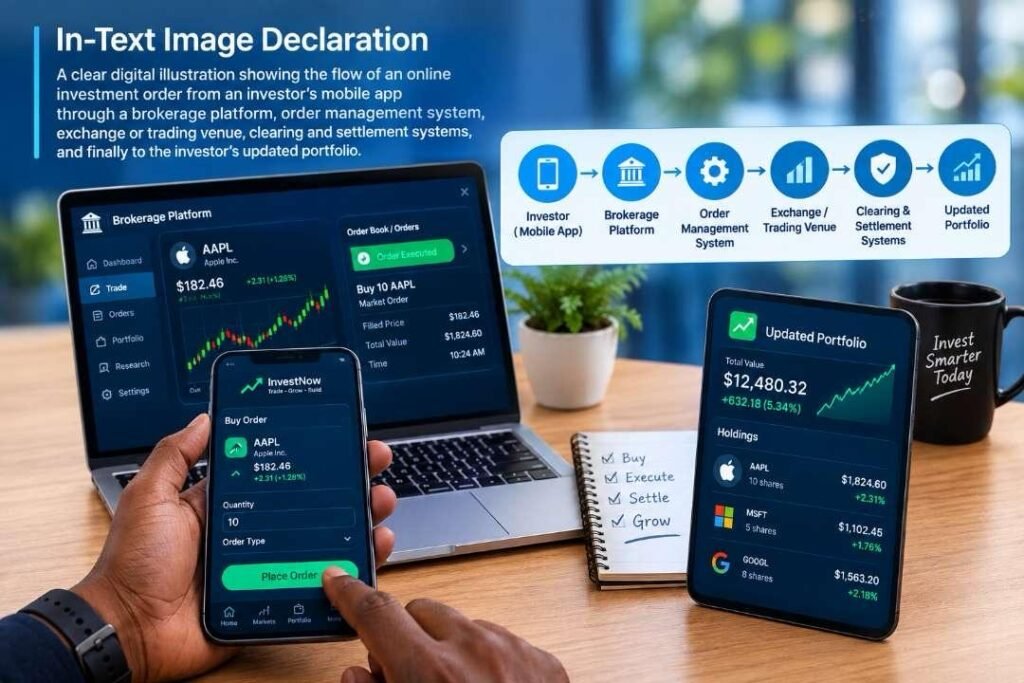
When an investor clicks “Buy” or “Sell”, the investment platform first gets the buy sell order and then passes it on to the order management system. The order is filled with details like security, quantity, order type, and any given price/condition. Prior to the order is made, the brokerage may automatically review any available security, available funds or securities, the account, its trading permissions and other requirements. Once the order has passed the appropriate checks it can be sent for execution. The destination is determined by security and brokerage’s arrangements. An order may be directed to: an exchange, an alternative trading venue, a market maker or another execution venue. To the investor, it can be a single step, but in technologic terms it’s a number of messages traveling between systems in a span of time that is quite short.
The type of an order selected may impact the processing of the order. Most often, a “market order” is given to the broker to be executed at the current market price, and a “limit order” is given to the broker to only accept for purchase or sale at a certain price. There are other types of orders that may have other conditions. When an order is placed at an execution venue it pertains to the orders that are available at the venue, based on the rules of the venue. A trade can take place if there is an appropriate trade counterparty. The brokerage will then get a report of execution and adjust the customer’s account. If it is not possible to complete the order, then the rest of the order can remain in order as per the terms of the order. The process explains why an online brokerage platform is more than just a button: It’s also an electronic gateway that turns the investor’s order into a standard message that can be understood by financial-market infrastructure.
The Importance and Function of Exchanges and Trading Venues
Stock exchanges and other trading sites give the atmosphere where buyers and sellers can interact following some set guidelines. An exchange is equipped with advanced technology that allows them to accept orders, manage them, provide the matching of the interest of buyers and sellers, and provide information regarding activities in the market. In modern exchanges the technology is very automated, and transactions can take place in very short periods of time in huge numbers. Their systems need to accurately process these transactions, have well-ordered markets, and disseminate information to market participants. While an exchange’s infrastructure may not be accessed directly by individual investors, orders from individual investors can eventually end up on the exchange’s infrastructure. The exchange is thus a component of a wider chain of participants that links the investors, brokerage firms, market participants and post-trade institutions.
It’s also crucial to note that not all deals take place on a regular exchange. The type of financial instrument, jurisdiction, or brokerage agreement may mean that orders are sent to various trading venues and/or liquidity providers. Technology is employed by brokerage firms to identify the placement of eligible orders and methods for execution based on the requirements and policies that they owe to their clients. All of these routing decisions may not be visible as part of the investor’s application, but it is possible for them to be a significant part of the transaction process. This is why online trading does not necessarily equate to simple trading, as the financial infrastructure is very simple. There might be multiple electronic systems in between an order and the execution.
After-the-Trade Clearing and Settlement
It does not follow that execution is the last step of a securities transaction. The clearing and settlement processes facilitate the process after a trade has been made, to ensure that the security is delivered to the buyer and the proper funds are delivered to the seller. Clearing means determining what obligations are created by trades and, if applicable, dealing with these obligations via clearing organizations. Central counterparty could be the buyer for each seller and seller for each buyer in markets where they are employed, to help control counterparty risk. Settlement occurs when the transfer of securities and funds is settled as per the prevailing settlement mechanism. The actual time varies between each market’s settlement cycle and its infrastructure, as well as from market to market, and from security to security.
The brokerage firms are linked to these post-trade systems via financial institutions and dedicated infrastructure. Once a security has been purchased by an investor, the brokerage is responsible for being sure that the purchase is properly recorded and the cash and securities are processed. Securities can be held or transferred for the account of financial firms and their customers by custodians and settlement institutions. Funds may also be moving between banks and/or payment systems. Much of this activity is done via electronic channels, and may not even be seen by the investor. However, it is crucial since an order execution that is well carried out needs to be an adequate financial transaction. These systems need to be able to keep up with the accurate maintenance of ownership, cash obligations, settlement status and other information.
Portfolio Tracking and Account Updates
Once a transaction is complete, and processed, the brokerage platform will update the investor’s digital account. The portfolio screen will display securities held, quantities, current/recent market value, available cash, transaction history and portfolio value changes. These are calculated using data from multiple internal/external systems. Details of holdings are derived from the brokerage’s books, valuations can be based on the most recent or previous market prices provided via the market-data infrastructure. The platform can then work out the information for each account and then show them to the investors in a way that’s easy to understand. One of the key benefits of digital brokerage tech is that information that used to be handled by hand or communicated with a financial institution can be shown almost instantly via an on-line dashboard.
Portfolio tracking systems also offer investors a history of their trades and their performance. Investors can view dates, quantities, and prices of purchases, fees, dividends, deposits, withdrawals, and more on their account activity depending on the platform. The value of the portfolio may fluctuate, however, with fluctuating market prices. There may be a displayed gain or a displayed loss but either of these may not be a gain or loss of actual funds but a change that has not yet been realized. Likewise, cash balances may be broken down into various types of cash or transactions that have yet to be collected. Knowing the difference between cash available and assets invested, pending and total portfolio value should help to accurately interpret investors’ dashboards rather than assuming that every number that is displayed on the screen is available to be withdrawn or is a permanent realization.
Electronic Records and Statements
Online brokerages have also made changes to the way investors are provided with financial records. More often than not, instead of being given a statement by mail, customers may find their account statements and other records, such as tax statements, trade confirmations and transaction history, on a secure online account. All these documents are created by the brokerage’s bookkeeping and accounting processes. A digital statement can include details of what’s in your account, account activity, cash movement, transactions, fees and other information and details for a specific period of time. While investors should keep proper records for tax, financial planning and personal documentation needs, electronic records can be easily searched, downloaded and stored in comparison to paper records.
Financial institutions can benefit from digital recordkeeping in terms of operational efficiency as well. Automated systems can create several statements and confirmations at a time without having to manually create each one. Meanwhile, all financial records should be kept secure as it includes sensitive information relating to customers and their financial transactions. To keep digital records secure, brokerage firms employ access controls, authentication systems, encryption, surveillance and other security measures. The investor needs to generally review the statements, rather than only with regards to the portfolio screen. A statement may be a better documentation of account activity and may be useful in detecting unknown transactions, incorrect information, and other problems that need to be addressed.
How Financial Institutions Fit Into the Technology Network
Online brokerage sites are only part of a financial system. Cash-transfer services and funds kept by banks and securities custody services by custodians can be offered to the customers. Exchanges and other trading venues offer ways of making trades; clearing organizations can help deal with obligations among market participants. Settlement systems enable the last step in the securities and fund transfer process. Regulators set regulations and supervision mechanisms, and technology providers can provide specific infrastructure, market data, cyber security services, cloud computing or others. The brokerage platform amalgamates many of these relationships from the investor’s standpoint and presents them with a single digital platform, enabling them to communicate with a complex financial web.
This is because it’s a networked system and reliability is paramount. Brokerage platforms need to be able to manage a high volume of users and orders, especially during times of heavy trading. They require a technology that is redundant, monitored, has cyber security controls, backup technologies and procedures to deal with technical failure. With resilience and operational controls being a priority for firms, a problem in one part of the financial technology chain can have a knock-on effect on other parts. Investors can just see the application, but there’s a whole network of servers, database, communication, authentication, order management, financial market and post trade systems. Digital investing is therefore dependent on the seamless collaboration of a multitude of technologies and institutions.
What Investors Should Know Before Trading Online
The easy way to use online brokerage sites doesn’t eliminate the dangers of investing. While technology has made the process of placing transactions easier, it does not mean that it will ensure that an investment will appreciate in value nor will it ensure that every transaction will take place at the price that an investor would like. The prices in the market may fluctuate quickly, orders may have different execution times, and technical issues could sometimes arise leading to difficulties in accessing financial services. It is important for investors to know about the fees, order types, account rules, market-data arrangements, withdrawal conditions and more applicable to their brokerage account. They should also keep their log-in details safe, use security features if they are available, keep an eye on account activity and regularly check account statements. Accessing the digital universe is convenient, but investing responsibly still involves the need for good stewardship of financial information and security of personal accounts.
In addition, investors should also differentiate between the brokerage platform and the financial market. A brokerage application should give access to investment service but won’t affect the underlying market price of the security. Prices are set in a process of interaction between buyers and sellers on relevant trading places and trading mechanisms. Similarly, research, charts, alerts and other information may be offered by a brokerage without such features being an assurance of future performance. Having a clear understanding of these differences will enable investors to make effective use of technology. The website should be used for accessing and managing investments, but not as replacement for knowledge of the financial products that are bought. Investors are still advised to consider investing in a specific investment to meet their needs and goals.
Conclusion
Online brokerage sites have rewritten the investing landscape by making the intricacies of the financial markets accessible, creating digital investing experiences. An investor can do all of the above without having to visit a brokerage. For each of these activities there are a series of technologies that link brokerage systems to the market data providers, exchanges, trading venues, banks, custodians, clearing organizations, settlement systems and other financial institutions. Order-management systems convert investor orders into electronic trading messages, execution systems find eligible orders, and post-trade systems ensure that completed orders are executed correctly. The resulting data are then fed into portfolio systems and statement systems that will present the information to investors via their digital accounts.
Online brokerage technology has thus revolutionized the way investors transact with financial markets as well as the way financial institutions manage and convey financial information. A seemingly rudimentary exchange that takes place on a cellphone is backed by a complex technological chain that enables the smooth and secure flow of information, orders, funds and securities. Knowing this chain can give investors a sense of what they have in front of them when viewing the brokerage interface and knowing what is going on behind it. With the growing digitization of financial markets, understanding these is becoming a crucial component of the financial market investing landscape.
Get more well researched information about How online brokerage platforms work here.