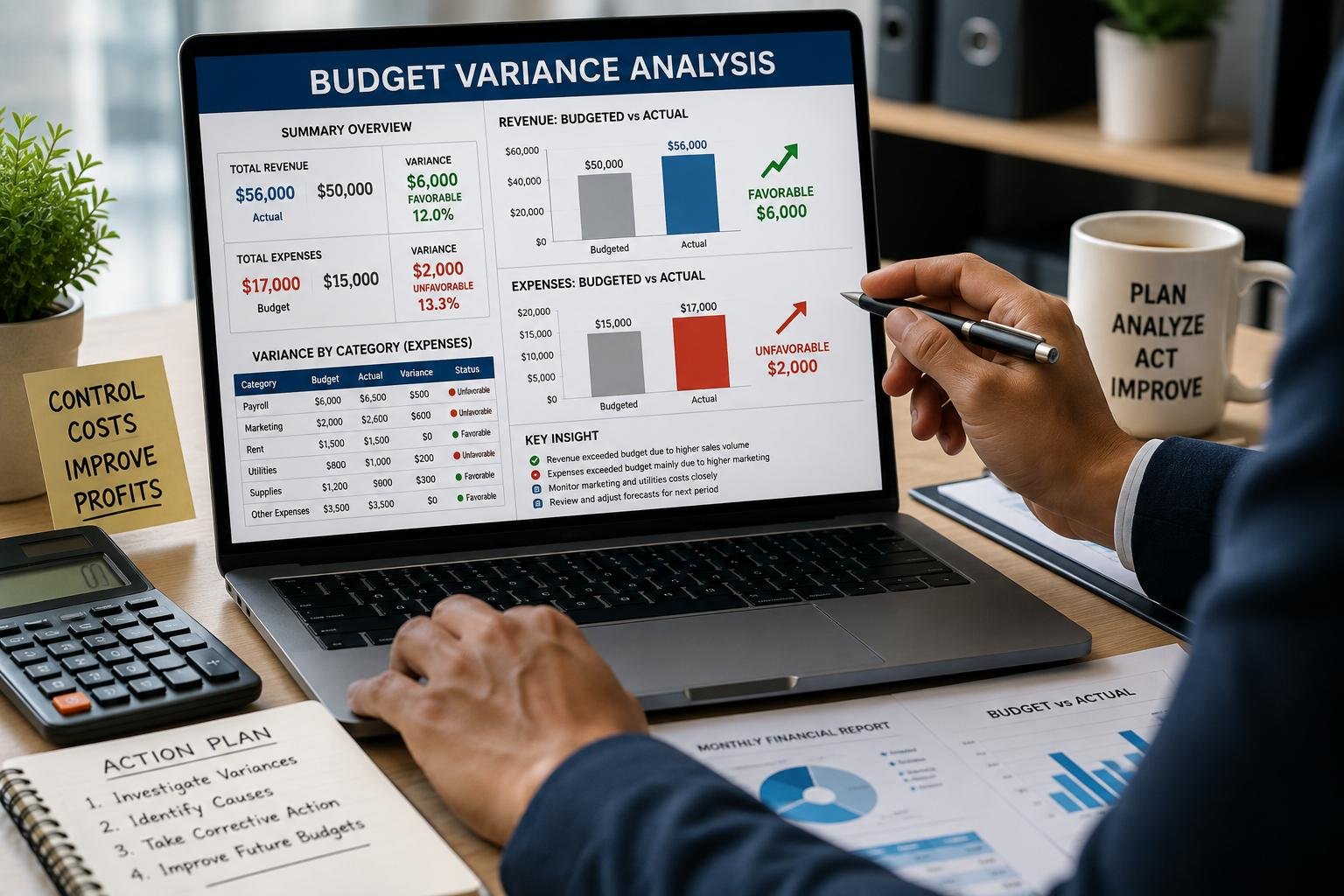
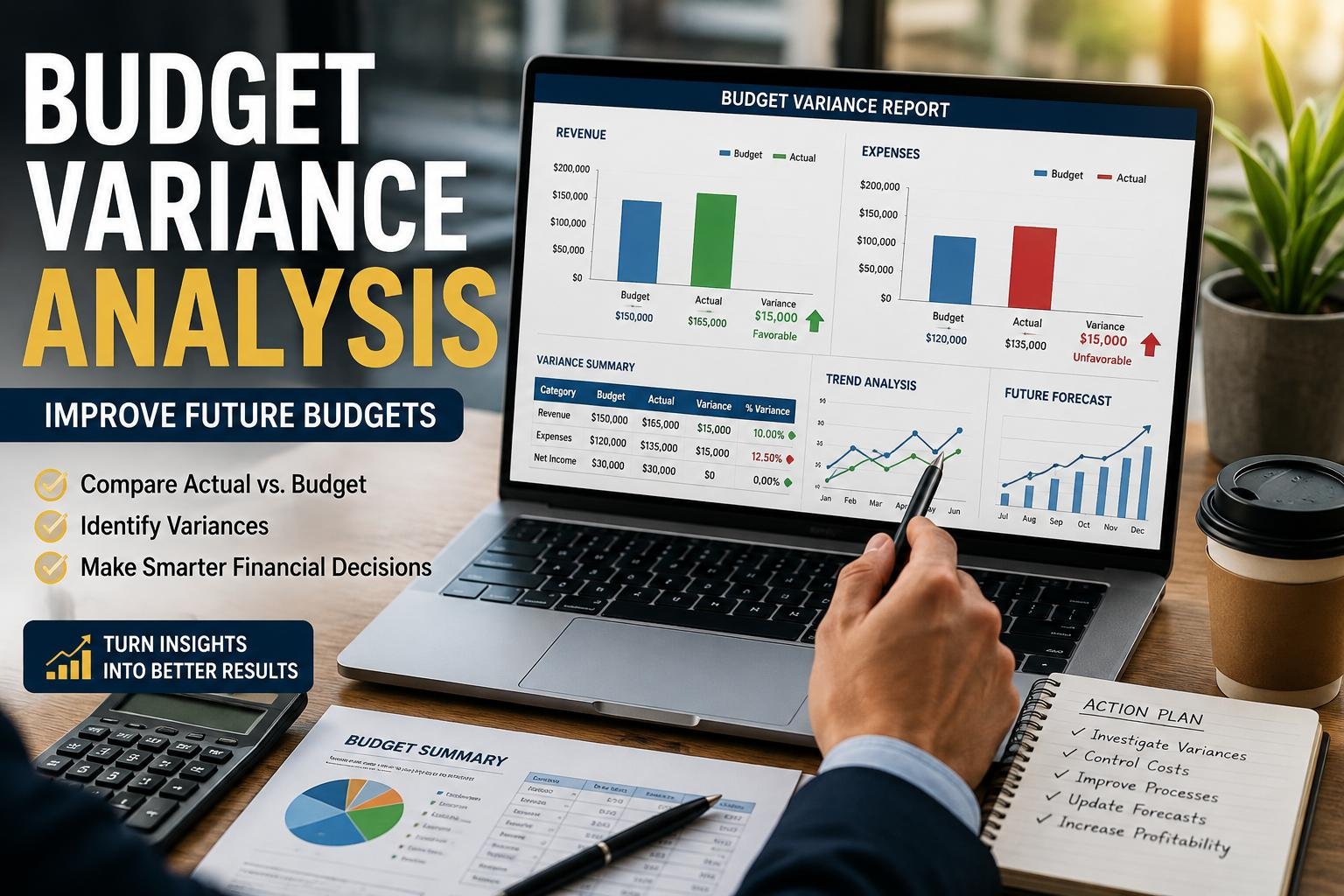
Introduction
One of the most crucial financial tasks of a new business owner is to make a business budget. A budget provides a business owner with clarity about the amount of money to be received, the amount to be spent, and if the business will be able to cover the activities it plans. If the entrepreneur doesn’t have a budget, he/she can make decisions on assumptions, it may be necessary to spend more than planned, or cash may run out just when it is needed the most. A good budget isn’t just a record of your income and expenditures; it is a financial blueprint that can assist in making your purchase, hiring, marketing, expansion, saving and other investment decisions. If you are a small merchant, freelance business, online shop, Service Company or a growing start-up, it’s important to learn how to make a realistic business budget to keep your spending under control and help your business grow.
What is a Business Budget?
Business budget is a financial plan that predicts a company’s expected assets, liabilities, cash flow and finances objectives within a set period of time. Typically, the small business creates a budget on a monthly, quarterly or yearly basis, depending on the business and its nature. It is used to see if the income the owner is expecting is the money the owner is planning to spend and if the owner is using the money responsibly. Sales revenue, operating expenses, salaries, rent, utilities, inventory purchases, marketing costs, taxes, loan repayments, equipment purchases, saving and emergency reserves are all aspects of a budget. It should not be regarded as a set in stone document which can never be changed. Rather, a helpful business budget is a financial plan that works and can be modified when sales figures, costs or the market or business priorities change.
If you’re just starting out, budgeting can seem complicated at first due to the number of financial numbers that need to be taken into account. As long as it’s broken into small steps, though, the process is a lot simpler. In essence, it is about determining how funds will be used, predicting the amount of spending, prioritizing expenditures and frequently monitoring and reviewing the actual costs against the cost plan. When entrepreneurs use a business budget as a tool for making business decisions instead of merely an accounting document, it becomes even more useful. A budget should have answers to practical questions like is there room in the business for a new employee, and what is the appropriate amount that can be spend on advertising, are prices adequate to cover costs and should money be allocated for unforeseen expenses.
What are the Reasons to have a Business Budget?
A business budget gives financial control as owners will be able to decide how to spend the money before it leaves the business. This is because if no budget is set, it’s easy to make one or two small purchases which end up accumulating into a lot of money, especially when multiple people have the power to use up company money. Budgeting can also help determine whether there are frivolous expenditures and promote entrepreneurs to make the distinction between money spent that is essential to their business growth and money spent that is just to reduce the cash flow. The owner will be able to identify possible financial issues at an earlier stage if expected income and expenses are made a part of the documentation. For instance the business if its expenses are always higher than the projected revenues then it can cut down discretionary spending, change the pricing, put a few efforts into the sales, negotiate the prices with suppliers or put off non-essential purchases until the situation grows severe and becomes a serious cash-flow issue.
The other benefit of a budget is that it turns general money targets into concrete targets. A business owner’s objective could be to boost annual revenue, save for an emergency fund, buy equipment, expand his or her business to a second storefront, or pay off a debt. These aims are simpler to manage if they’re associated with certain numbers and dates. The owner can choose to save a percentage each month rather than just informing the business to save more money. Rather than increasing marketing expenditure the owner could set a marketing budget and track to see if the increased expenditure is resulting in increased sales. This helps to tie day-to-day financial decision making to the future of the business, and keeps managers accountable for the use of company resources.
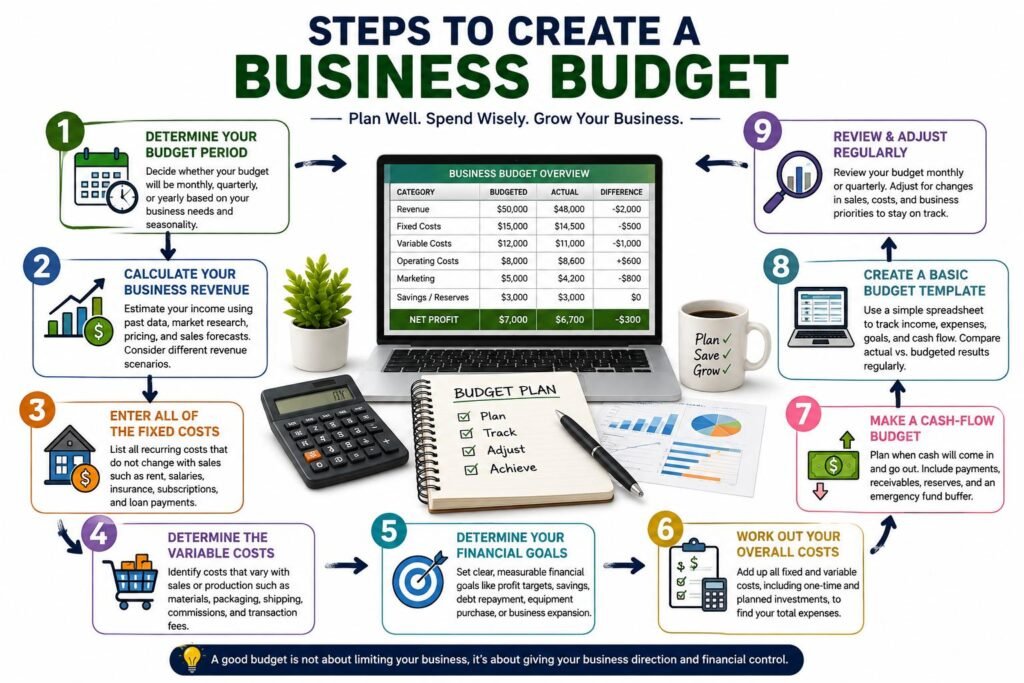
Step 1: Determine Your Budget Period
The first thing you need to do when developing a business budget is to determine the time frame the budget will be covering. Many companies have an annual budget since it gives a general idea of what is likely to happen in the business in a year, but an annual plan should be broken down into smaller sub-periods like months or quarters. Monthly budgeting is especially helpful to the novice as it allows them to easily spot issues quickly and also to compare the results to those expected. If the business has a strong seasonal sales pattern, it may require more detail as there can be significant variations in business activity between different months. For instance a retailer may find that certain months are busier than others when it comes to sales, or a business involving tourism may have specific months that are busier. If these patterns can be understood, the budget can be set along realistic expectations and not on the basis of the expectation that each month would have the same results.
Entrepreneurs must also take into account the frequency of a big expense when choosing a “budget period”. Some expenses may be periodic (monthly) and some may be recurring (annual, quarterly, or otherwise). Other large monthly bills, such as insurance costs, license renewals, equipment costs, taxes and professional fees, can add up and be easily forgotten if only routine monthly bills are being considered. One effective strategy is to make a list of all the bills that are recurring and some of the bills that happen occasionally, and figure out when they’re likely to come. If an annual expense is anticipated, then the company can provide a little amount of the sum each month, so that the money is not available all in one, as the expense falls due. This way, the budget will be more realistic and will help in cash-flow planning.
Step 2: Calculate your Business Revenue
An accurate estimate is vital to a business’s budget because it will help them determine reasonable spending. When forecasting sales, it is important that new business owners don’t simply pick the number they hope will be true as this can make the entire sales forecast unreliable. Instead, using available evidence (such as if the business is already running, then previous sales; if the business has not yet opened, then customer numbers, average transaction value, pricing, market research, seasonal trends, and capacity to produce products/services) to estimate revenue should be done instead. The revenue for a service provider could be the number of clients expected times the amount of revenue each client would generate. A retailer might be able to estimate the number of units that will be sold and the average price that he/she will get for each unit sold.
It’s also important to consider various revenue possibilities instead of sticking with one forecast. A ‘conservative’ scenario is one that assumes less sales than anticipated, and a ‘realistic’ scenario is one that assumes that there is the most realistic estimate possible based on the information that is available. A positive scenario could illustrate what could occur should sales be greater than expected. This is particularly useful for startups as they may not have much historical data to work with. If the revenue is not certain then the budget should be based on the assumptions which can be explained and reviewed, and not wishful thinking. It is also important to determine if there will be any sales that aren’t collected at the same time. When a business records the revenue, but the cash is not available due to credit sales, delayed customer payments, refunds, discounts, and unpaid invoices can impact the amount of cash.
Step 3: Enter all of the fixed cost.
Once an amount of revenue is estimated the next step is to identify the fixed costs. Fixed costs are costs that do not vary significantly over a particular time period and are not dependent on the volume of sales and/or production. Typical costs include rent for office or shop, some insurance premiums, payments of software licenses, salaries, loan repayments, accounting fees and some licensing fees. Not all fixed costs are necessarily constant over time but these costs are typically easier to foresee than costs that vary directly with sales volume. Separate listing of fixed costs can help business owners understand the minimum amount of money the business requires when determining the expenses that are variable with sales.
Entrepreneurs should consider factors other than the obvious to make this part of the budget. A small subscription may add up to be a big expense if there is multiple software, cloud, communication, professional membership or online advertising platforms that the business subscribes to. It’s important for the owner to check bank statements, invoices, contracts, receipts and prior financial records to see if there are any recurring payments that need to be addressed. If the business is new and there is no historical record, then the business can seek quotes from the suppliers and services to calculate the costs. It is equally important to differentiate between fixed costs which are essential and the optional commitments. This distinction will help to identify a range of costs that may be cut or eliminated if there is a drop in revenue.
Step 4: Determine what the Variable Costs are
Variable costs are costs that fluctuate based on the business activity, production, sales volume or customer demand. These may be inventory costs, packaging costs, sales commission, shipping costs, transaction fees, raw materials, etc. and certain advertising costs. Variable costs can actually rise rapidly as sales rise for some businesses as additional quantities of products are purchased, produced, packaged and/or delivered. It is important to know these costs because increased revenues won’t necessarily result in more profit. As costs of making more sales increase almost as fast as the increase in sales, profits may be only slightly higher than they were before.
Entrepreneurs need to find out the relationship between sales and the cost of sales to estimate variable costs. For instance, if a company has handmade products, the owner might want to work out the average expense for materials and packaging of a handmade product. Commission paid to a salesperson in a service business should be added to the variable cost calculation as it is a cost for each sale. In addition, businesses need to periodically check the prices of suppliers, so that any changes in the cost of materials, shipping or transactions can have an impact on profitability. Breaking out the variable costs from the fixed costs will help the owner know the amount of money that will be affected by the increased sales and if the existing sales price has enough profit on the end.
Step 5: Determine what you want to Accomplish Financially
A business plan budget gains a lot more value with the addition of any financial goals. At the start of the budget cycle, entrepreneurs should determine what they would like the business to achieve, then break those goals down into quantifiable money goals. These goals could be a specific amount of revenue, a profit margin amount, an emergency fund amount, a debt repayment amount, a equipment acquisition amount, a marketing expense amount or saving for expansion. All goals need to be specific enough to measure progress. For instance, a business owner may have a general business goal of “growing profits,” but then a specific goal of raising monthly net profit by a specific amount over a given time frame.
It is also important for financial goals to be attainable and match the financial resources of the business. Extremely aggressive targets can lead to either over-spending or put pressure on making risky decisions. When setting goals, entrepreneurs should take into account the state of sales, cash flow, existing commitments, market conditions and the ability of the business. Sometimes it’s good to rank goals as not all goals can be funded at the same time. Generally, the bills that must be paid like payroll, taxes, rent and supplier payments should be paid before discretionary goals. After priorities are determined, then the budget can be allocated available funds accordingly. Regular goals review also enables the business to adjust the goals as the time changes.
Step 6: Work out your Overall Costs
After identifying the fixed and variable costs, total these up to arrive at the expected total amount of expenses to be incurred on the operation of the business for the budget period. This should encompass regular and occasional costs, and should come to a total which shows the financial needs of the business. Don’t be afraid to include costs that may be small, but still happen on a regular basis. All of these little things cost a business money, and one that doesn’t take them into account might underestimate the costs. Dedicated funds for planned investments for equipment, training, technology upgrades or costs if the investment is planned to take place within the budget period should also be included as an investment for the owner.
Once the total expenses have been determined, compare with the estimated revenue. If projected income exceeds expenditures by a significant amount, then there may be some financial reserves to be saved, invested, paid back on loans, and/or put into financial reserves. When expenditures are near budgeted revenues, the owner should be leery because unforeseen costs and/or decreased sales may result in a lack of cash. When expenses are higher than the amount of revenue, adjustments need to be made prior to the budget being put in place. This may include cutting back on non-essential spending, renegotiating terms with suppliers, raising prices as necessary, and/or strengthening sales or delaying significant purchases. It doesn’t have to be all the money, but rather it must be spent within the company’s financial means and strategic needs.
Step 7: How to make a Cash-Flow Budget
There is a relationship between a profit-based budget and a cash-flow budget, but they aren’t the same. Revenue can be booked before it’s paid and this can create a situation where a business is appearing profitable, but at the same time, lacks adequate cash flow. Therefore, business owners need to make a prediction of when cash will flow in and out of the business. Any customer payment schedules, suppliers payment terms, payroll, rent, loan repayments, taxes, utilities or other payment requirements should be taken into account when preparing a cash-flow budget. This is especially important for companies that lend money on credit and/or have different seasonality in their income. When the owner does know when money will actually become available, they will be able to avoid situations where they have an adequate expected income from the business, but the cash flow to pay current bills is inadequate.
Also, the cash-flow budget should have a good amount of emergency fund. Financial strain can happen due to unforeseen repairs, equipment failures, a drop in sales, price increases by suppliers, or sudden business opportunities. It is simple but the amount of the reserve will vary according to nature and size of business. A financial buffer is a great advantage to the business as it makes it more flexible and abates the risk of having to borrow money at high-interest rates if a sudden expense comes up. The cash-flow forecast will need to be reviewed regularly as actual cash-flow will not usually be the same as the forecasted cash-flow.
Step 8: Create a Basic Business Budget Template.
You don’t need to use complicated accounting software to make an effective budget. It is possible to have columns for expected income, fixed costs, variable costs, financial objectives, cash buffers, and other planned expenses on a simple spreadsheet. All the figures can be different by month and the owner can use them to compare the expected income and expenditure with the actual situation. The template should be easily maintainable as a hard to maintain budget is not likely to be reviewed on a regular basis. The basic categories are a good place for the entrepreneur to start and gradually include more detail as needed as the business expands. The goal is to develop a system that gives useful information, but is not unnecessarily complex.
A good budgeting template starts by adding up the funds that are expected to be received, including fixed, variable, savings or reserves, debt payments, and planned investments. The owner can then make a calculation of all expenses and subtract all expected income to find out the expected surplus or deficit. The actual results can be added along with the original budget result, to see the difference. If, for instance, the company was advertising at a specific level and they overspent by a considerable amount, the owner can look into it to determine why they incurred such an increase in advertising expenses. These comparisons help to create more accurate future budgets over time, as it builds on the business’s understanding of its actual spending.
Step 9: Review and adjust the budget regularly
Never create a business budget for a one-time use. The business environment is dynamic and can change rapidly, particularly for small businesses that are reliant on a small number of customers, suppliers or products. The monthly review of the budget enables owners to see how revenue and expenses are doing, and notice big disparities between the two. Spending might need to be adjusted if sales are less than anticipated. When sales are up, the owner may be able to save more, pay off debt, obtain the equipment needed, or invest in growth. Regular reviews also uncover any recurring issues – where it might be regularly spending too much on a certain category of expense or where it might be putting too few dollars in a certain category of expense.
When evaluating a budget, entrepreneurs need to be aware of why there were big deviations instead of just if the business overspent or underspent the budget. If a higher expense generated extra income, or is required to accomplish an important business goal, then it is not necessarily an issue. Similarly, if there were unexpected cost savings but perhaps due to insufficient marketing, maintenance or necessary purchases then it is not necessarily a good thing. The most useful budget review is that of how money was spent and whether the initial predictions have been fulfilled. Adjustments should be made because of the performance of the business and the changes in the circumstances and not at random.
Common Budgeting Mistakes Beginners Make
A frequent error is that the revenue is overstated and expenses are underestimated. While entrepreneurs are bound to be optimistic when they start a new business, so much so that they spend more than their business can afford before they realize that they need to cut costs. The other error is to overlook other types of expenditures like annual insurance, taxes, repairs, professional fees, equipment replacement, and licensing fees. Some business owners also commingle their personal and business expenses making it hard to establish the actual business expenses. Being able to keep the business finances separate from their own and keep accurate books is much easier when they are doing budgeting. Entrepreneurs should also never make a budget that is too complex for them to use. It’s better to have a simple, and regular, budget that’s worth something than a complicated budget that is prepared once and forgotten.
One of the other big mistakes you can make is not leaving room for the unexpected costs. All budgets are estimates and results will of course vary from what is anticipated. The businesses can find themselves with reduced sales, higher costs from their suppliers, equipment failures, refunds from their customers or even unanticipated regulatory charges. A contingency reserve allows for some of these disruptions to be absorbed, without impacting on essential operations, at this time. It is important for entrepreneurs not to use the budget as a punishment tool, either. Budgeting isn’t about stopping the spending, it is about controlling spending to make sure it aligns with the business’s objectives and financial ability. If owners are aware of this principle, budgeting is no longer an administrative chore, but a valuable management tool.
Conclusion
Once business owners know how to start with a blank sheet of paper to create a budget, they will have more control and better tools to help make business decisions. The first step is to determine the length of the budget period to use and to estimate what can be expected in terms of revenue. Next, fixed and variable costs are identified, which are then followed by measurable financial objectives, a calculation of the total costs and a preparation of the cash-flow forecast. These numbers can then be compiled in a simple budget template and help to facilitate more easy comparison between actual and expected outcomes. Most importantly, the budget should be regularly looked at and revised, as times and circumstances may change within a business, in terms of customer demand, costs and financial priorities.
If you are a first time entrepreneur or just a small business owner, you don’t have to use a complicated financial model to budget. A good and straight plan is the best place to start, and it should ask three questions; how much money will be coming in, how much money will have to go out, and what the business is trying to do with the money available. Continuous tracking of these numbers, prioritizing expenses and eliminating unnecessary ones, keeping cash flow reserves, and adjusting estimates as needed can help business owners avoid overspending and face financial difficulties early. Making a budget more than a spreadsheet, it becomes a system for managing your finances, which can help you maintain financial stability, accountability, and sustainable business growth.
Get more well researched information about how to create a business budget here.