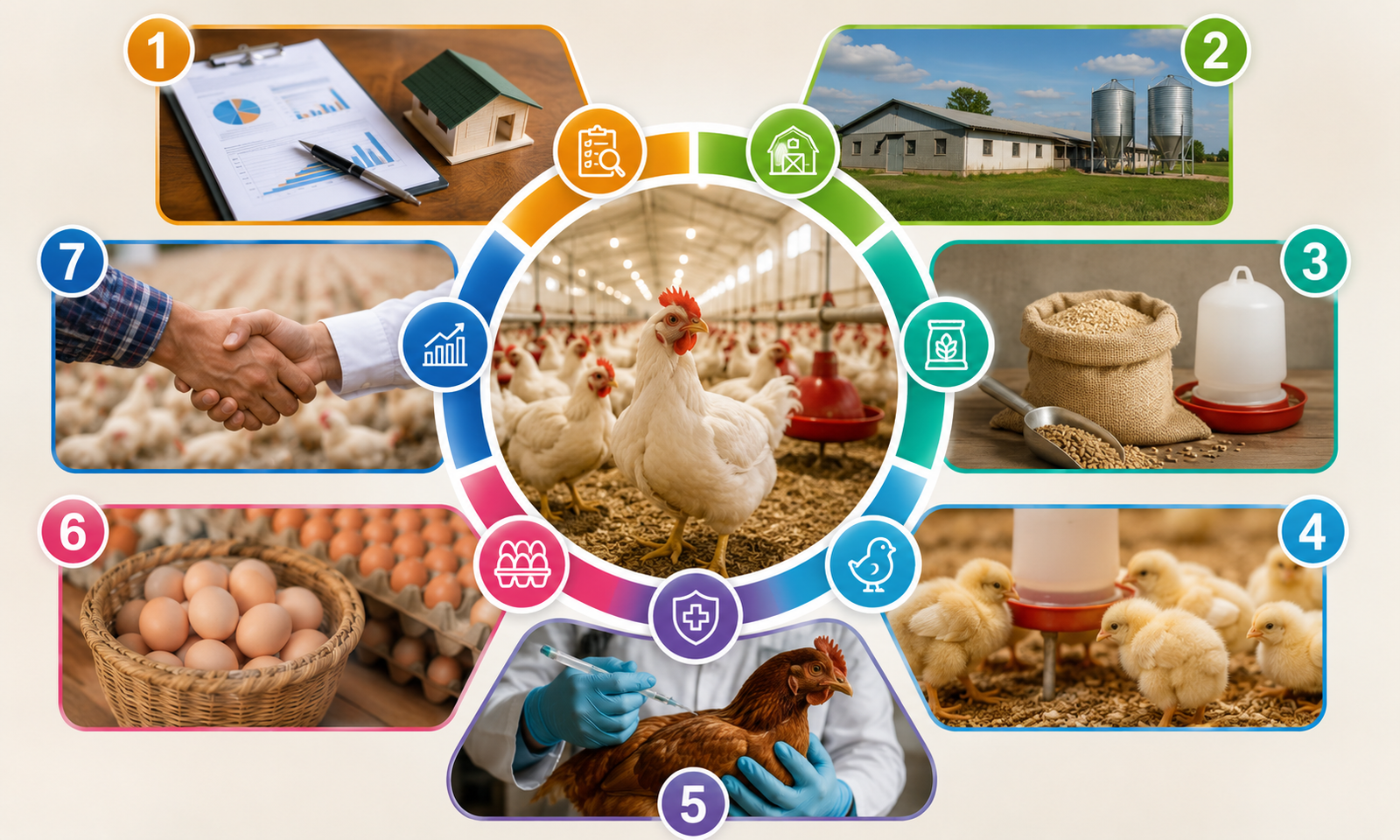
Be it a beginner or a veteran it is one of the easiest and possible the most profitable agriculture to undertake is the poultry business. Poultry farming has become a lucrative venture for many business owners due to its growing demand for its meat and eggs to meet nutritional and protein requirements. Unfortunately, it’s not a field that is truly a walk in the park when it comes to success. Careful planning, technical knowledge and management activities are essential. A knowledge of the foundational principles of poultry production assists in minimizing risks including outbreaks of disease and poor growth rates and losses to producers. In this guide, these seven steps will guide aspiring farmers for a strong beginning and a sustainable and profitable poultry business that can expand and overcome some of the common hurdles in the poultry industry.
- Create a robust business plan.
The most important and primary thing that has to be done to start a poultry rearing venture is to come up with a business plan that is accurate and comprehensive. A solid roadmap outlines where you’re going, who you’re targeting, your initial investment, ongoing expenses, and profits. It also will assist you in determining if you are preparing eggs, meat or a combination of both. Risk strategies to deal with outbreaks of disease or variability in feed costs should also be put into your business plan. Planning and lack of direction and financial control makes many poultry farms unprofitable in the first year. Having a good understanding of successful designs and resources such as this guide on how to build a profitable poultry enterprise will also assist at this early point in the process, giving a deeper understanding of operational efficiency at this young age and sustainability within this type of business. The business plan is like a roadmap that helps you make all the right decisions to help your poultry enterprise expand and evolve.
- Choose appropriate breeds of poultry
Selecting a breed of chicken will play a key role in achieving maximized productivity and profitability. Growth rate, feed conversion ratio and resistance to diseases varies among breeds. For instance, broiler varieties like Ross 308 and Cobb 500 offer quick rates of weight gain and are excellent for meat; layer varieties like ISA Brown are excellent for egg production. This needs to be based on your business’s objectives, climate conditions and local market demand. Also, opt for trusted hatcheries to get healthy and well-bred chicks! If the animal is poor quality, it could have serious consequences for survival and productivity, therefore impacting profitability. Newly beginning flockers should select breeds that can thrive well in their climate and area, and have a track record of good performance. The correct selection of the breed is the basis of efficient production and success in poultry farming.
- Building suitable housing and infrastructure.
In poultry birds housing occupies an important place for good health and production. A properly designed poultry house will not have to compromise with adverse weather conditions, predation or disease, as well as ventilation and room for movement. You can decide to use a deep litter system if you are in a smaller production or a battery cage system if you are in a larger production. Cage systems are usually employed on commercial layer farms, while deep litter systems can be found more prevalent for broilers and small farmers. The poultry house must be properly drained and have access to clean flooring areas as well as a good ventilated environment to decrease the build-up of ammonia. Other conditions that affect birds’ growth and egg production are lighting and temperature control. Try to keep stocking densities low in order to reduce stress and the spread of disease to birds. While it can be costly upfront, investing in the necessary housing infrastructure can drastically minimise long-term loss and enhance efficiency, highlighting its importance in any successful poultry business.
- Ensure good feeding and nutrition management.
One of the most important expenses in raising birds can be feeding and sometimes it can take up as much as 70% of all the costs. For this reason, good feed management can be a critical factor in achieving profitability. To ensure growth, egg production, and immunity, the balanced diet of poultry birds should include proteins, carbohydrates, vitamins, and minerals. Commercial feeds are typically sold in sections for use in laying and broilers, with the different categories designed for use during the different stages of growth or to ensure layer mash is fed continuously for optimal egg production. To prevent health problems farmers need to ensure that feeds are fresh, tend to proper storage and contamination free. In addition, it is important to have clean, fresh water available at all times since dehydration can quickly decrease productivity. In addition, some farmers use ingredients found within their local environment to supplement commercial feeds, but this approach could need careful consideration in order to achieve a balanced diet. The ability to promote bird performance along with minimizing waste and maximizing growth rates helps to make the poultry enterprise much more economically successful, while more efficient feeding practices.
- Strengthening Disease Prevention and Health Management
One of the most critical areas of poultry production is disease control because a disease outbreak can kill an entire flock in a matter of days. If not managed well, common diseases like Newcastle disease, coccidiosis and avian influenza can cause extensive economic loss. It is important to have a robust biosecurity program in place to deter entry and dissemination of disease. This will involve limiting farm access, cleaning equipment and keeping litters clean. Vaccination programmes should be adhered to closely and in line with veterinary guidelines, to provide immunity in birds. Knowledge of the farmer’s practice should also include routine observation of the bird’s behavior, foods consumed and droppings for any early signs of disease. Early isolation and treatment of infected birds will help stop the spread from happening. Other preventative measures include maintaining a clean environment, pest control and ventilation. Good disease management is an absolute essential for a successful and profitable poultry business – especially in areas where disease is prevalent.
- Set up efficient farm management and biosecurity practices
The successful poultry farming needs daily management and discipline in operation. Fundamental aspects of farm management include keeping tabs on feed consumption, growth rates, death rates, and financial records. These records will assist farmers in assessing performance and in making decisions about business. The implementation of biosecurity on farms should be incorporated into all parts of the production – restriction of visitors, use of protective clothing, routine disinfection of production sites and buildings. Sanitary measures need to be taken to reduce contamination hazards and trained employees. Additionally, good waste management and manure disposal are crucial factors that prevent pollution of the environment and spreading of manure disease. In addition, good management involves production cycles for a continuous supply to the market. So, if poultry farms are not managed effectively, then they can still be unprofitable and inefficient, despite their good finances. Hence, a key factor in establishing a long-term sustainable and profitable sized poultry business is to manage the business well.
- Plan out an effective marketing strategies
Most new small-scale poultry farmers overlook marketing and that is why it is very important for such farmers to ensure profitability. A Farm can only be successful if it has reliable customers, no matter how well it is done. Farmers should decide as early as possible what market they want to tap, which may be consumers at home, restaurants or supermarkets, or egg distributors. By developing buying relations, you will be able to achieve regular sales and steady earnings. The pricing of a product should match the cost of production, but be competitive with others selling the same or similar product. Processed or packaged poultry products can also provide added value for the farmer, as well as provide for higher profit margins. Social media websites and local advertising may additionally be employed to connect with too many more customers and increase market visibility. Furthermore, knowledge of the seasonal variation helps the farmers determine the better cycle’s line of production. Efficient marketing strategies play a critical role in getting poultry products to market promptly and at a profitable price, thus helping to keep the cash flow going and the market enterprise profitable in the long term.
Conclusion
Returning to the chicken farm to launch a poultry business is not a simple matter of a hunch; it takes planning and the application of knowledge and management procedures. Trade planning, selection of breeds, housing, feeding, disease control, farm management and marketing are all key aspects that influence the success or failure of each of these seven steps. If any part of these is overlooked, there are significant efficiencies and cost implications. These strategies can, however, form a solid base for long-term sustainability and growth if implemented properly. The poultry industry continues to be one of the lucrative businesses of agriculture, particularly for the entrepreneurs who are looking for reliable income generating ventures. With careful application, hatcheries can slowly develop a sustainable and profitable poultry business that will supply the demand of the market and provide a significant role in food production and generation of income.